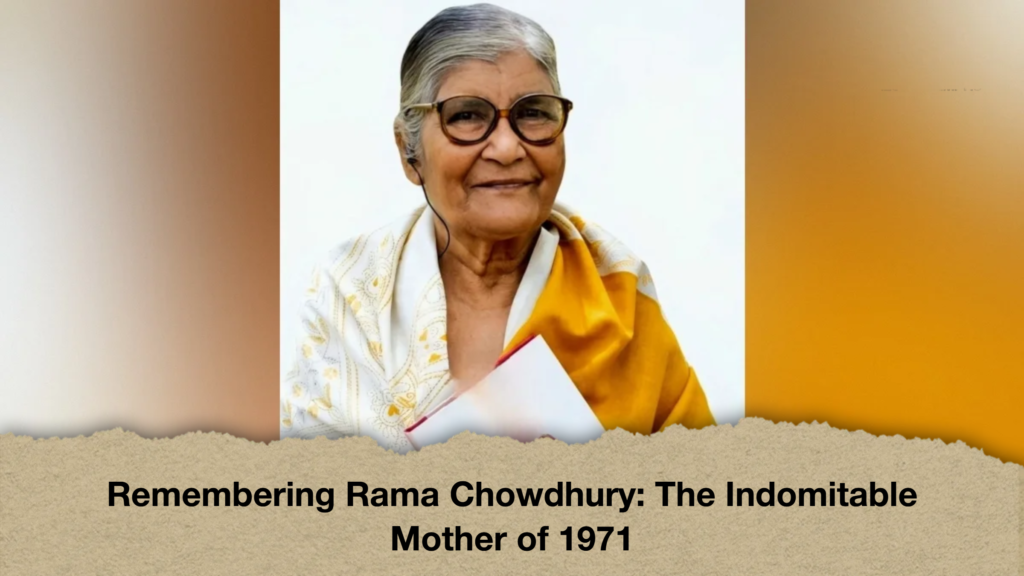
History is often shaped not merely by grand political shifts, but by the quiet, unyielding resilience of individuals who endure unimaginable suffering. Rama Chowdhury was one such towering figure—a valiant female freedom fighter, an educator, a prolific author, and an unyielding survivor of the 1971 Liberation War of Bangladesh. Known universally as ‘Ekattorer Jononi’ (The Mother of ’71), her life story encapsulates the brutal horrors of wartime violence, the profound grief of a grieving mother who lost all her children, and an inspiring portrait of fierce self-respect in the face of absolute destitution.
Born in the village of Popadia within the Boalkhali upazila of Chattogram, Rama Chowdhury pursued higher education at a time when opportunities for women were severely constrained. In 1961, she earned her Master’s degree in Bengali language and literature from the University of Dhaka, placing herself among the pioneering female postgraduates of southern Chattogram. She commenced her professional career in 1962 as the headmistress of Cox’s Bazar Girls’ High School, dedicating nearly sixteen years to academic leadership across various institutions while nurturing a deep passion for literature.
Her life altered irrevocably with the outbreak of the Liberation War in 1971. While her husband was away in India, she remained at her ancestral home in Popadia, sheltering her elderly mother and three young sons. On 13 May 1971, Pakistani occupation forces, aided by local collaborators, raided her home. She was subjected to unspeakable atrocities while clutching her infant child. Following the assault, she sought refuge in a nearby pond, but the brutalized homestead was torched with gunpowder, reducing her life’s possessions and treasured memories to ashes. For the remainder of the war, she endured a nomadic existence hiding in forests, open fields, and ruined foundations. This harrowing personal trauma later formed the bedrock of her seminal memoir, Ekattorer Jononi, transforming individual pain into an enduring historical document.
The advent of victory on 16 December 1971 brought no personal reprieve. Grief struck relentlessly when her five-year-old son, Sagar, succumbed to illness on 20 December. Barely two months later, on 15 February 1972, her three-year-old son, Togr, passed away after a tragic mishap. Decades later, her surviving son from a second marriage, Dipankar Tunus, died in a road accident on 16 December 1998. Having buried all three children without traditional cremation rites, Rama Chowdhury took a solemn vow. Refusing to wear shoes out of profound grief, she walked barefoot for nearly fifteen years across the soil where her children lay buried, turning her physical austerity into a silent, lifelong protest against war.
Despite facing grinding poverty in post-independence Bangladesh, she steadfastly guarded her dignity, refusing charity or handouts. As an educated intellectual, she sustained herself by personally hawking copies of her own published books along the streets of Chattogram. Her extensive literary contributions spanned poetry, essays, and novels, including notable works such as Ekantar Din Jajapamer Podya, Bhab Boichitrye Rabindranath, and Srijon Protibhar Sondhane.
On 3 September 2018, Rama Chowdhury passed away at Chattogram Medical College Hospital after a prolonged illness. She was laid to rest with full state honours beside her son Tunus in Popadia, and was posthumously awarded the prestigious Begum Rokeya Padak. Her legacy remains an indelible cornerstone of Bangladesh’s national consciousness, reminding future generations of the immense human cost paid for freedom.