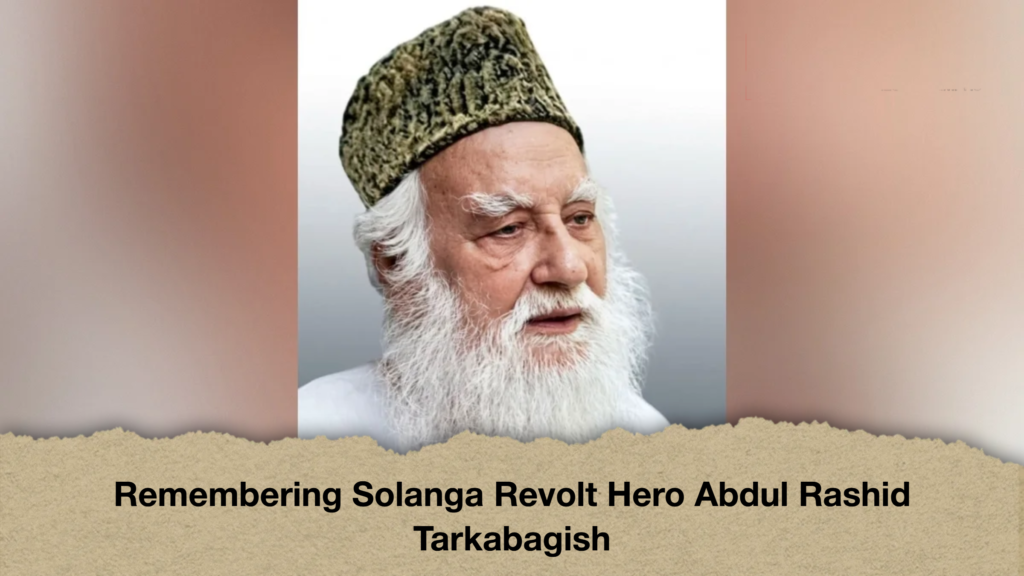
Some figures in Bengal’s history represent far more than the period in which they lived. They become enduring symbols of resistance, courage and the struggle for people’s rights. Maulana Abdul Rashid Tarkabagish was one such figure. From the anti-British movement to the campaign for linguistic rights, and from farmers’ demands to the wider struggle for democracy and social justice, his political life was marked by a strong commitment to public causes.
Tarkabagish was born on 27 November 1900 in Tarutia village, in the Solanga area of Sirajganj, into a respected Pir family. His father was Shah Syed Abu Ishaq and his mother was Azizunnesa. He grew up in an environment shaped by religious values, humanitarian principles and a sense of responsibility towards ordinary people.
One of the defining chapters of his life was the historic Solanga Revolt. On 27 January 1922, during the turbulent period of the anti-British Non-Cooperation Movement and the campaign to boycott British goods, thousands of people gathered at Solanga market under his leadership.
The gathering ended in a violent confrontation when British police opened fire on the crowd. A large number of people were killed or injured in the incident, leaving a deep mark on the history of the region. The episode subsequently became known as the Solanga Revolt, while Tarkabagish emerged as one of the central figures associated with the resistance.
His political activism did not end with the anti-colonial struggle. Three decades later, he became involved in the movement for the recognition of Bangla as a state language in Pakistan. During the Language Movement of 1952, he played an active role in advocating linguistic rights and carried the demand for Bangla into Pakistan’s Constituent Assembly.
On 12 August 1955, Tarkabagish delivered a speech in Bangla in Pakistan’s Constituent Assembly, an act remembered as a significant expression of the linguistic and cultural aspirations of the Bengali-speaking population. His intervention reflected the growing demand for recognition of Bangla and the political rights associated with Bengali identity.
Tarkabagish also held a prominent position within the country’s political movement. He served as president of the Awami League from 1956 to 1967. Throughout his political career, he remained associated with several movements concerning farmers, workers and disadvantaged sections of society. His involvement extended to the Khilafat and Tebhaga movements as well as other campaigns centred on social and economic rights.
For Tarkabagish, politics was not simply a contest for political power. It was closely connected with questions of dignity, justice and the rights of ordinary citizens. Religious values, nationalism, democratic ideals and concern for disadvantaged communities shaped much of his public life.
His political journey came to an end on 20 August 1986, when he died in the early hours at the then PG Hospital. He was 85.
Decades after his death, his name remains closely associated with some of the important struggles in Bengal’s political history. The events at Solanga, the campaign for linguistic recognition and his long involvement in public movements form important parts of his legacy.
Remembering Tarkabagish is therefore not merely an exercise in recalling an individual political leader. It is also an opportunity to reflect on a period when questions of independence, language, representation and social justice shaped the political consciousness of the people of Bengal.
From the bloodshed at Solanga to the struggle for linguistic rights, Abdul Rashid Tarkabagish left his mark on several defining moments of the region’s history. His life continues to be remembered as that of a determined public figure who stood alongside movements for rights and social change.