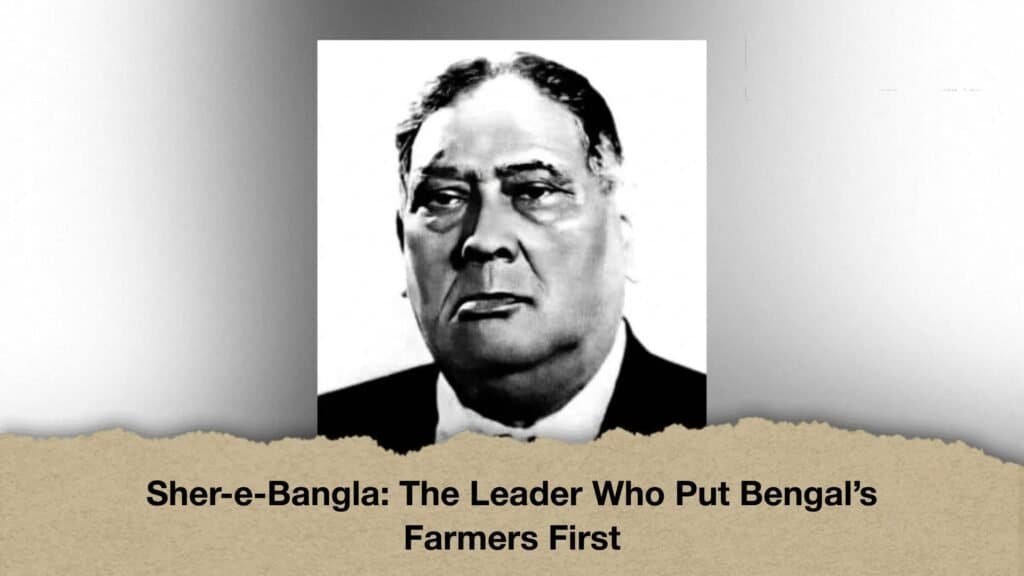
Remembered as a champion of rural communities, Fazlul Huq devoted much of his career to bringing the concerns of disadvantaged people into the political mainstream. His influence extended across several defining periods of the Indian subcontinent’s history, from British colonial rule and the independence movement to the partition of Bengal and the early years of Pakistan.
On the political stage, he was known for his determination and formidable presence. Among ordinary people, however, his reputation rested largely on his efforts to improve their economic circumstances and protect their interests. Prominent leaders, including Sheikh Mujibur Rahman, Huseyn Shaheed Suhrawardy and Maulana Abdul Hamid Khan Bhashani, also knew him as ‘Huq Sahib’.
His legacy remains closely connected to the belief that political leadership should serve the people, particularly those whose voices are often overlooked.
Early Life, Education and Career
Fazlul Huq was born on 26 October 1873 in Saturia village, in what is now Barishal District, Bangladesh. His father, Muhammad Wazed, was a lawyer. From an early age, he demonstrated considerable academic ability and a strong commitment to education.
He attended Presidency College in Calcutta, where he pursued higher studies and earned a postgraduate degree in mathematics. He subsequently studied law and obtained his Bachelor of Law degree in 1897 before beginning his legal career.
Fazlul Huq later entered government service and worked as a deputy magistrate. His experience within the colonial administration, however, brought him into conflict with aspects of British rule. He eventually resigned and returned to legal practice.
His career as a lawyer gave him an opportunity to observe the social and economic difficulties confronting people under colonial rule. Yet he increasingly recognised that legal practice alone could not address the structural inequalities affecting Bengal’s rural population.
He turned towards politics, seeking to influence the institutions and policies that shaped people’s lives. His growing involvement in public affairs eventually established him as one of the most prominent Bengali political leaders of his generation.
Emergence as a Leader in Indian Politics
During the first half of the 20th century, Fazlul Huq became an influential figure in the politics of British India. He played an important role in the political developments surrounding the establishment of the All-India Muslim League in Dhaka in 1906, an organisation that later became central to the movement for Pakistan.
His election to the Bengal Legislative Council in 1913 marked another significant milestone. From 1916 to 1921, he served as president of the All-India Muslim League. He was also associated with the Indian National Congress and served as its general secretary during 1918–1919.
His involvement in different political organisations reflected the complexity of the political environment in which he operated. Questions of religious representation, constitutional reform, education and relations between communities were central to the debate over India’s future.
Fazlul Huq participated in political initiatives aimed at strengthening cooperation between the Congress and the Muslim League. He was associated with the negotiations surrounding the Lucknow Pact of 1916, which sought agreement on constitutional reforms and political representation.
His career was not confined to one political organisation or a single ideological position. He navigated changing alliances and competing interests while seeking to advance the concerns of the communities he represented.
These experiences helped establish his reputation as a political figure capable of operating at both provincial and all-India levels.
A Political Career Built Around Peasant Rights
The struggle to improve the position of Bengal’s peasants and tenants became the defining feature of Fazlul Huq’s public life.
During British rule, rural Bengal was marked by widespread poverty, indebtedness and unequal landholding arrangements. Many cultivators worked under the authority of landlords, while dependence on moneylenders left farming families vulnerable to mounting debts. Poor harvests and financial obligations could push households into prolonged hardship, sometimes threatening their land and homes.
Fazlul Huq believed that the province could not achieve meaningful progress unless its rural population received greater economic security. He therefore sought to organise peasants and tenants into a political force capable of challenging the established interests that dominated rural society.
In 1936, he founded the Krishak Praja Party, or Peasants and Tenants Party. Its emergence provided a political platform for rural communities whose concerns had often received insufficient attention in provincial politics.
The party campaigned on issues affecting cultivators, including indebtedness, the relationship between landlords and tenants, and the need to improve the economic position of ordinary agricultural workers.
Following the Bengal provincial elections of 1937, Fazlul Huq became the premier of undivided Bengal. His government faced considerable challenges, but agrarian reform remained one of its central priorities.
In 1938, legislation including the Bengal Agricultural Debtors Act and measures addressing moneylending sought to protect indebted cultivators. Debt settlement boards were established to help resolve disputes and reduce the burden of outstanding loans.
These initiatives were significant attempts to address problems that had affected rural Bengal for generations. Although the reforms could not eliminate the province’s deep-rooted economic inequalities, they helped bring agricultural debt and the position of vulnerable cultivators into the centre of government policy.
For Fazlul Huq, political office carried a responsibility to improve people’s lives. His commitment to the rural population helped secure his enduring reputation as a leader who sought to make government more responsive to the needs of ordinary citizens.
The Lahore Resolution and the Partition of Bengal
One of the most consequential episodes in Fazlul Huq’s career came on 23 March 1940, when he presented the Lahore Resolution at the annual session of the All-India Muslim League in Lahore.
The resolution called for independent states in the Muslim-majority areas of north-western and eastern India. It subsequently became a major political foundation for the movement that led to the creation of Pakistan in 1947.
Fazlul Huq’s role in presenting the resolution placed him at the centre of one of the most important political developments in the final years of British rule. However, his subsequent political career was shaped by disagreements with other leaders, shifting alliances and differences over strategy.
The question of Bengal’s future became increasingly contentious as negotiations over independence gathered pace. Fazlul Huq supported the idea of an undivided Bengal, reflecting the province’s longstanding social, economic and cultural connections.
Nevertheless, Bengal was partitioned in 1947. East Bengal became part of Pakistan, while West Bengal joined India. The division transformed the region’s political geography and had lasting consequences for its people.
The new boundary disrupted established connections between communities and reshaped economic and political relationships across Bengal. The partition remains a defining event in the region’s history, and Fazlul Huq’s position on the question forms an important part of his political legacy.
The Language Movement and the United Front Victory
Following partition, Fazlul Huq continued to play a significant role in East Bengal’s politics. The creation of Pakistan brought new political challenges, particularly concerning the representation of the eastern wing, the distribution of economic resources and the recognition of Bengali identity.
The demand to recognise Bengali as a state language became a central issue. For the people of East Bengal, the language question represented not only cultural identity but also a broader demand for political dignity and equal rights.
The provincial elections of 1954 marked another major turning point. The United Front, an alliance of opposition parties, secured a decisive victory against the ruling Muslim League.
The result reflected widespread dissatisfaction with the existing administration and growing demands for greater autonomy, recognition of Bengali and a political system more responsive to the needs of the province.
Fazlul Huq became chief minister of East Bengal following the United Front’s victory. His longstanding reputation as a champion of peasants, together with his political experience and popular support, contributed to his position within the coalition.
The election represented more than a change of government. It demonstrated the strength of public demands for political representation and recognition of the rights of East Bengal’s population.
However, the new administration faced considerable difficulties amid political instability and tensions with Pakistan’s central government. These challenges limited its ability to fulfil all the expectations generated by its electoral success.
Even so, the United Front victory remains an important episode in the political history of East Bengal, illustrating the growing influence of regional identity and popular demands for democratic representation.
Later Years and Final Responsibilities
Fazlul Huq continued to hold important public positions after his tenure as chief minister. He served in Pakistan’s central cabinet and was appointed governor of East Pakistan in 1956, remaining in the position until 1958.
His political career spanned several distinct periods, including British colonial rule, the movement towards independence, the partition of the subcontinent and the early years of Pakistan. Few political figures of his generation witnessed such extensive changes in the region’s political structure.
His career also involved disagreements, changing alliances and decisions that remain subjects of historical discussion. These complexities reflect the competing political interests and difficult choices that shaped the period.
Fazlul Huq died in Dhaka on 27 April 1962. He was buried at the Mausoleum of Three Leaders near the Dhaka University area, alongside other prominent political figures of Bengal. His resting place remains an important historical landmark.
His death marked the end of a long public career, but his contribution to Bengal’s political development continued to influence discussions about leadership, social justice and the rights of ordinary people.
A Legacy Rooted in Public Service
Sher-e-Bangla A. K. Fazlul Huq was a lawyer, political organiser, legislator and administrator. Yet his most enduring distinction was his effort to make the concerns of peasants and disadvantaged communities a central part of political debate.
His initiatives on agricultural debt and rural welfare reflected an understanding that economic development could not be separated from the conditions of those who worked the land. By advocating reforms and organising rural communities, he helped broaden the political participation of people who had long struggled to secure adequate representation.
His legacy should also be understood in the context of the political complexities of his time. His alliances changed, his decisions sometimes attracted criticism, and his governments operated under difficult circumstances. A balanced assessment of his career must acknowledge these limitations alongside his achievements.
Nevertheless, his contribution to Bengal’s political history remains substantial. He helped establish agrarian concerns as a major issue in provincial politics and demonstrated the importance of connecting public leadership with the everyday problems of ordinary people.
The questions that shaped his career remain relevant today: how to protect farmers from financial insecurity, ensure fair economic opportunities, expand access to education and reduce social inequality.
His life offers a lasting lesson about the responsibilities of leadership. Public office acquires meaning when it is used to address the needs of the people, particularly those who have the least power to influence decisions affecting their lives.
The title ‘Sher-e-Bangla’ is therefore more than an honourific. It represents a historical association with the aspirations, struggles and hopes of Bengal’s ordinary people.
As his birth anniversary is observed on 26 October, tribute is paid to a leader whose political journey was closely intertwined with the history of Bengal. He remains remembered as a champion of farmers, a friend of the common people and a determined advocate for the rights of the disadvantaged.