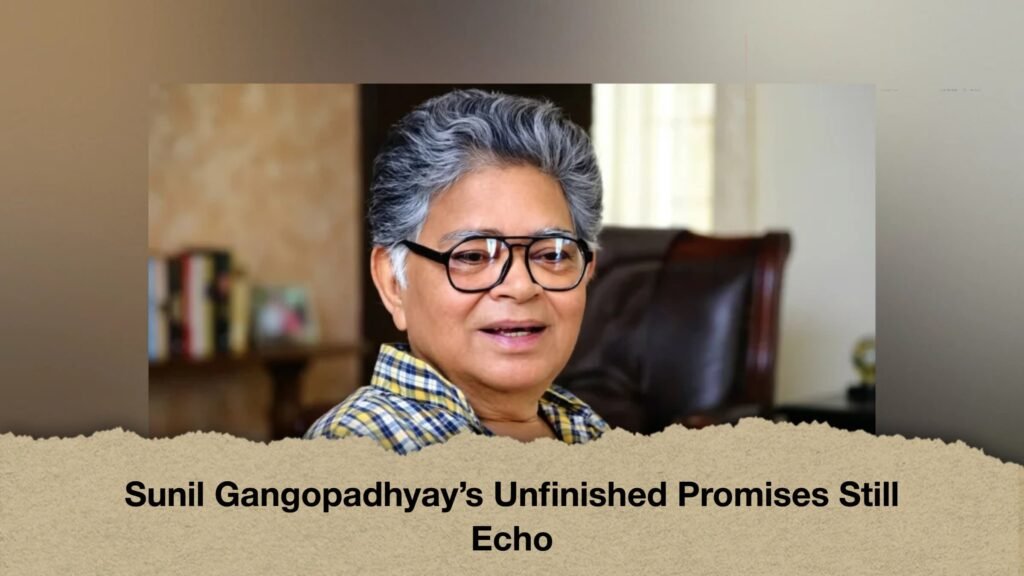
Some poems transcend literature and become part of a reader’s own memory. They evoke childhood, unfulfilled dreams, a parent’s face, first love and the quiet pain of things that never came to pass. Sunil Gangopadhyay’s celebrated poem Keu Kotha Rakheni — often translated as Nobody Kept Their Word — belongs firmly to that tradition.
The poem begins with memories of promises made during childhood and gradually develops into a meditation on disappointment and the passage of time. What initially appears to be the poet’s personal recollection becomes something much wider: an account of how ordinary hopes can remain unfulfilled despite years of waiting.
The recurring sentiment is captured in the poem’s opening refrain: “Nobody kept their word; thirty-three years have passed.” The words establish the central theme of the work — promises remembered long after the people who made them have disappeared from the poet’s life.
Among the earliest memories is that of a woman from the poet’s childhood who promised to return on a particular auspicious day. She never did. There is also the memory of Nader Ali, the boatman at his maternal uncle’s home, who had promised to show him the famous three-tide lake when he grew older. That promise, too, remained unfulfilled.
The dreams themselves were modest. A marble, a stick of confectionery or the opportunity to take part in the excitement of a local festival could represent the height of childhood desire. Yet those seemingly insignificant wishes acquire greater meaning when viewed from adulthood. They become symbols of a time when happiness seemed close enough to touch, but somehow remained just beyond reach.
The poem’s emotional centre arrives with the memory of the poet’s father. His father touched his shoulder and said, “You’ll see, one day, we too…” The sentence trails off, but its unfinished nature gives it much of its power.
Behind those words lay the hope of a better future. For a family living with limitations, the promise represented the belief that one day they would also experience the pleasures and opportunities that appeared distant at the time. It was a father’s hope for his child and, perhaps, a hope for the family itself.
But that future never unfolded as imagined.
The poem later refers to the father having become blind and to the fact that they never got to see those hoped-for things. The image transforms a private family memory into a broader reflection on hardship, ageing and dreams that remain unrealised.
Then comes love.
Baruna, another important figure in the poem, makes a promise associated with fragrance and affection. The poet responds with extraordinary devotion, searching for 108 blue lotuses in an attempt to fulfil the demands of love. Yet despite that effort, Baruna also fails to keep her word.
The pattern is unmistakable. Childhood brings promises that are not fulfilled. Youth brings hopes that disappear. A father’s dream remains incomplete. Love, despite sacrifice and devotion, does not provide the certainty the poet seeks.
That is why the poem’s refrain carries such lasting force. It is not merely an expression of one writer’s disappointment. It speaks to a familiar human experience.
People promise to return but do not. They say they will remain beside us but eventually leave. They offer assurances that “one day everything will be all right”, only for that promised day never to arrive.
Gangopadhyay’s achievement lies in transforming such ordinary experiences into poetry that feels deeply personal to each reader. The poem does not require a reader to share the poet’s exact circumstances. Its emotional truth is enough.
A major figure of modern Bengali literature
Sunil Gangopadhyay was one of the most versatile and influential figures in modern Bengali literature. Although he was widely celebrated as a poet, his work extended across novels, short stories, essays, travel writing and literature for younger readers. His literary career spanned several decades and produced a remarkably diverse body of work.
He was born on 7 September 1934 in Amgram, in what is now Madaripur district of Bangladesh. Part of his childhood was spent in a rural Bengali setting before his family moved to Kolkata. Experiences of place, memory and displacement later became important elements in his writing.
In 1953, Gangopadhyay and a group of young poets helped establish Krittibas, a literary magazine that became an important platform for a new generation of Bengali poets. The publication was associated with changing literary tastes and helped create space for new forms of poetic expression and contemporary sensibilities.
Gangopadhyay also wrote under several pseudonyms, including Nil Lohit, Sanatan Pathak and Nil Upadhyay. His range as a writer was considerable. He moved comfortably between poetry and fiction, historical narratives and travel writing, while also creating popular works for younger readers.
Among his best-known novels are Sei Samay, Prothom Alo, Purba-Pashchim, Aranyer Din Ratri and Atmaprakash. He also became particularly popular with younger readers through his Kakababu adventure series.
His historical novel Sei Samay earned him the Sahitya Akademi Award in 1985, recognising his contribution to Bengali literature.
Poetry, however, remained central to his literary identity. His poems explored love, youth, loneliness, urban life, memory, desire, the body and questions of existence. The recurring figure of Neera became one of the most recognisable elements of his poetic world.
Gangopadhyay died in Kolkata on 23 October 2012, aged 78.
A poem that became a shared memory
Gangopadhyay’s lasting appeal comes partly from his ability to give simple language to complicated emotions. His writing often begins with something intimate — a childhood recollection, an encounter, a relationship or a private disappointment — and gradually opens into a larger human experience.
Keu Kotha Rakheni does precisely that.
Its memories of childhood evoke the ache of growing older. The father’s unfinished promise recalls the hopes families place in the future. The story of Baruna captures the vulnerability of love. Together, these moments create a portrait of a life shaped not only by what happened, but also by what never happened.
That may explain why the poem continues to resonate across generations. Readers can recognise their own lost promises in it: someone who never returned, a dream that never materialised, a relationship that did not survive or an anticipated future that remained permanently out of reach.
Sunil Gangopadhyay died in 2012, but the emotional world he created remains very much alive. His poems continue to give words to memories that many people struggle to express for themselves.
On his birth anniversary, his literary legacy is therefore remembered not simply through his long list of books and achievements, but through the intimate emotions that continue to connect his work with readers.
The childhood that disappeared.
The father’s unfinished dream.
The pain of first love.
The long wait for someone to return.
And the quiet disappointment of promises left unfulfilled.
These are experiences that belong to no single generation.
That is why, decades after the poem was written, its central lament still feels remarkably familiar: people make promises, time moves on, and sometimes the promised moment never comes.
Sunil Gangopadhyay gave that universal experience a memorable literary voice. His words remain a reminder that some of the strongest poems are born not from grand events, but from the small promises, hopes and disappointments that shape an ordinary life.
Born: 7 September 1934
Died: 23 October 2012