The National Board of Revenue (NBR) has launched operations at four establishments in Dhaka over allegations involving the sourcing of alcohol and alcohol-based products from unauthorised channels, as well as possible evasion of customs duties and value-added tax.
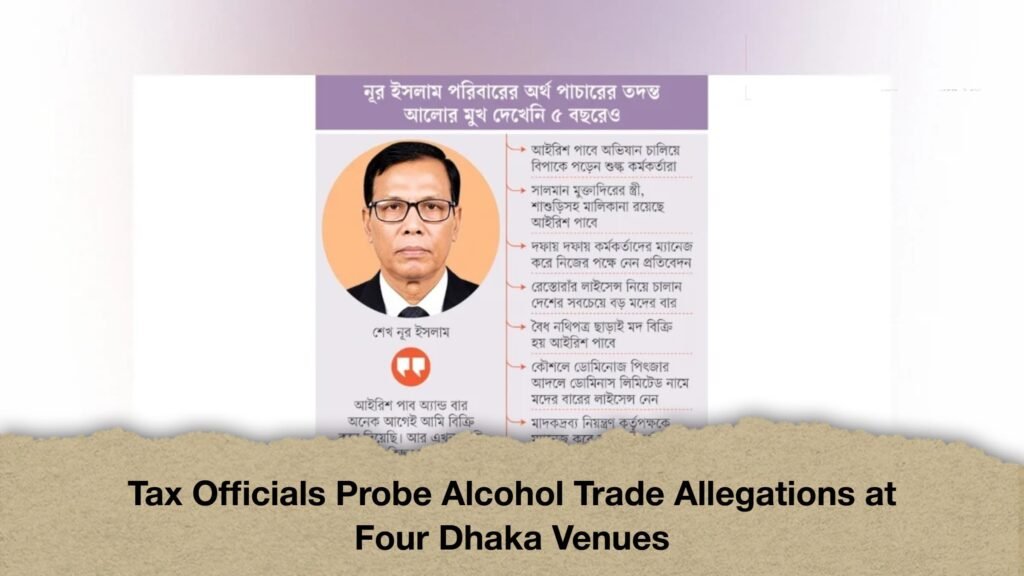
One of the establishments targeted was Fu-Wang Bowling and Services Ltd, associated with Sheikh Nur Islam, the father-in-law of content creator Salman Muqtadir. The other three were Ray-Canvas Restaurant, Habib Hotel International and Margarita Lounge.
The latest operation has brought renewed attention to earlier allegations surrounding Irish Pub and Restaurant, which was previously associated with Nur Islam and had faced scrutiny from the Customs Intelligence and Investigation Directorate (CIID).
According to sources, a CIID team conducted a raid on Irish Pub in the New Jurai area of Dhaka in December 2021 following intelligence reports. During the operation, officials reportedly recovered substantial quantities of imported foreign alcohol, including Imperial whisky and premium vodka brands said to have originated from Scotland and London.
The establishment was unable to produce valid import documents for the alcohol, according to customs officials involved in the operation. The products were subsequently seized.
Officials were later told by representatives of Irish Pub that some of the alcohol had been purchased from Bangladesh Parjatan Corporation. However, according to the source, supporting documentation was not produced to substantiate the claim.
The investigation also raised questions over the documents presented by the establishment. A 2016 document relating to the purchase of foreign alcohol from the tourism corporation was reportedly used in connection with the sale of products manufactured in 2019 and 2020. Customs officials consequently raised concerns over the authenticity and validity of the records.
A criminal case was filed at Kadamtali Police Station over the allegedly irregular import and possession of alcohol. The case was subsequently transferred to the Police Bureau of Investigation (PBI) and later to the Criminal Investigation Department (CID).
A customs official who was involved in the earlier operation alleged that investigators subsequently faced repeated difficulties and pressure. The official also claimed that the former owners of Irish Pub attempted to influence the investigation. These allegations, however, have not been established by a court.
The same official said Irish Pub had no bills of entry to substantiate the import of the foreign alcohol being sold there. The official further alleged that the import licence cited by the establishment was actually intended for agricultural machinery and could not legally be used to import alcoholic beverages.
The 2021 raid reportedly uncovered another irregularity: 57 walkie-talkies allegedly being used without approval from the Bangladesh Telecommunication Regulatory Commission (BTRC).
Irish Pub was reportedly controlled by members of Nur Islam’s family. Sources said Nur Islam served as its managing director, while his wife, Shila Islam, was chairperson and their daughter Disha Islam was a director.
According to the source, Nur Islam held 4,000 shares in the company, Shila Islam held 3,000, while Disha Islam and Tasnim Islam held 1,500 shares each. Together, the family reportedly held all 10,000 shares of the company at one stage. The shares were later transferred to Delwar Hossain and Selimuzzaman, according to the report.
Sources also alleged that the establishment initially operated under a restaurant licence before functioning as a bar. A warehouse was reportedly established near the Buriganga river, relatively close to Pangaon Customs House.
Some customs officials raised concerns over the location, saying the narrower section of the river near the customs house could potentially make the movement of consignments easier. However, the officials could not provide documentary evidence proving that Irish Pub or Nur Islam had used the route to transport illicit alcohol.
Questions were also raised over the legal basis for importing and selling large quantities of foreign alcohol. Earlier allegations suggested that a restaurant licence had effectively been used to operate a bar. Nur Islam has denied these allegations.
There were also allegations that information concerning financial transactions involving Nur Islam’s family and Canadian banks emerged during the investigation. Some former customs officials claimed that potential money-laundering concerns were not pursued further and that a report was eventually submitted in Nur Islam’s favour. These remain allegations and were not established as findings of a court.
Nur Islam has rejected the allegations. Speaking to Kalbela, he said he had sold Irish Pub and Bar a long time ago and was no longer involved with the establishment. He also denied operating a bar under a restaurant licence or influencing the investigation.
The latest NBR operation has now brought the issue back into focus.
Four teams led by the CIID conducted the latest raids. Officials from the NBR’s Income Tax Intelligence and Investigation Unit, the Central Intelligence Cell (CIC), the VAT Audit, Intelligence and Investigation Directorate, and the Dhaka North Customs, Excise and VAT Commissionerate also took part.
According to NBR sources, intelligence reports had indicated that a number of bars, restaurants, diplomatic bonded warehouses and duty-free shops in Dhaka were allegedly obtaining alcohol and alcohol-based products from unauthorised sources.
During the latest operations, officials examined the source of alcohol and related products kept at the establishments, import and purchase documents, the legality of the stock, and records showing payment of customs duties, VAT and income tax.
Officials are also checking whether any of the products were supplied to customers who were not legally authorised to purchase them. Where irregularities are found, products may be detained as part of the investigation.
The NBR said details of the findings would be disclosed after the operations are completed.
The latest raids do not, by themselves, establish wrongdoing by the establishments or individuals involved. Any allegations of customs violations, tax evasion, illegal sourcing or other offences will ultimately depend on the evidence gathered during the investigation and any subsequent legal proceedings.