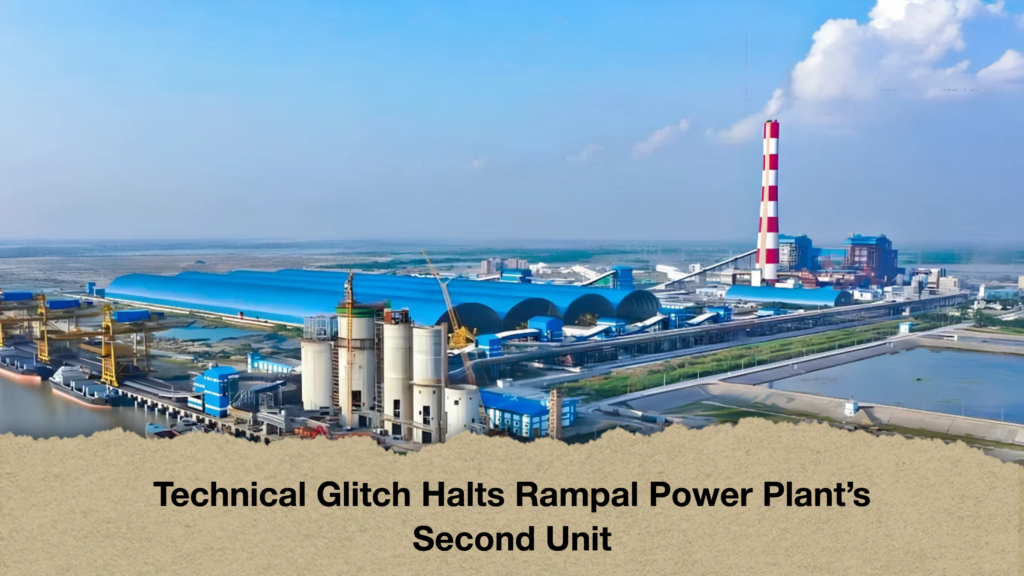
Production at the second unit of the Rampal thermal power station in Bagerhat has been suspended due to an unexpected technical malfunction. The unit completely stopped generating electricity from 11:00 AM on Sunday, marking yet another disruption for the high-capacity energy facility. Despite this setback, authorities have confirmed that generation from the first unit remains fully operational, ensuring that electricity supply to the national grid stays uninterrupted.
Anwarul Azim, the General Manager of the Human Resources department at the Rampal power plant, officially confirmed the suspension to the media. He explained that repair works are currently underway to address the technical failure, though it may take at least four days for the unit to resume normal operations. However, plant officials were unable to specify the exact nature of the mechanical or technical glitch that triggered the shutdown.
The 1,320 MW mega power project stands as a prominent collaborative energy venture between Bangladesh and India. The initiative was formally set into motion following a bilateral agreement signed on 29 January 2012 between the Bangladesh Power Development Board (BPDB) and India’s NTPC Limited. Constructed under the banner of the Bangladesh-India Friendship Power Company (Private) Limited (BIFPCL), the facility spans 1,034 acres of land acquired across Rajnagar and Gourambha unions within the Sapmari-Kaigardaskathi mouza of Rampal upazila. The massive infrastructure project incurred an estimated cost of approximately BDT 16 billion.
Following extensive construction and developmental phases, the first unit successfully commenced commercial generation on 23 December 2022. This was followed by experimental test runs on the second unit on 24 October 2023, which ultimately led to its formal inauguration into commercial production on 12 March 2024. Nevertheless, internal plant records indicate that since entering commercial service, the second unit has faced persistent operational challenges, experiencing temporary shutdowns exceeding thirty separate occasions due to recurring technical faults and maintenance hurdles. Engineers and technical teams remain deployed at the site to complete the ongoing repairs and restore stability to the plant’s dual-unit generation network.