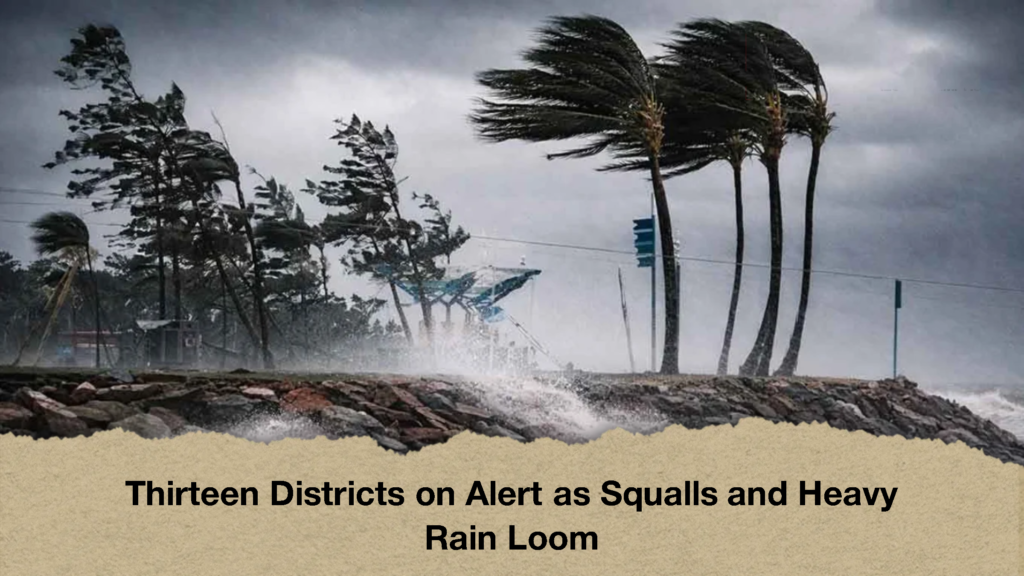
The Bangladesh Meteorological Department has issued a weather warning forecasting squall-driven rain and thunderstorms across thirteen districts, including the capital, Dhaka, through Monday morning. Atmospheric conditions are expected to produce temporary gusts reaching speeds between 45 and 60 kilometres per hour.
Valid from 9:00 pm on Sunday, 16 August, until 9:00 am on Monday, the official bulletin warns of unstable weather patterns tracking across central, western, and southern regions. Surface winds originating from the south and south-east are anticipated to intensify overnight, triggering sudden downpours and volatile conditions across major river routes.
The meteorological department has advised that the affected areas include Dhaka, Rajshahi, Pabna, Faridpur, Jessore, Kushtia, Khulna, Barisal, Patuakhali, Noakhali, Comilla, Chattogram, and Cox’s Bazar. Inland river ports operating within these regions have been instructed to hoist Warning Signal Number 1. Vessel masters, particularly those operating smaller passenger craft and commercial trawlers, have been urged to exercise extra vigilance against sudden gusts and deteriorating surface visibility.
Mid-August in Bangladesh frequently sees enhanced monsoonal activity as moist air drawn from the Bay of Bengal encounters inland weather troughs. These atmospheric interactions regularly produce intense, short-lived convective cells capable of causing rapid urban drainage backlogs, disrupting morning transport networks, and creating choppy river conditions across the delta.
Monsoon activity across the Bengal delta routinely intensifies during mid-August, as moisture-laden air masses off the Bay of Bengal interact with inland trough lines. These micro-scale weather systems frequently generate short-lived, intense convective storms capable of causing localized urban waterlogging, disrupting morning commutes, and creating hazardous navigation conditions along inland waterways.
Residents and commuters across the capital and southern river basins are advised to remain cautious during early morning travel. Maritime authorities continue to monitor regional wind velocities and waterway conditions to safeguard riverine traffic throughout the warning period.