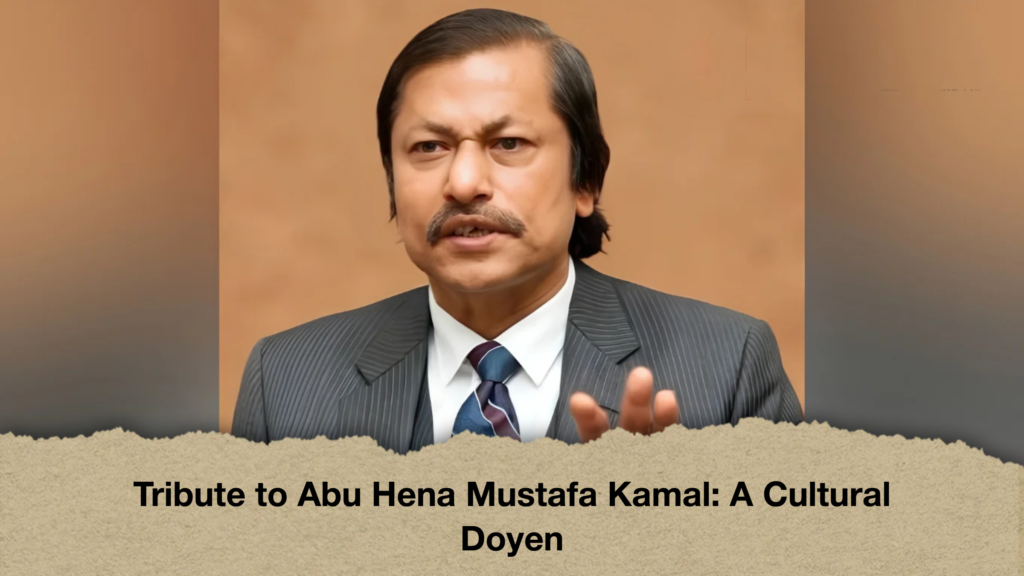
Abu Hena Mustafa Kamal remains one of the most luminous figures in Bengali literature and cultural history. Over a remarkably prolific career cut short at the age of 53, he distinguished himself as a poet, lyricist, essayist, researcher, literary critic, academic, vocalist, orator, and television presenter. His vast contributions across multiple artistic disciplines continue to shape the cultural heritage of Bangladesh.
Born on 13 March 1936 in the village of Govinda within the Pabna district, Abu Hena grew up under the guidance of his father, M. Shahjahan Ali, a dedicated schoolteacher. His early environment nurtured an abiding passion for reading and music. He completed his Matriculation at Pabna Zilla School in 1952, followed by his Intermediate in Arts (IA) at Dhaka College in 1954. He then entered the University of Dhaka, where he earned a BA Honours in Bengali in 1958 and an MA in 1959.
During the 1950s, a vibrant literary and intellectual movement was taking shape in Dhaka. Abu Hena quickly became a pivotal voice in this emerging cultural sphere. While still a student, he co-edited Purbo Banglar Kobita (Poems of East Bengal) alongside Mohammad Mahfuzullah in 1954, a landmark publication in his early career. Concurrently, he forged creative partnerships with friends Abu Bakar Khan, Anwaruddin Khan, and M. Asafuddowlah to advance modern musical compositions. The beloved song Shei Champa Nodir Tire, famously performed by Abu Bakar Khan, was penned by Abu Hena during this period, alongside his regular performances as a registered artist for Radio Dhaka.
His lyricism was distinguished by poetic simplicity, deep romantic sensibility, evocative descriptions of nature, and subtle melos of separation. Classic compositions such as Onek Brishti Jhore Tumi Ele, Tumi Je Amar Kobita, Oshru Diye Lekha E Gan, Nodir Majhi Bole, Ei Banglar Hijol Tomale, and Opomane Tumi Jole Uthechhile Shedin Bornomala remain deeply embedded in the Bengali musical canon. One of his most celebrated verses reflects this signature aesthetic:
“After much rain, you arrived,Like a handful of sunlight filling my eyes—You arrived.”
As a poet, Abu Hena possessed an individual and reflective voice. His major poetic collections—Apon Joubon Boiri (1974), Jehetu Jonmandho (1984), and Akrantho Gojol (1988)—examined introspection, solitude, romantic longing, and social consciousness. He matched his creative output with rigorous academic prose. His critical works include Shilpir Rupantor, Kotha O Kobita, and his doctoral thesis published as The Bengali Press and Literary Writing, 1818–1831. His essays demonstrated deep erudition, incisive analysis, and exceptional linguistic grace.
His professional life began in college teaching before he served as Assistant Director at the Public Relations Directorate in 1962. He joined the Department of Bengali at the University of Dhaka as a Lecturer in 1963, transferring to the University of Rajshahi in 1965. Awarded a Commonwealth Scholarship in 1966, he undertook doctoral research at the University of London, earning a PhD for his historical work on the early Bengali press and literature.
Returning to academia in Bangladesh, he became an Associate Professor at the University of Chittagong in September 1973, before returning to the University of Dhaka as a Professor of Bengali on 1 November 1978. In addition to his university duties, he held key administrative posts in national cultural institutions. He was appointed Director General of the Bangladesh Shilpakala Academy in 1984 and Director General of the Bangla Academy in 1986, serving in the latter position until his death.
In recognition of his monumental service to literature and culture, Abu Hena was honoured with numerous prestigious accolades, including the Alaol Literary Award in 1975, the Suhrid Literary Gold Medal in 1986, the Ekushey Padak in 1987, and the Abdul Karim Sahityavisarad Gold Medal in 1989.
Abu Hena Mustafa Kamal passed away in Dhaka on 23 September 1989. Though decades have elapsed since his passing, his songs, verse, and scholarly insights endure as vital components of Bengali artistic life.