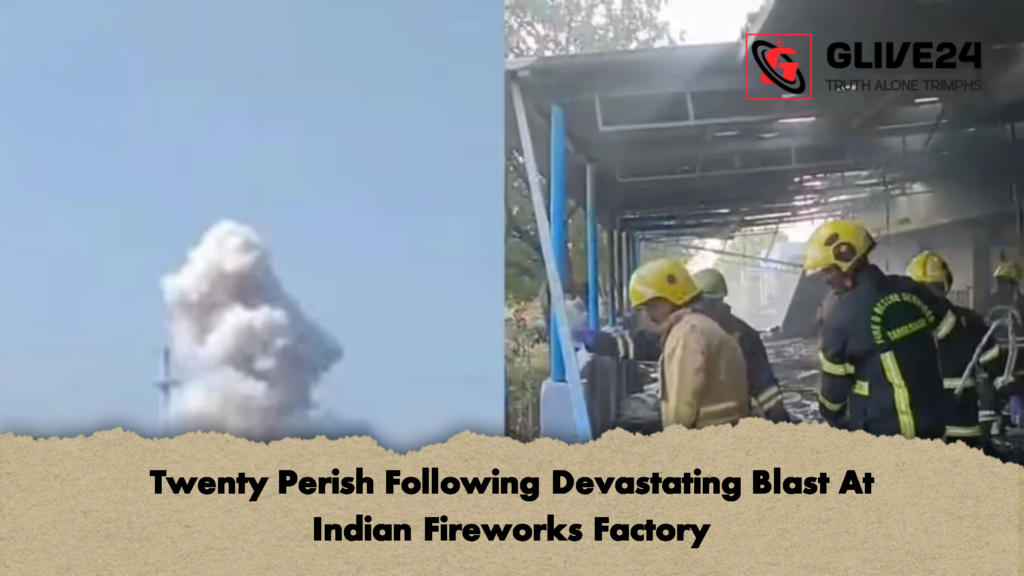
A profound tragedy has struck the southern Indian state of Tamil Nadu, where a catastrophic explosion at a pyrotechnics manufacturing facility has claimed the lives of at least 20 workers. The incident occurred on Sunday, 19 April 2026, in the Virudhunagar district, a region globally renowned for its fireworks industry but also frequently marred by industrial accidents of this nature. Beyond the confirmed fatalities, a significant number of labourers sustained severe injuries, leaving the local community in a state of profound shock and mourning.
Table of Contents
Circumstances of the Explosion
The disaster unfolded at a factory located in the Kattanarpatti area during what was intended to be a routine production shift. Preliminary investigations conducted by local law enforcement and forensic experts suggest that the ignition was triggered by a volatile chemical reaction. It is strongly suspected that friction generated during the manual mixing of highly combustible chemicals served as the catalyst for the initial blast. This primary explosion then triggered a chain reaction that rippled through the facility’s storage units, detonating stockpiles of gunpowder and finished pyrotechnic goods.
At the time of the incident, approximately 30 labourers were believed to be working inside the premises. The sheer magnitude of the detonation was such that the deafening roar was reportedly heard up to 10 kilometres away, rattling windows and causing panic in neighbouring villages. The structural integrity of the factory was compromised instantly; at least four production rooms—constructed specifically to contain small-scale blasts—were completely reduced to charred rubble within seconds, trapping many workers beneath heavy masonry.
Emergency Response and Rescue Operations
Upon receiving news of the blast, emergency services from multiple jurisdictions, including Sivakasi, Sattur, and Virudhunagar, were mobilised in a large-scale rescue effort. Firefighting units faced a particularly perilous environment as they battled to contain the inferno amidst the constant threat of secondary explosions.
-
Containment: It took rescue teams over an hour of intensive and dangerous effort to bring the blaze under control and neutralise the remaining hazardous materials.
-
Casualties: Once the flames were extinguished, the grim task of recovering bodies from the scorched remains began. Search and rescue dogs were deployed to locate those missing under the collapsed structures.
-
Medical Care: Those who survived the initial blast were rushed to nearby government hospitals. Many of these survivors remain in critical condition, suffering from extensive thermal burns and respiratory damage due to the inhalation of toxic chemical fumes.
Incident Summary and Casualty Data
The following table provides a concise breakdown of the key figures and locations associated with this industrial disaster:
| Category | Details |
| Primary Location | Kattanarpatti, Virudhunagar District, Tamil Nadu |
| Date and Time | Sunday, 19 April 2026 |
| Confirmed Fatalities | 20 Individuals (Subject to change) |
| Estimated Workforce | 30 Personnel present at the time of the blast |
| Primary Cause | Chemical friction during the mixing process |
| Responding Stations | Sivakasi, Sattur, and Virudhunagar Fire Units |
| Structural Impact | 4 Industrial production units completely razed |
Regulatory Scrutiny and Safety Concerns
The Virudhunagar district, and specifically the town of Sivakasi, serves as the hub for nearly 90% of India’s firework production. However, this industrial dominance is often overshadowed by a recurring failure to adhere to stringent safety protocols. Police officials have confirmed that a comprehensive investigation is currently underway to determine whether the factory was operating with a valid licence and if it had implemented the mandatory safety buffers required for handling explosive materials.
A specialist forensic team has been deployed to the site to collect chemical residues and examine the scorched machinery. Authorities are particularly interested in whether the facility was overcrowded—a common violation in the region—and if the workers had received adequate training in handling hazardous substances. There are also concerns regarding whether the factory had been illegally subcontracting work to unauthorised units, which often lack even basic fire safety equipment.
High-Level Condolences and Accountability
The scale of the loss has resonated at the highest levels of the Indian government. Prime Minister Narendra Modi expressed his profound sorrow via a statement on social media, extending his deepest condolences to the bereaved families. He also voiced his hopes for the swift recovery of those currently hospitalised, promising that “all possible assistance” would be provided to the victims.
Similarly, the Chief Minister of Tamil Nadu, M.K. Stalin, has voiced his grief and directed district authorities to ensure that the best possible medical care is provided to the survivors. The state government is expected to announce an ex-gratia compensation package for the kin of the deceased. However, for many in Kattanarpatti, the demand for stricter industrial oversight and the prosecution of negligent factory owners remains the more pressing concern. As the search for survivors beneath the debris continues, this incident serves as a harrowing reminder of the high human cost associated with the global pyrotechnics trade.