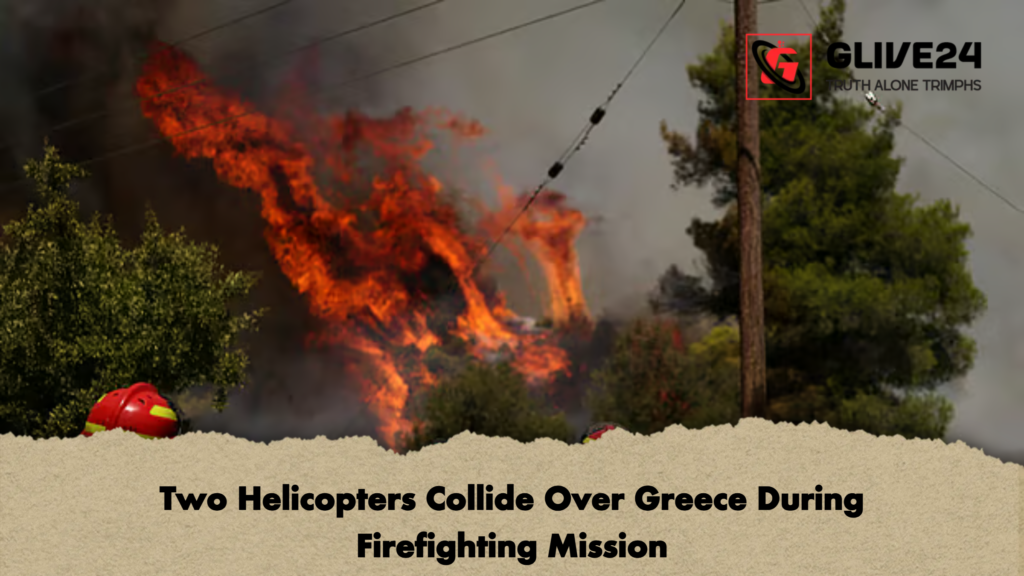
Two crew members were killed when two helicopters collided in mid-air while taking part in a firefighting operation in Greece, where devastating wildfires have spread across several areas amid hot and dry conditions.
The accident occurred on Sunday in the border area between Attica and Boeotia, about 65 kilometres west of the capital, Athens. One of those killed was reportedly a Danish pilot, while the other was a Greek fire service co-ordination officer.
Both helicopters were actively involved in efforts to contain the advancing wildfire when the collision took place. Preliminary video footage appears to show one aircraft striking the rotor of the other. Following the impact, one helicopter caught fire and crashed into a ravine. The second aircraft was also damaged but managed to make an emergency landing in an area covered by low vegetation.
According to Greece’s fire service, both helicopters involved in the accident were Bell aircraft leased from Australian company McDermott Aviation. The aircraft had been deployed as part of the aerial response to the wildfire, with air support playing a crucial role as flames spread rapidly through affected areas.
There were four crew members aboard the two helicopters in total. Two survived the crash, including a British pilot and a Greek co-ordination officer who were on board the other aircraft. They were rescued following the accident. The two crew members from the helicopter that crashed into the ravine were initially found unconscious but were later pronounced dead.
Although preliminary details about the identities of the two victims have emerged, authorities have not formally released the full names of all four crew members. The circumstances surrounding the crash remain under investigation.
As a precautionary measure, Greece has temporarily suspended flights by all Bell-model helicopters operating in the country. A source from the Ministry of Climate Crisis and Civil Protection said the decision was taken in accordance with established safety procedures following the accident. Investigators are expected to examine the circumstances of the collision, the positioning of both aircraft and the conditions under which the firefighting operation was being conducted.
The crash came as Greece faced a difficult wildfire situation in several parts of the country. Fires have broken out in multiple locations during the week, prompting the evacuation of large numbers of residents from areas considered at risk. Prolonged periods of high temperatures, combined with dry conditions, have increased the danger of fires spreading quickly and made firefighting operations more challenging.
Greece is not alone in confronting severe summer wildfire conditions. Several European countries have also experienced periods of intense heat and heightened fire risk, placing additional pressure on emergency services, firefighters and aerial firefighting crews.
Helicopters are particularly valuable during wildfire emergencies because they can reach remote and mountainous terrain that may be difficult for ground crews to access. They can also operate close to fire fronts and, depending on their configuration, deliver water or other firefighting materials to areas where flames are advancing. Any reduction in the availability of such aircraft can therefore complicate efforts to contain a rapidly spreading blaze.
The accident has also highlighted the risks faced by pilots and emergency personnel working in demanding aerial firefighting environments. Such operations often require several aircraft to operate in the same airspace while crews contend with smoke, poor visibility, strong winds, mountainous terrain and rapidly changing fire conditions. However, no definitive conclusion about the cause of this particular collision can be reached until the official investigation is completed.
Greek Prime Minister Kyriakos Mitsotakis expressed his condolences following the deaths. In a message posted on the social media platform X, he offered his sympathies to the victims’ families and wished those injured in the accident a swift recovery.
The investigation is now expected to focus on the precise sequence of events leading to the collision, including the flight paths and positions of the two helicopters immediately before the impact. Authorities will also assess operational and weather conditions as part of the inquiry. The findings could provide important information about what happened and whether any additional safety measures are needed for aerial firefighting operations in the future.
For the crews continuing to battle Greece’s wildfires, the tragedy serves as a stark reminder of the dangers involved in one of the most demanding forms of emergency aviation. With the fire threat remaining serious, authorities face the difficult task of maintaining an effective aerial response while ensuring that pilots and other personnel can carry out their work as safely as possible.