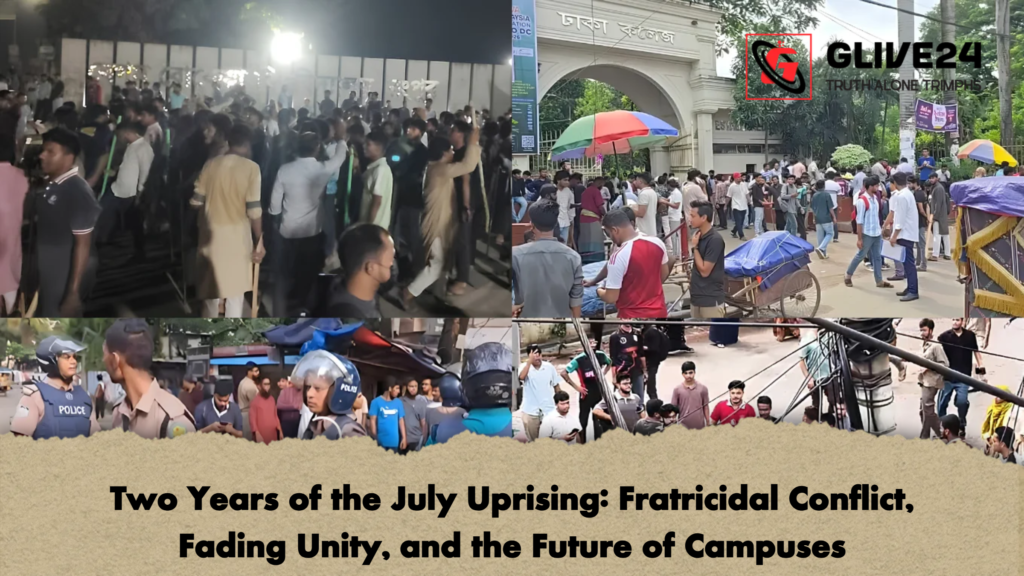
The very organisations that fought shoulder to shoulder on the streets to demand the fall of Sheikh Hasina’s government are now facing each other in bloody confrontations at the country’s higher education institutions, raising a crucial question: is unity fading away?
From Begum Rokeya University in Rangpur (BRUR) to the historic Jagannath University, Dhaka College, and Dhaka Alia Madrasah—the picture is the same everywhere. Over issues such as displaying political placards, removing banners, hall seats, or capturing campus control, BNP-backed Jatiyatabadi Chhatra Dal and Jamaat-backed Islami Chhatramibir are engaging in repeated clashes. Chase and counter-chase, demonstrations with local weapons, and over a hundred students getting injured in these incidents create an extreme contradiction with the memories of their beloved July uprising.
The Equation of Power and Historical Division Behind the Conflicts
The strategic unity forged during the July movement had a specific objective—to bring down the fall of Sheikh Hasina’s government. But after the change in power, the old political mindset of exerting single-handed influence on campuses has reared its head once again.
-
The struggle for establishing authority on campus: Following the change of government, students expected a campus free from hegemony and peaceful. However, the practice of occupying halls and seats, and asserting influence centering events has started anew, which is the core reason for the face-to-face stance of the two groups.
-
The manifestation of ideological conflict: The verbal altercations created centering war crimes and liberation war issues at BRUR prove that political ideologies, hidden behind tactical alliances, are also playing a major role here. The BNP and Chhatra Dal know that politics cannot be done in this country by directly opposing the liberation war. Therefore, they are bringing forward the liberation war.
-
Unity of main parties vs distance in field reality: When main parties like the BNP and Jamaat are calling for a broader unity to thwart Sheikh Hasina’s potential political return or conspiracy, that message from the streets fails to reach cadre-based student politics. The strategic compromise of national politics is failing to impact the control at the grass-roots level of campuses.
Political Coexistence or New Chaos?
This fratricidal conflict between Chhatra Dal and Chhatramibir has not only increased suffering for general students, but it is also questioning the entire achievement of the uprising. The unity built in July is on the verge of getting lost in the politics of anger and supremacy.
To quickly restore discipline and a normal environment in universities, every student organisation must shun the path of conflict and ensure political coexistence. Without democratic practices, respect for dissenting opinions, and swift administrative action against perpetrators based on video footage, these campuses will once again plunge into a long cycle of instability.