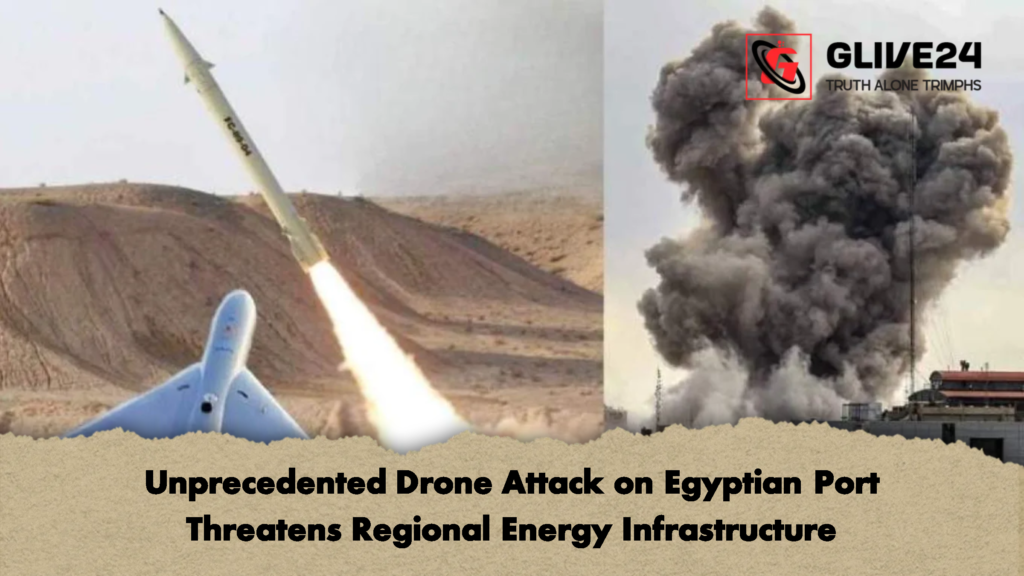
A unprecedented drone strike targeting a floating liquefied natural gas (LNG) terminal in the Mediterranean port of Damietta has raised sharp security concerns that Middle Eastern hostilities are expanding into critical infrastructure sectors previously insulated from direct military action.
The assault occurred on Wednesday afternoon during active fuel discharge operations. According to maritime risk management and intelligence group Ambrey, an unmanned aerial vehicle struck the starboard side of the Energos Winter, a Marshall Islands-flagged floating storage and regasification unit owned and operated by a United States-based firm. The resulting explosion triggered a fire that subsequently spread to an adjacent Greek-owned LNG carrier, the GasLog Salem, causing minor hull damage and a localized gas leak. Emergency response teams and local marine firefighting vessels contained the blaze and evacuated all crew members safely, with no fatalities or injuries reported.
While Egyptian officials initially acknowledged a fire at the Port of Damietta without specifying its source, the Cabinet released a statement on Thursday confirming that preliminary forensic investigations established a drone attack as the cause. No sovereign state or regional paramilitary faction has officially claimed responsibility for the strike.
International security analysts view the incident as a calculated strategic signal. Dr H.A. Hellyer, a senior associate fellow at the Royal United Services Institute (RUSI), told reporters that the attack—whether launched directly or via proxy groups belonging to the self-styled “Axis of Resistance”—demonstrates a capability to project power beyond the primary theatres of the Levant and the Persian Gulf. By striking a US-owned asset within Egyptian territorial waters, the perpetrators underscored the vulnerability of Mediterranean energy corridors to asymmetric warfare.
The strike represents the first direct physical spillover of regional military tensions onto Egyptian soil. Cairo has spent months navigating a delicate diplomatic tightrope, serving as an intermediary alongside international partners to de-escalate confrontation between Washington, Tel Aviv, and Tehran. While Egyptian leadership has routinely condemned strikes on commercial shipping lanes, the government maintains a cautious defense posture and remains unlikely to launch offensive retaliatory strikes.
Diplomatic ties between Egypt and Iran have been historically cool since the 1979 Islamic Revolution, constituting one of the longest diplomatic cold spells in the Arab world. Although recent high-level ministerial exchanges had signaled a gradual rapprochement, security experts caution that targeting energy assets inside Egyptian jurisdiction complicates Cairo’s efforts to remain a neutral arbiter.
The disruption at Damietta comes at a challenging time for Egypt’s domestic energy market. Declining output from domestic fields has forced Cairo back into international spot markets to import LNG to meet summer power grid demands. Although state officials emphasized that emergency reserves would prevent immediate supply deficits, news of the attack sent crude oil and European natural gas futures rising on global commodity exchanges.