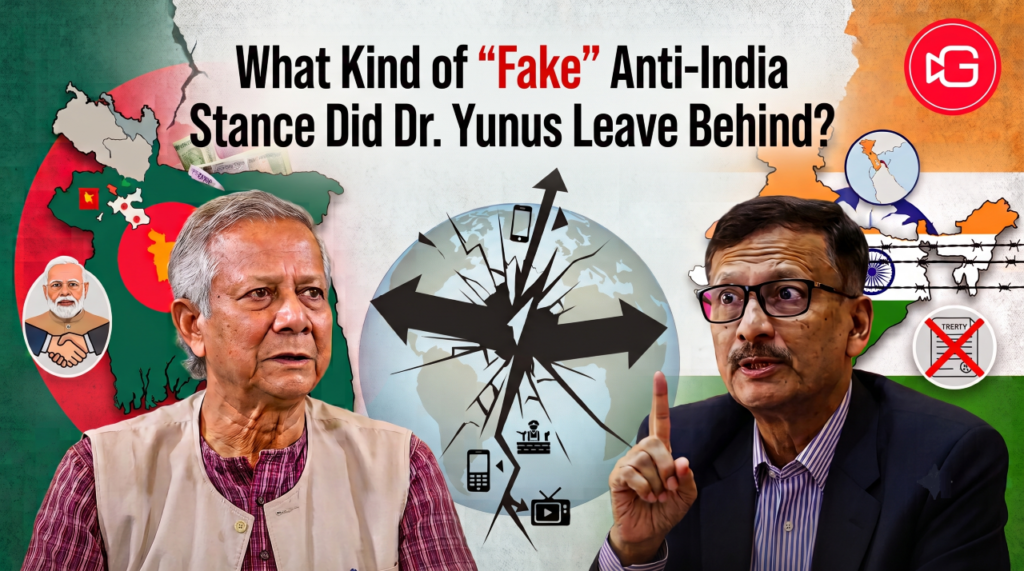
A recent interview with Dr. Yunus’s Foreign Affairs Adviser, Touhid Hossain, has surfaced. In it, he stated that at Dr. Yunus’s own initiative, he requested a telephone conversation with Narendra Modi. Responding to that request, Narendra Modi spoke with Dr. Yunus. Following this, Touhid Hossain expected relations with India to return to normal. Hearing this line, you too might think—well, exactly, after so much interest, why didn’t India normalize relations?
But you may have forgotten that right at the start of taking power, Dr. Yunus threatened India regarding the Seven Sisters. If an Indian head of state issued such a threat regarding Bangladesh’s “Chicken’s Neck,” we would undoubtedly view it as an attack on Bangladesh’s sovereignty. Had our government then shown the slightest flexibility regarding relations with India, we would have torn the administration apart. Even if our government wanted to, moving relations forward would have been impossible due to public opinion. Not only that, after the Yunus government came to power, almost everyone involved in their administration delivered anti-India speeches. Attempts were made through official propaganda to promote the idea that India alone was responsible for all of Bangladesh’s problems. After such a scenario, what kind of relations with India can we possibly expect?
When it comes to relations, the bilateral realities of both countries must also be borne in mind. Just as we have an irreplaceable dependence on India for essential imports, raw materials for the readymade garments sector, riparian dependency, energy imports, and the use of India’s airspace and maritime boundaries, India has almost no such reliance on us. On the other hand, the privileges we grant India are things India can easily manage without. We hold no leverage or civilian pressure to force India to relent. And this is known not just to the governments of both nations, but to the general public of India and Bangladesh as well. The stark reality is that apart from using our border to perpetrate terrorism in India, we possess no capability to harm India. And if terrorism is to be our language, then there is no need to even bring up the question of diplomatic relations.
Against this backdrop, after threatening India’s sovereignty, doesn’t expecting normalized relations sound like an absurd, spoiled child’s wish? Or can Dr. Yunus make such demands as a son-in-law simply because he married an Indian woman? Of course, the arguments of those who practice anti-India politics often resemble these unrealistic demands. They spout anti-India rhetoric all day long, only to present a laundry list of rights to India afterward—even though almost all of those “rights” sound like the whims of a hostile neighbor.
However, this kind of anti-India politics used to work once upon a time. In the past, the general public’s source of information was traditional media, which could unilaterally shape public opinion. But in this age of social media, that brand of politics is becoming virtually impossible. When Dr. Yunus issued a threat regarding India’s sovereignty, that video was not viewed by Bangladeshis alone; it spread across India within moments. Indian citizens subtitled the video and circulated it widely. Indian political parties that campaign on anti-Pakistan platforms used that video to project Bangladesh as a “new Pakistan.” Videos of our cozy interactions with Pakistan only added fuel to that fire. After all this, even if Narendra Modi wanted to, could he have normalized relations with the Dr. Yunus government? What level of national backlash would Modi have faced had he posed for a smiling photo with Yunus?
When Dr. Yunus assumed power, their rhetoric led us to believe that he would expose and definitively cancel all the alleged unfair secret deals with India. Furthermore, deals like Adani’s—which his associates decried as unjust—would be immediately revoked. They were expected to officially hold India responsible for events like the BDR massacre, file lawsuits in international courts against every unfair practice imposed on Bangladesh, deport 2.6 million Indians working in Bangladesh, and talk eye-to-eye (!) with India. There were countless such claims, too numerous to list in a single piece. The nation waited in breathless anticipation, feeling as though things might even escalate to a missile exchange or two.
They engaged in all this posturing on the surface, but what did they do behind closed doors? Not a single agreement with India was cancelled. They suppressed all talk regarding the concessions they promised to revoke. Instead, Dr. Yunus called the Indian Prime Minister himself, making desperate attempts to normalize ties. He directed the Foreign Minister to visit India and expressed his own desire to travel there. Ultimately, he felt privileged to secure a meeting on the sidelines of BIMSTEC after persistent pushback. What kind of game did this international player show us? We watched in utter astonishment at the vast chasm between the “dream” and its “interpretation”!
The Awami League claims that by building relations with India, it secures national interests and maximizes returns on our indispensable dependencies. On the other hand, anti-India elements campaign on the narrative that India gives us the short end of the stick, promising that once in power, they will look India in the eye and guarantee our fair share. That is why we expected far more from Dr. Yunus’s foreign policy than from the Awami League administration. Instead of gaining anything, however, we watched critical benefits like transshipment facilities slip through our fingers.
Anti-India sentiment versus friendship with India serves as a potent political “currency” in Bangladesh. Similarly, pro-Pakistan inclination is another political “currency.” These cards clearly yield support or opposition from specific segments of the population. Therefore, from those who hold power, we expect transparency regarding foreign relations, including ties with India. Those who profess anti-India stances should demonstrate it in heart, word, and deed. But judging the anti-India posture advertised by Dr. Yunus against reality, there is no choice today but to call it “fake.” It wasn’t just the dream that was fake—the reality was fake too.
Editorial Desk,
glive24.com