Ensuring safety, comfort, and hassle-free transit for female professionals and students in Bangladesh’s public transport sector has been a nearly three-decade-long endeavor. Originating in 1997 under the directive of the then Prime Minister Sheikh Hasan and the initiative of Communications Minister Anwar Hossain Manzu, dedicated women’s bus services have navigated numerous structural hurdles before culminating in the modern ‘Pink Bus’ era of 2026.
Despite multiple interventions, priority government programmes, and repeated revival attempts by the Bangladesh Road Transport Corporation (BRTC), previous women-only transport initiatives struggled to achieve longevity. Managerial weaknesses, vehicle shortages, inadequate maintenance, poor publicity, and flawed lease arrangements consistently undermined past services, causing them to gradually fade into obsolescence.
1997–1998: The Genesis of Women’s Buses
The institutional journey of dedicated transport for women in Bangladesh commenced in 1997. Following government directives, the BRTC introduced the first exclusive women’s bus service to facilitate secure travel for working women and female students. Later, between late 1998 and 1999, pilot schemes were launched to accommodate female garment workers. Although these early services drew enthusiastic initial responses from commuters, they ultimately failed to take root due to a lack of long-term planning, consistent maintenance, and effective operational management.
2001–2004: Revival Under the 100-Day Programme
Following the political transition in 2001, the incoming administration incorporated urban mobility solutions for women into its inaugural 100-day priority agenda. Revamped women’s bus routes were launched with state backing across Dhaka and surrounding corridors in early 2002.
While the service operated smoothly for its first two to three years, supervision and maintenance standards deteriorated significantly under the prevailing leasing model. Vehicles began breaking down systematically. Although authorities attempted a route overhaul in August 2004 using 22 buses, the active fleet dwindled to just 11 units, eventually reducing the service to near-total inactivity.
2008–2024: Repeated Resurrections and Persistent Decline
Refusing to abandon the concept entirely, the BRTC periodically attempted to breathe new life into the initiative. In July 2008, a five-bus women’s service was deployed along the Mirpur-Gulistan and Khilgaon Taltola-Gulistan routes. Subsequent ministerial backing from the Ministry of Road Transport and Bridges helped stabilize the active fleet at roughly 12 vehicles by 2015.
Nevertheless, structural sustainability remained elusive. By early 2024, active vehicle counts had slumped to between seven and nine. A severe lack of public awareness campaigns meant that many female commuters remained unaware of timetables or operational routes. Consequently, vehicles frequently ran under-capacity, prompting operators to occasionally admit male passengers and effectively convert the specialized units into standard public transport, defeating the core objective of safe female transit.
2026: A New Era With the ‘Pink Bus’
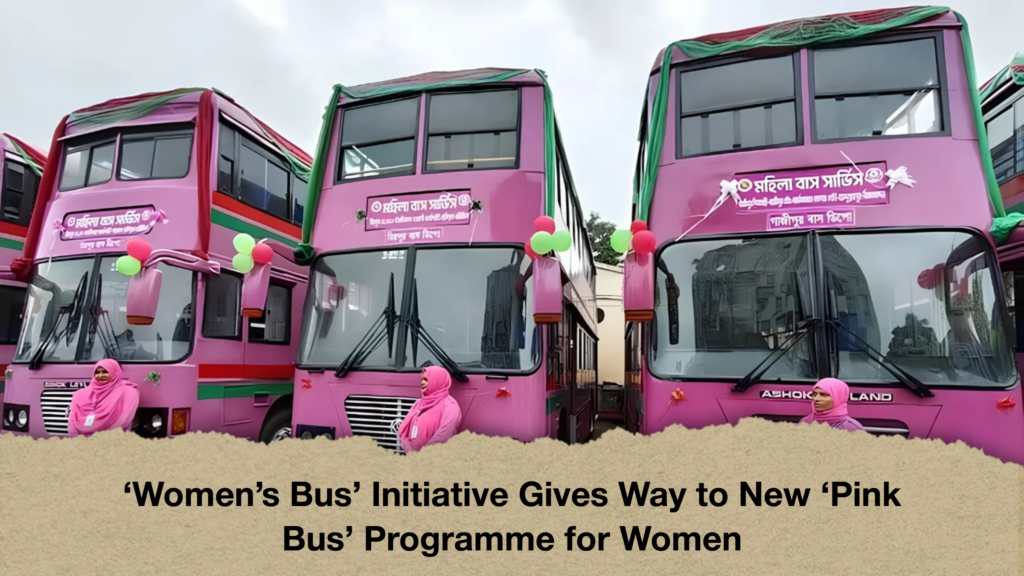
Drawing vital lessons from three decades of setbacks, the BRTC rolled out a reimagined ‘Pink Bus Service’ on 18 August 2026. Beyond a mere aesthetic coat of paint, the initiative introduces fundamental structural and operational overhauls.
Addressing an inaugural ceremony, Minister of Road Transport and Bridges, Railways, and Shipping Sheikh Rabiul Alam stated that the specialized pink bus fleet operates under the direct supervision of female drivers and conductors, fulfilling key pledges outlined in the government’s electoral manifesto. He emphasized that the service aims to cultivate a secure, comfortable commuting environment while expanding female participation in the public transport workforce.
A defining characteristic of this new rollout is the direct employment of female operational staff. Approximately 16 women underwent specialized training to serve as professional drivers. The initial fleet comprises 14 distinctive double-decker pink buses allocated across strategic urban hubs: ten units serving Dhaka and Narayanganj corridors, two in Bogura, and two in Chattogram.
The designated routes span critical metropolitan arteries, including Notun Bazar-Motijheel, Taltola-Motijheel, Demra-GPO, Mirpur-Motijheel, Mohammadpur-Motijheel, Abdullahpur-Motijheel, Gazipur-Airport, and Narayanganj-Dhaka. Regional deployment covers Sherpur-Matidali in Bogura and Kalurghat-Patenga in Chattogram.
Prospects for Long-Term Viability
Historical precedent highlights that consistency remains the ultimate challenge for dedicated women’s transport initiatives. Without sustained fleet maintenance, strict adherence to schedules, transparent publicity, and robust administrative oversight, past vulnerabilities risk resurfacing.
By superseding legacy leasing structures with direct state management and empowering female drivers and conductors, authorities hope to rewrite the narrative. Designed to curb harassment, unwanted physical contact, and pervasive insecurity in public spaces, the success of the modern Pink Bus service will ultimately be measured by its resilience and permanence in the years ahead.
By Senior Reporter