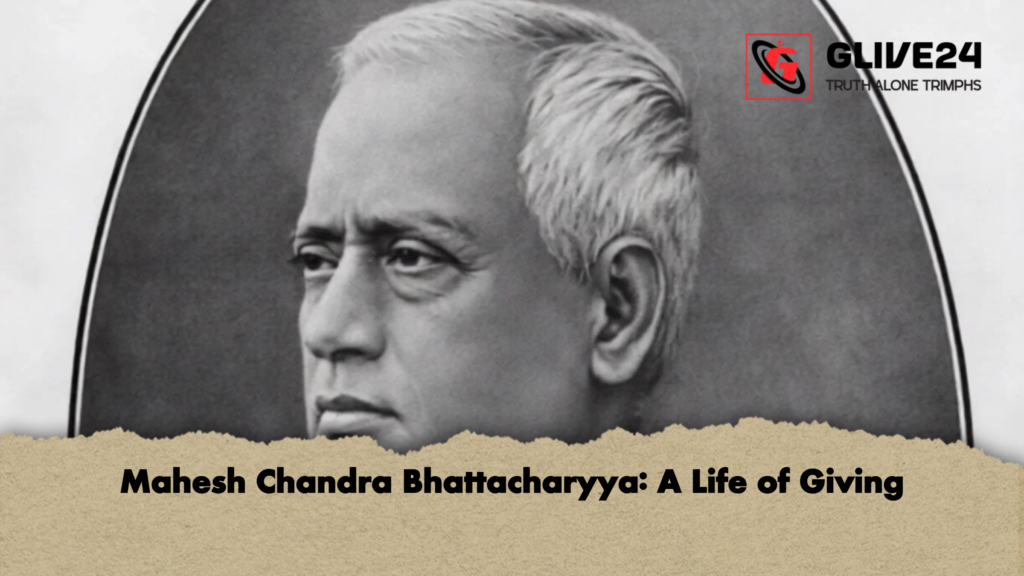
Mahesh Chandra Bhattacharyya stands in the annals of Bengal’s social history as a rare and luminous example of selfless philanthropy. A homeopathic medicine trader by profession, he was far more distinguished for the manner in which he devoted the entirety of his earnings to the welfare of his country, society and fellow human beings. Quiet, unassuming and free from vanity, his lifelong practice of charity created a standard of altruism that remains exceptional even today.
Born on 1 December 1858 in the village of Bitghar in Nabinagar, Brahmanbaria, Bhattacharyya grew up in a household steeped in learning and moral values. His father, Ishwardas Tarksiddhanta, was a respected scholar, while his mother, Rammala Devi, embodied compassion and resilience. Crushing poverty, however, deprived him of formal schooling. This hardship did not extinguish his thirst for knowledge. Through disciplined self-study at home and unwavering determination, he educated himself and eventually became self-reliant. For a period, he even served as a teacher at a local Bangla school, reflecting his commitment to learning and instruction.
In 1883, armed with a mere fifty-five rupees, Bhattacharyya travelled to Calcutta in search of livelihood. There he established a homeopathic medicine business, guided by honesty, diligence and perseverance. Commercial success followed swiftly, yet personal luxury never appealed to him. Instead, he regarded wealth as a trust to be returned to society, a principle that defined his entire life.
His contributions to education and social welfare were both wide-ranging and enduring. In 1923, he founded Ishwar Pathshala in Comilla in memory of his father. Earlier, in 1920, he had established the Rammala Students’ Hostel at Shaktala Palli, followed by the Rammala Library in 1935. He played a pioneering role in promoting female education, helping to establish Nivedita Girls’ School and Nivedita Girls’ Hostel in Comilla. In his native village, he founded an Education Council, while in Kashi he set up Ishwar Pathshala Tol for traditional learning.
Beyond education, his concern for public welfare was deeply practical. He financed the construction of Rammala Road and the Rammala Post Office in 1935, and excavated a large pond in his village to provide drinking water to all, irrespective of caste or creed. During a devastating famine at Baidyanath while on pilgrimage, he quietly arranged daily meals for four to five hundred destitute people, refusing publicity for his generosity.
For pilgrims, he built the Kalighat Pilgrims’ Rest House at Tollygunge No. 21 in 1935, offering free accommodation for several days. In Varanasi, he established a dharmashala named after his wife, Harsundari Devi. Alongside his social work, he maintained a keen interest in literature, authoring the book Byabosayi in 1312 of the Bengali era and later penning his autobiography, Atmakatha.
Mahesh Chandra Bhattacharyya passed away on 10 February 1944. Though he left behind no personal fortune, his legacy of compassion, humility and unwavering service continues to inspire generations.
Key Institutions Founded by Mahesh Chandra Bhattacharyya
| Year | Institution | Location | Purpose |
|---|---|---|---|
| 1920 | Rammala Students’ Hostel | Comilla | Student accommodation |
| 1923 | Ishwar Pathshala | Comilla | Primary education |
| 1935 | Rammala Library | Comilla | Public library |
| 1935 | Kalighat Pilgrims’ Rest House | Kolkata | Free lodging for pilgrims |
| — | Nivedita Girls’ School & Hostel | Comilla | Female education |
| — | Ishwar Pathshala Tol | Kashi | Traditional learning |