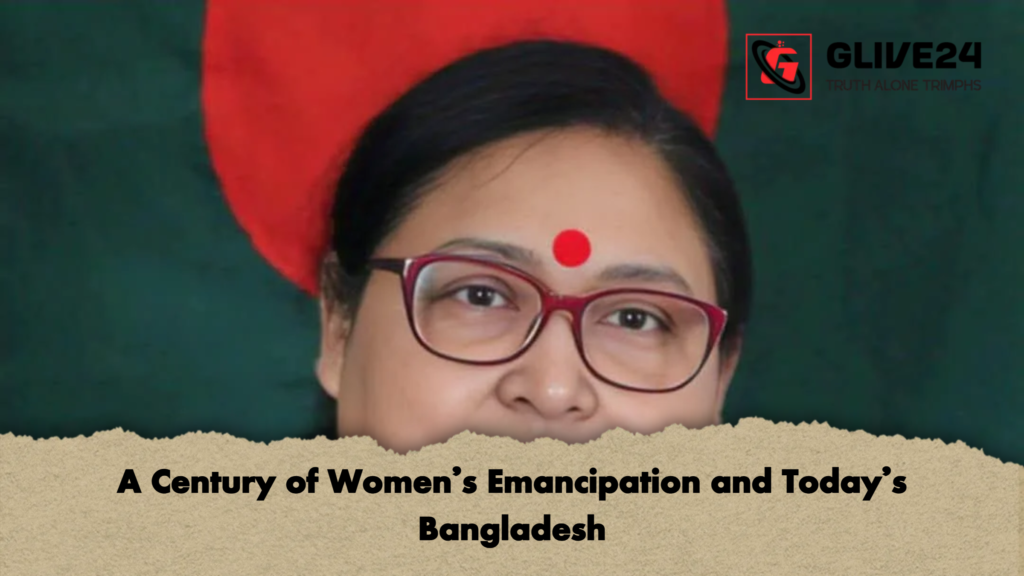
Hosne Ara Jemi
For over a hundred years, the current of women’s emancipation in this land has flowed—not merely as a history of names or events, but as a struggle for the very self-identity of Bengali society.
When, at the turn of the nineteenth and twentieth centuries, female education was almost forbidden, Begum Rokeya took up the pen as a weapon. Her vision of Sultana’s Dream was not mere fiction; it was a revolutionary perspective.
Ela Mitra endured persecution yet remained unyielding in anti-British and anti-feudal movements. Preetilata Waddedar sacrificed her life, weapon in hand, to resist colonial rule.
In the subsequent chapters of this journey—language movements, the Liberation War, and anti-authoritarian struggles—women’s presence has always been evident. Following independence, numerous women’s organisations emerged, such as the Bangladesh Mahila Parishad, which have consistently campaigned on legal reform, family law, violence prevention, and political representation.
So the question arises: why, despite these achievements, is there still doubt today?
Table of Contents
A Dual Reality
In contemporary Bangladesh, we witness a dual reality.
On one hand:
-
Female enrolment in primary and secondary education is historically high.
-
Women’s participation has increased across the ready-made garment sector, administration, banking, education, and even the armed forces.
-
Reserved seats in local government have ensured political representation.
-
Women are vocal, organised, and actively protesting on social media.
On the other hand:
-
Misogynistic language and violence are rising, both online and offline.
-
The influence of religious and conservative political forces is increasingly visible.
-
Some educated women even justify patriarchal structures as “natural” or “religiously sanctioned.”
Does this tension signify a failure of women’s emancipation?
Struggle Is Never Linear
History shows that social progress is never unidirectional. When women gain education and economic participation, familial power dynamics shift—often making many uncomfortable, provoking backlash.
Patriarchal mindsets are not confined to men; they are deeply embedded in family structures, religious interpretation, social norms, and economic dependency. Many women find security, respect, or identity within this framework.
Education, if it does not cultivate critical thinking, may produce degrees without independent thought. Consequently, political or social positions cannot be explained solely by educational attainment.
Are Achievements Negligible?
Certainly not. In today’s Bangladesh:
-
Life expectancy for girls has increased.
-
Maternal mortality has declined.
-
Women are representing the country in international sports and cultural arenas.
-
Participation in higher education has risen significantly.
These achievements are not just on the pages of history—they are visible in everyday life.
Yet, violence, inequality, child marriage, and workplace insecurity persist. In other words, the country simultaneously bears light and shadow.
Where Lies the Challenge?
Perhaps the issue lies not in the existence of movements, but in their continuity. Key questions include:
-
Are movements speaking in the language of the new generation?
-
Is the gap between rural and urban realities adequately understood?
-
Is resistance being offered without dialogue with religious sentiments?
-
Can liberation be sustainable through ideals alone, without economic security and social protection?
The Way Forward
Bangladesh is not a monochromatic reality; it is a land of progress and reaction, protest and compromise. If a century of struggle today faces questions, it is not a sign of failure—but a proof of life. A dead struggle invites no questions.
What is now needed:
-
Self-criticism
-
Cultivation of critical thinking in education
-
Expansion of women’s economic independence
-
Dialogue within social and religious spheres
-
Participation of the new generation
The history of emancipation is never completed in a single day. Just as in Rokeya’s time, the struggle continues today—the only difference is the strategy.
The question remains: Which forces do we wish to empower? Because if achievements are not safeguarded, they are lost. And if struggle ceases, history regresses.
Author: Expatriate poet, writer, and social activist