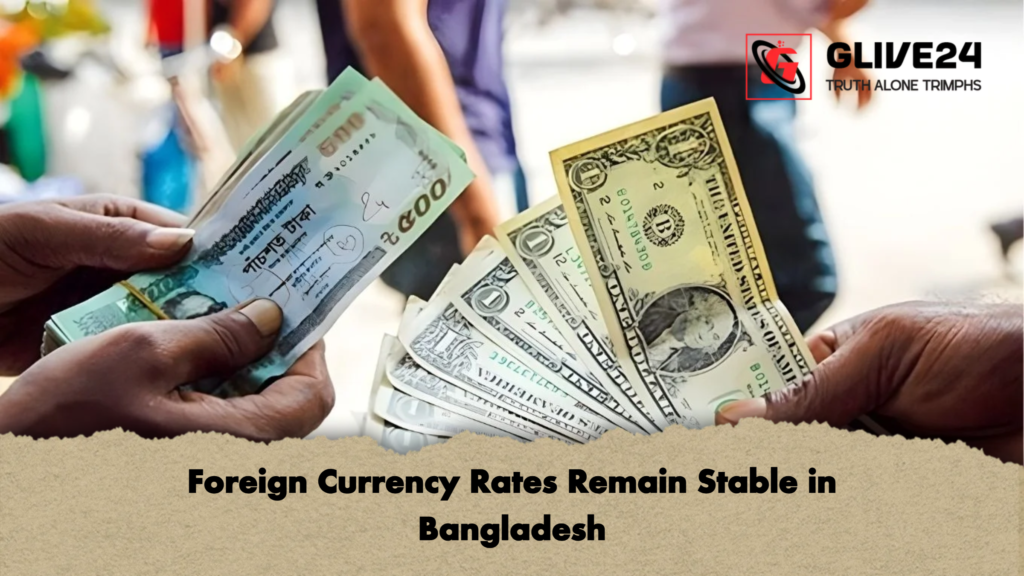
The role of foreign currency in Bangladesh’s economy continues to grow steadily, driven largely by the contributions of the country’s extensive expatriate community. Remittances from overseas Bangladeshis and international trade transactions form a crucial part of the nation’s financial ecosystem. For both businesses and individuals sending or receiving money internationally, staying informed about current exchange rates is an essential daily requirement.
On 16 February 2026, the Bangladesh Bank released updated exchange rates for major foreign currencies in the domestic market. The figures indicate relative stability, with minimal fluctuations across most currencies.
According to the central bank’s latest data, the US Dollar (USD) remains unchanged at BDT 122.30 for both buying and selling. The Euro (EUR) is quoted at BDT 145.13 for purchase and BDT 145.17 for sale, reflecting a negligible difference. Meanwhile, the British Pound (GBP) is slightly higher, with a buying rate of BDT 166.91 and a selling rate of BDT 166.95. Rates for the Japanese Yen (JPY) and Indian Rupee (INR) have seen no significant movement.
Major Currency Exchange Rates – 16 February 2026
| Currency | Buying Rate (BDT) | Selling Rate (BDT) |
|---|---|---|
| US Dollar (USD) | 122.30 | 122.30 |
| Euro (EUR) | 145.13 | 145.17 |
| British Pound (GBP) | 166.91 | 166.95 |
| Japanese Yen (JPY) | 0.80 | 0.80 |
| Australian Dollar (AUD) | 86.50 | 86.55 |
| Singapore Dollar (SGD) | 96.80 | 96.97 |
| Canadian Dollar (CAD) | 89.80 | 89.81 |
| Indian Rupee (INR) | 1.35 | 1.35 |
| Saudi Riyal (SAR) | 32.61 | 32.50 |
Analysts note that global economic volatility can impact local currency markets. Bangladesh, with its heavy reliance on international trade and remittance flows, experiences frequent fluctuations in the taka’s exchange rate. For expatriates sending money home and local businesses conducting foreign transactions, awareness of current rates is vital to ensure accurate financial planning and to minimise losses.
The stability of the US Dollar and British Pound, coupled with minor variations in the Euro and other currencies, serves as an important indicator for ongoing market transactions. Observing these rates allows businesses and remittance recipients to make informed decisions, safeguarding the efficiency and profitability of their operations.
As Bangladesh’s economy increasingly integrates with global markets, daily monitoring of currency exchange rates remains a critical tool for economic stability and strategic financial management.