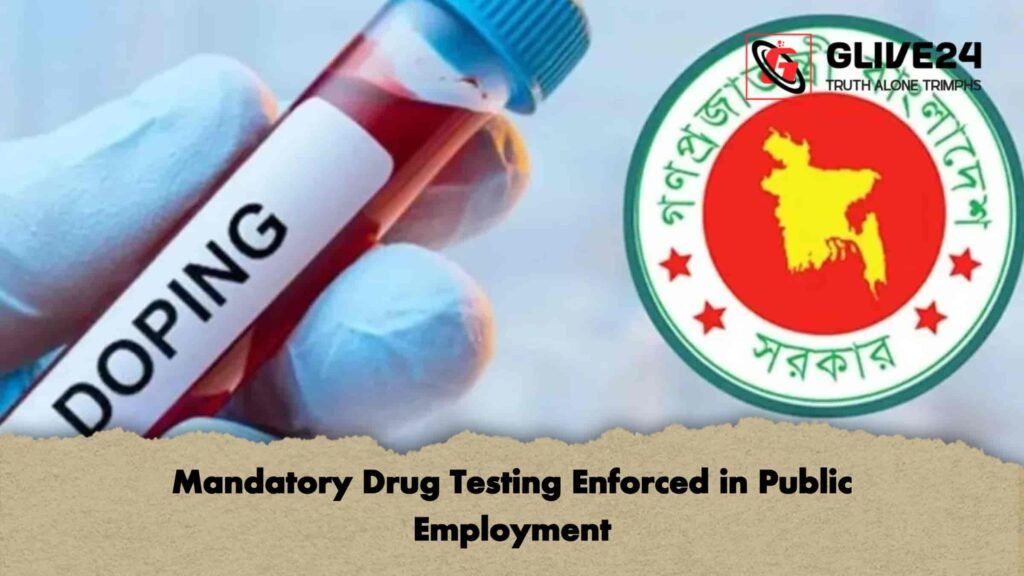
The government has officially introduced mandatory drug testing for applicants seeking employment in government, semi-government, local government, and autonomous institutions. Under the new regulation, any candidate who tests positive for drugs during pre-employment screening will be declared ineligible for appointment. Similarly, current employees who are found to be under the influence of drugs will face disciplinary action under the Government Servants (Discipline and Appeal) Rules–2018. Failure to seek appropriate treatment after a positive result will be treated as a punishable offence.
This policy has been formally enacted under the 2026 Biological Sample Drug Detection (Drug Test) Regulations, which were implemented last Monday by the Ministry of Housing and Internal Affairs.
Table of Contents
Formation of the Drug Testing Technical Committee
A dedicated Drug Testing Technical Committee has been established to ensure the efficiency and transparency of the testing process. The committee will be chaired by the Director General of the Department of Narcotics Control and will include representatives from relevant agencies and institutions. Additional experts may be co-opted into the committee as required.
Key Committee Members
| Position | Responsibility / Institution |
|---|---|
| Chairperson | Director General, Department of Narcotics Control |
| Member | Additional Secretary, Drug Branch, Ministry of Housing and Internal Affairs |
| Member | Professor, Department of Biochemistry, Bangladesh Medical University or designated university |
| Member | DIG (Forensic), Police Criminal Investigation Department (CID) |
| Member | Director, National Laboratory Medicine & Referral Centre |
| Member | Director, National Institute of Mental Health |
| Other | Additional experts as required |
Scope of Application
Under the new regulation, drug testing is mandatory in the following scenarios:
-
Recruitment in government, semi-government, local government, autonomous, and private institutions
-
Issuance and renewal of vehicle, marine, and aviation licences
-
Issuance and renewal of firearms licences
-
Overseas employment programmes
-
Students in higher education institutions, when drug use is suspected
Testing Procedures and Security
Strict protocols govern the drug testing process:
-
Candidates must report to designated collection centres
-
Digital records of photographs and fingerprints are mandatory
-
Sample confidentiality must be maintained
-
Laboratory entry, exit, and operations are logged in both digital and manual registers
-
CCTV monitoring is maintained at all times
-
Test results are disclosed only to authorised officials
Database Management
All test results, past and future, will be stored in a secure national drug testing database. Any breach of security measures will be treated as a disciplinary violation.
Previously, certain organisations—including the Department of Narcotics Control, National Security Intelligence, Metro Rail, BCS recruitment, Jahangirnagar University, Bangladesh University of Professionals, and driver recruitment programmes—conducted drug testing. The new regulations make this process mandatory across all relevant institutions.
Implementation Overview
| Institution / Sector | Previously Applied | New Regulation Applied |
|---|---|---|
| Department of Narcotics Control | ✔ | ✔ |
| National Security Intelligence | ✔ | ✔ |
| Metro Rail | ✔ | ✔ |
| BCS Recruitment | ✔ | ✔ |
| Jahangirnagar University | ✔ | ✔ |
| Bangladesh University of Professionals | ✔ | ✔ |
| Driver Recruitment | ✔ | ✔ |
| Other Government & Private Institutions | ✖ | ✔ |
Through this policy, the government aims to ensure a drug-free and safe working environment across all public and relevant institutions, enhancing workplace safety and integrity.