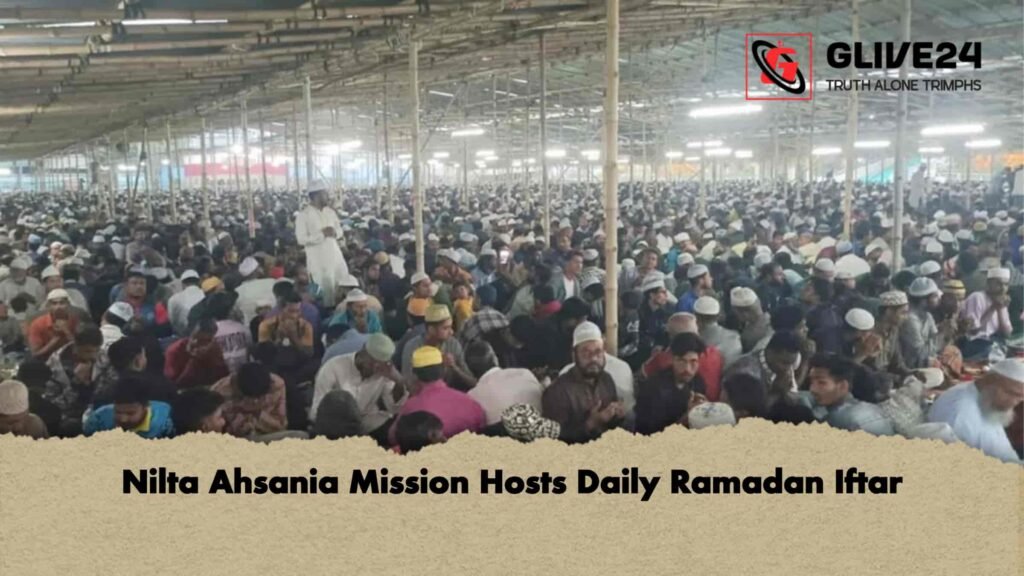
In the early hours of each day, the courtyard of the Nilta Central Ahsania Mission in Kaliganj, Satkhira, comes alive with activity and devotion. Following the Fajr prayer, preparations for the day’s iftar begin, continuing throughout the holy month of Ramadan. The mission serves approximately six thousand people daily, transforming its modest grounds into a vibrant hub of faith, community, and service.
The culinary preparations are meticulous. Chickpeas are boiled to perfection in large cauldrons, seven-layered firni is carefully prepared, and samosas are consistently fried to golden perfection. These tasks commence at dawn, marking the start of a day-long programme of spiritual and logistical dedication. A team of around fifty professional chefs, supported by 250 volunteers, ensures that every meal maintains the mission’s high standard of quality and care.
Amanat Ali, who has supervised iftar preparations for twenty-five years, explains, “Every day we use 190 kilograms of chickpeas, 144 kilograms of semolina, 150 kilograms of sugar, and 600 kilograms of milk to prepare the seven-layered firni. Work begins at dawn and concludes by 3 p.m. With Allah’s grace, everything proceeds smoothly, and the blessings of our spiritual guides sustain us.”
Mohammad Asaduzzaman, responsible for samosa preparation, adds, “From six in the morning, I work with five to six assistants. Daily we peel and chop 180 kilograms of potatoes and prepare 154 kilograms of flour. Though financial compensation is limited, the satisfaction of serving others is invaluable.”
Between 250 and 300 volunteers help assemble and distribute the iftar plates. Each plate contains dates, bananas, flattened rice, chickpeas, and firni. Mohammad Nazmul Hasan, a volunteer for two decades, reflects, “This programme runs from the first to the thirtieth day of Ramadan. Participating over twenty years has been a special honour.” Local devotees, such as Ansar Ali, note, “The mission provides a serene environment for prayer and iftar. Six to seven types of iftar items are served, and everyone breaks their fast together in harmony.”
Dr. Md. Najrul Islam, General Secretary of Nilta Central Ahsania Mission, states, “The daily cost is approximately 260,000 taka. This is fully covered by generous donations from devotees both in Bangladesh and abroad. Our role is solely to organise, while fifty chefs and 250 volunteers work tirelessly to ensure success.”
Established in 1935 by the eminent scholar Khan Bahadur Ahsanullah (R.), the mission initially received home-prepared meals from local residents. Today, it has evolved into a grand iftar festival, serving thousands and symbolising social unity and humanitarian service.
Daily Iftar Preparation Summary
| Preparation Stage | Quantity/Details | Responsible Team |
|---|---|---|
| Chickpea Boiling | 190 kg | Amanat Ali & 50 chefs |
| Seven-Layer Firni | 7 layers (144 kg semolina, 150 kg sugar, 600 kg milk) | Chef Team |
| Samosa Preparation | 180 kg potatoes, 154 kg flour | Mohammad Asaduzzaman & 5–6 assistants |
| Iftar Plate Assembly | 6,000 plates | 250–300 volunteers |
| Daily Cost | 260,000 Taka | Covered by devotees’ donations |
Nilta’s daily iftar is more than a meal distribution; it is a living testament to devotion, community, and service. Throughout Ramadan, Nilta Sharif shines as a centre of faith, generosity, and unity, embodying the spirit of the holy month.