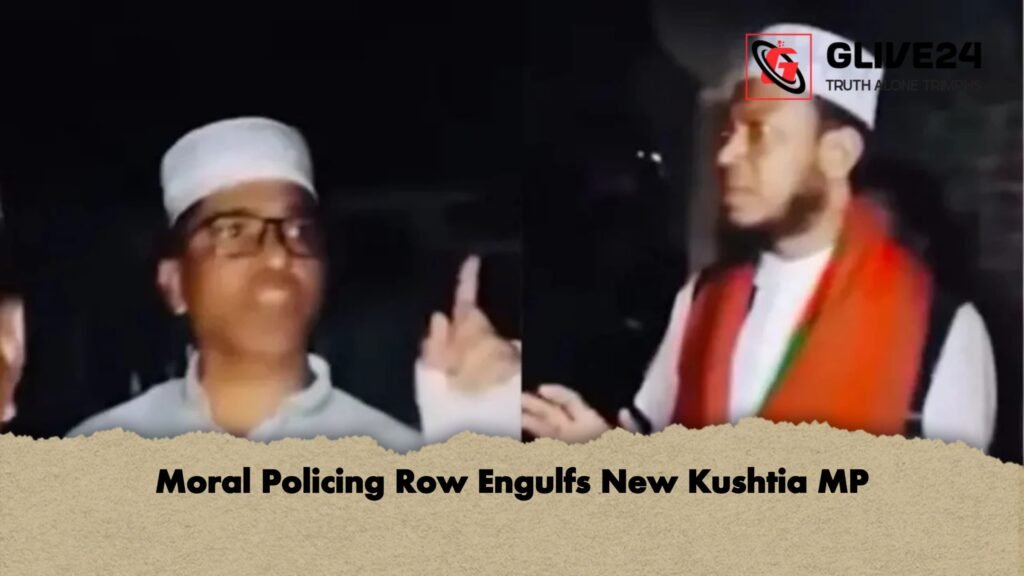
The political landscape in Kushtia has been plunged into a heated debate over civil liberties following allegations of “moral policing” directed at Amir Hamza, a newly elected Member of Parliament associated with Jamaat-e-Islami. The controversy erupted after a video surfaced on social media, depicting the legislator overseeing a heavy-handed enforcement of “religious sanctity” during the holy month of Ramadan—an act critics describe as a blatant overreach of constitutional authority.
Table of Contents
The Viral Confrontation
The footage, which has since gone viral across Bangladesh, shows MP Amir Hamza patrolling a local market in Kushtia Sadar accompanied by a cohort of followers and uniformed police officers. In the video, Mosiul Azam, the In-charge of the Patikabari police outpost, is seen adopting an aggressive stance towards local shopkeepers.
With the MP standing firmly by his side, the officer is heard shouting: “It is the month of Ramadan; no carrom boards or televisions are permitted. That is the end of the matter!” This direct interference in the private recreation of citizens has sparked a wave of indignation, with many viewing it as an unjustified affront to individual freedom.
Disciplinary Fallout and Administrative Denial
As public outcry intensified, the district police administration moved swiftly to distance itself from the incident. Mosiul Azam was summarily withdrawn from his post at the Patikabari outpost and “closed” to the police lines pending further investigation.
While the disgraced officer claimed he was merely acting on “orders from above,” the Superintendent of Police (SP) for Kushtia, Jasim Uddin, issued a categorical rebuttal. “The police department issued no such directive,” the SP stated. “The officer was simply echoing the personal sentiments expressed by the Member of Parliament.”
Conflicting Perspectives on Authority
| Stakeholder | Key Position and Official Stance |
| Amir Hamza (MP) | Claims actions were a “religious duty” to ensure prayer time respect. |
| Mosiul Azam (Officer) | Claimed he followed “superior orders”; currently facing disciplinary action. |
| Jasim Uddin (SP) | Denied police involvement; attributed the rhetoric solely to the MP. |
| Civil Society | Viewed the act as an illegal exercise of power and a breach of privacy. |
Threats Against the Press
The controversy has been further exacerbated by reports of the MP’s hostility towards the media. In a separate recording, Hamza reportedly targeted a news portal titled Khaborwala, suggesting that those associated with the outlet “deserved to be killed.” The portal’s perceived “crime” was merely fulfilling its journalistic duty by reporting on the MP’s controversial and allegedly misleading public statements. This escalation has drawn sharp criticism from press freedom advocates who fear a chilling effect on local reporting.
A Question of Constitutional Rights
While MP Amir Hamza maintains that his actions were a soft “invitation to faith” (Da’wah), human rights activists argue that the presence of armed state police transforms a religious suggestion into a coercive threat. In a democratic society, personal conduct within private spaces is governed by the law of the land, not the individual piety of a legislator.
The incident serves as a stark reminder of the dangers posed when political figures co-opt state machinery to enforce a specific ideological or religious agenda. While the police have taken internal measures, the long-term impact on social harmony and the professional integrity of the force remains a significant concern for the residents of Kushtia.