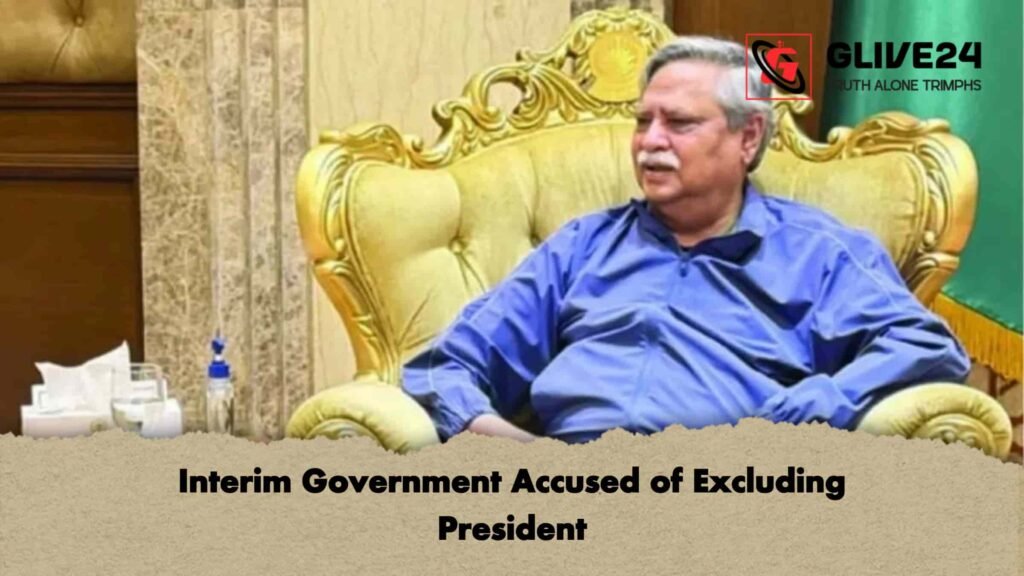
Bangladesh President Mohammad Shahabuddin has publicly accused the interim government of failing to inform him about a critical agreement, describing the omission as a serious constitutional oversight. The President stated that he was not briefed on a recently signed accord with the United States, a matter that, according to the constitution, required his awareness.
In a recent interview, the President said:
“I was not informed about anything. On matters of such national importance, I must be consulted. Previous governments, regardless of size or scope, always kept the President apprised. This is a constitutional obligation. The interim government, however, completely disregarded this.”
Key Allegations by the President
President Shahabuddin highlighted that he was consistently excluded from important decision-making during the interim government’s tenure. He emphasised that the appointment of the Chief Adviser, a process he initiated, was carried out without any coordination with him. He further stated:
“The person appointed as Chief Adviser through my involvement never once consulted with me.”
The President’s main grievances can be summarised as follows:
| Issue | Details of Allegation |
|---|---|
| Foreign Visits | Two scheduled foreign trips were abruptly cancelled without explanation |
| Official Events | Denied participation in university convocations and other government ceremonies |
| Diplomatic Missions | Presidential portraits were removed overnight from all foreign high commissions |
| Press Support | Withdrawal of Press Wing assistance; presidential images and messages excluded from national day publications |
The President also noted that his exclusion from events where his presence is mandated by protocol undermines established traditions and diminishes the symbolic significance of his office.
Political Repercussions
These remarks have sparked intense debate within Bangladesh’s political circles. Analysts argue that the interim government’s operational approach raises serious questions regarding constitutional compliance and transparency. The controversy has the potential to erode public confidence in both governmental communication channels and institutional coordination.
Political observers contend that this incident underscores the urgent need to strengthen consultation and coordination mechanisms between the President and the government. The debate over the interim government’s policies and the President’s constitutional role is likely to intensify in the coming months.
At present, the dispute has reignited discussions on procedural transparency, institutional respect, and governance standards, with potential long-term implications for administrative relations and policymaking in Bangladesh. Ultimately, the divergence between the President’s claims and the interim government’s actions marks the emergence of a significant constitutional and political confrontation.