
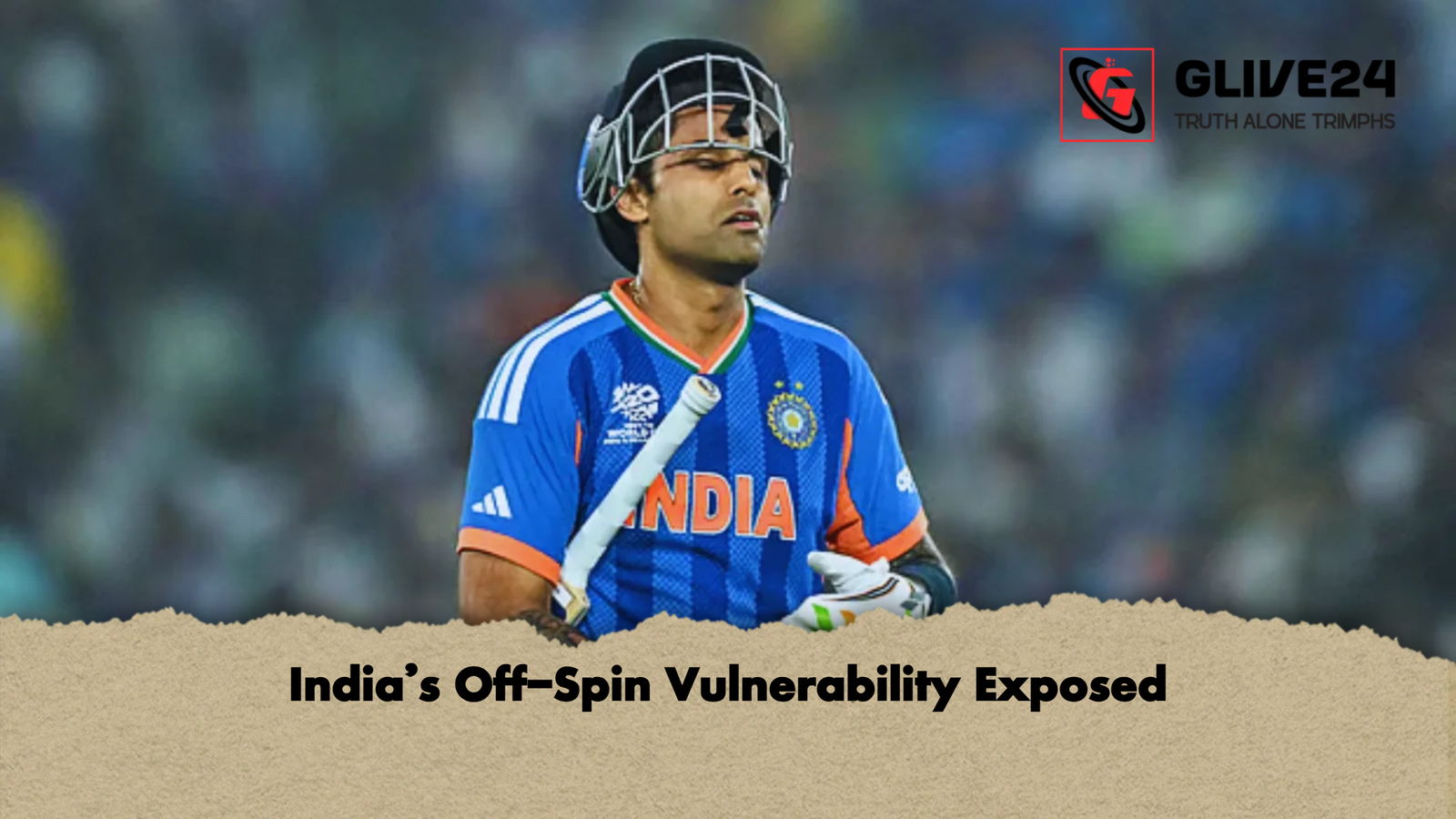
India face a defining moment in the Super Eight stage of the ICC Men’s T20 World Cup, with two must-win fixtures determining their fate. The first of these comes against Zimbabwe at Chennai’s iconic M. A. Chidambaram Stadium. While Zimbabwe’s pace spearhead Blessing Muzarabani—currently the leading wicket-taker in the Super Eight with 11 scalps—poses a significant threat, a deeper statistical analysis reveals a more pressing concern for India: off-spin.
For years, India’s batting has been synonymous with mastery against spin. Yet, in this tournament, that reputation has been notably undermined. Across five matches, India have lost just once, but their recurring struggles against off-spin have become increasingly evident. No fewer than six different off-spinners have exploited this weakness with considerable success.
A key structural factor lies in India’s batting composition. Of their 16-man squad, nine players bat left-handed. During the group stage, as many as seven left-handers featured in the playing XI against sides such as the USA, Pakistan, and the Netherlands. Even in the Super Eight defeat to South Africa, seven left-handers were retained. This imbalance has allowed opposition captains to deploy right-arm off-spinners as a tactical “match-up” advantage.
Statistically, the issue is stark. India have lost 18 wickets to pace and 19 to spin in the tournament so far. Of those 19, a striking 12 have fallen to off-spin alone.
India’s Wickets by Bowling Type
| Bowling Type | Total Wickets Lost | To Off-Spin |
|---|---|---|
| Pace | 18 | — |
| Spin | 19 | 12 |
Among the most successful against India has been Namibia’s Gerhard Erasmus, who claimed four wickets with his off-breaks, while Pakistan’s Saim Ayub chipped in with three, mixing off-spin with occasional variations. More concerning than the numbers, however, is the timing of these dismissals—four of the 12 wickets to off-spin have come during the powerplay, exposing early fragility.
Openers Abhishek Sharma and Ishan Kishan, both left-handers, have each fallen twice to off-spin. Their struggles are reflected in India’s opening partnership average of just 6.8—the lowest among Super Eight teams. The middle order has fared little better, scoring at a modest 6.23 runs per over against off-spin across 102 deliveries.
Zimbabwe are well-equipped to exploit this weakness. Captain Sikandar Raza is a seasoned off-spinner, supported by part-time options such as Brian Bennett and Tony Munyonga. Notably, Raza has opened the bowling in victories over Australia and Sri Lanka earlier in the tournament, and a similar ploy against India appears likely.
Although Chennai’s traditionally spin-friendly surface has behaved unusually in this World Cup—registering a relatively poor spinner strike rate of 22.3 and an average of 30.23—the psychological impact of repeated failures against off-spin may weigh heavily on India’s batters.
Recognising the issue, players such as Suryakumar Yadav and Tilak Varma have reportedly devoted extended training sessions to countering spin with aggressive strokeplay. Batting coach Sitanshu Kotak acknowledged the challenge, stating, “We know Zimbabwe will target us with off-spin, and we are working on it.”
For India, the battle ahead is not merely against Zimbabwe, but against a tactical flaw that threatens to derail their campaign.