
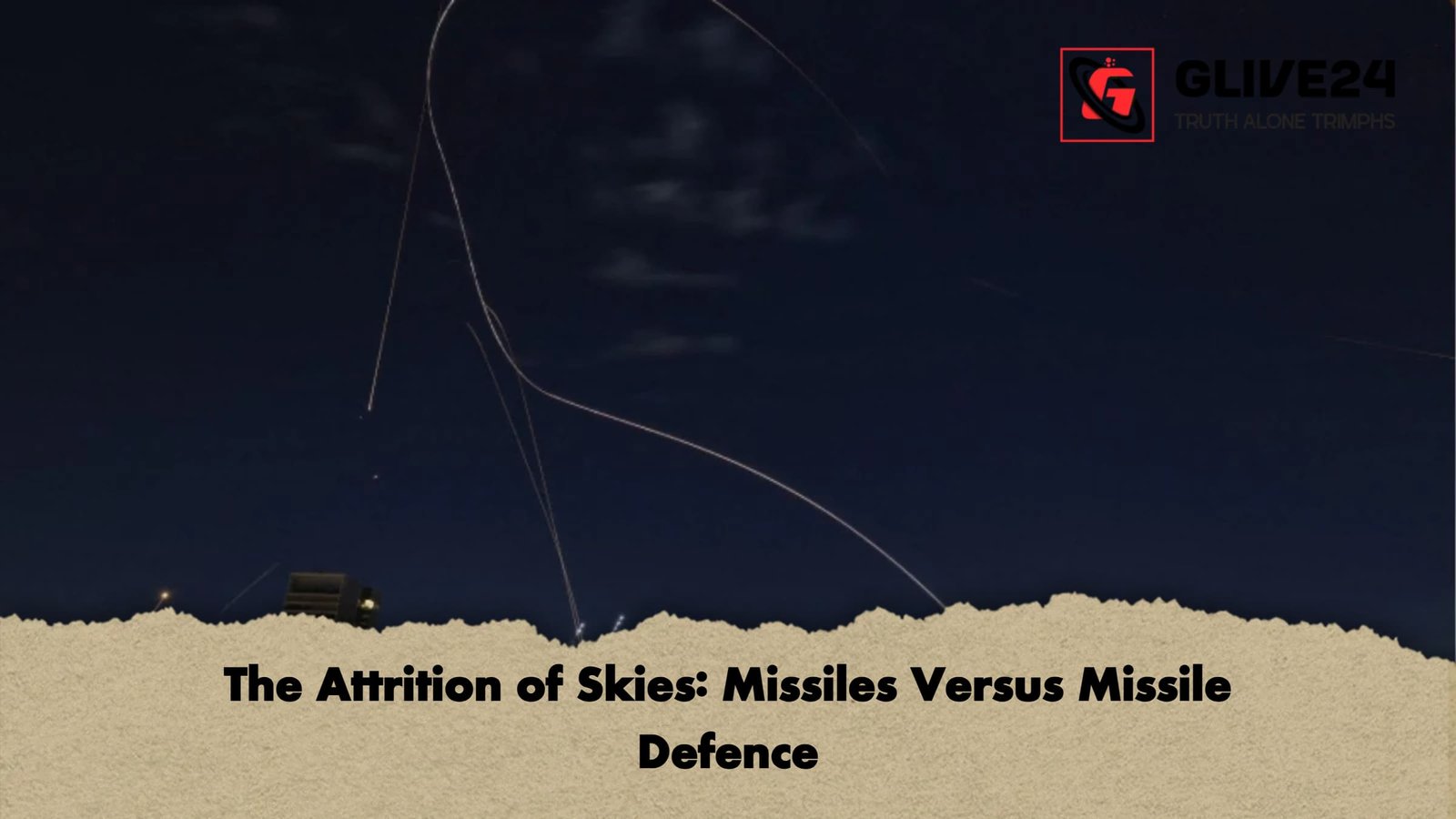
The escalating conflict in the Middle East has evolved into a high-stakes clinical trial of modern warfare: a relentless duel between Iranian ballistic trajectories and the sophisticated interceptors of the United States and Israel. As drones and missiles illuminate the night sky, a critical question emerges—not just who possesses the superior technology, but whose arsenal will be the first to run dry.
Table of Contents
The Mathematical War of Attrity
According to analysis by AFP and open-source intelligence from Mintel World, the opening 48 hours of the current hostilities saw Iran launch a staggering 400 missiles and 1,000 drones targeting locations across the UAE, Kuwait, Bahrain, Qatar, and Jordan.
Scott Benedict, an analyst at the Middle East Institute and former Marine officer, likens the situation to a primitive yet lethal contest. “It is a competition of stockpiles,” he noted. “Two archers are firing at one another; the one who exhausts their quiver first is the one who loses.” While US President Donald Trump has asserted that American interceptor stocks are “virtually limitless,” independent experts suggest the reality of industrial production lines tells a different story.
Production Realities and Interceptor Scarcity
The primary challenge for the US-Israeli coalition is the sheer cost and complexity of defensive hardware. While Iran can produce relatively low-cost “suicide drones” and short-range missiles in high volumes, the interceptors required to neutralise them are among the most expensive and slowest-to-manufacture munitions in the world.
Key Defence Production and Usage Data:
| System/Metric | Annual Production Capacity | Recent Combat Usage (Est.) |
| THAAD Interceptors | ~96 Missiles per year | 150 used in 12 days (2025) |
| Patriot Interceptors | ~600 Units per year | High expenditure across Gulf |
| Iran’s Missile Stock | 2,000+ (Long-range) | Hundreds launched in 48 hours |
| Engagement Ratio | 2 Interceptors per 1 Ballistic Missile | N/A |
Targeting the Archer, Not the Arrow
Faced with the unsustainable mathematics of interception, the strategic focus of the US and Israel has shifted toward “killing the archer.” US Defence Secretary Pete Hegseth recently articulated this doctrine, stating that the coalition must prioritise the destruction of Iranian mobile launchers and production facilities rather than simply attempting to swat every incoming projectile out of the sky.
Research by Étienne Marcuzzo of the Foundation for Strategic Research suggests that the density of Iranian strikes has recently fluctuated. This raises a pivotal question: Is Tehran conserving its “silver bullets” for a protracted war, or has the coalition successfully degraded its launch capabilities?
The Prospect of Perpetual Conflict
Experts warn that even if Iran’s sophisticated ballistic inventory is depleted, it retains a vast “low-tier” arsenal of short-range missiles and drones. Much like the Houthi rebels in Yemen, Iran could maintain a “low-intensity but permanent” pressure on regional security for years. Without a comprehensive political resolution, the Middle East faces a future of perpetual sky-watch, where the cost of protection may eventually outweigh the ability to provide it.