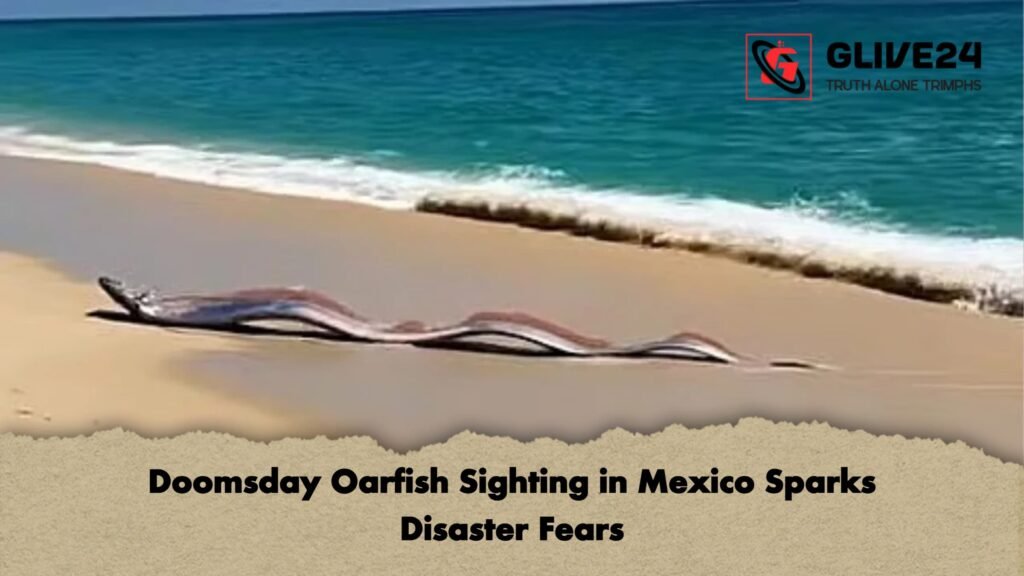
The pristine shores of Cabo San Lucas, Mexico, recently became the stage for an encounter that felt more like a scene from a high-stakes science fiction thriller than a beach holiday. Two American tourists, Monica Pittenger and her sister Katie, stumbled upon a pair of rare, colossal oarfish—creatures so steeped in ancient mythology that their appearance is widely regarded as a harbinger of imminent natural catastrophe.
Table of Contents
Messengers from the Sea God’s Palace
In Japanese folklore, the oarfish is known as Ryugu no Tsukai, or the “Messenger from the Sea God’s Palace.” According to centuries-old legend dating back to the 1600s, these “Doomsday fish” only rise to the surface and beach themselves to warn of massive underwater disturbances, specifically powerful earthquakes and tsunamis.
While modern science remains sceptical, history provides chilling coincidences. Most notably, in the months leading up to the devastating 9.1-magnitude Tohoku earthquake and tsunami in Japan in 2011—which claimed nearly 20,000 lives—approximately two dozen oarfish were found washed up along the Japanese coastline. Similar sightings were reported shortly before significant seismic events in the Philippines in 2017.
A Rare Glimpse into the ‘Twilight Zone’
Oarfish typically inhabit the “Twilight Zone” of the ocean, living at depths exceeding 3,000 feet. Because they dwell in such extreme environments, seeing a single specimen is a once-in-a-lifetime event; witnessing two simultaneously is bordering on the miraculous. A 2018 study noted that along the California coast, this elusive species had been documented only 19 times in an entire century.
The specimens discovered by the Pittenger sisters were estimated to be nearly 30 feet in length. “They looked like giant silver ribbons gasping on the sand,” Monica Pittenger recounted. Despite the ominous reputation of the fish, Katie and a group of five other bystanders spent hours battling the surf to guide the distressed, 600-pound creatures back into deeper waters.
Physical and Mythological Profile of the Oarfish
| Feature | Specification |
| Maximum Length | Up to 36 feet (11 metres) |
| Maximum Weight | Approximately 600 lbs (270 kg) |
| Habitat Depth | 600 to 3,300 feet (The Mesopelagic Zone) |
| Visual Appearance | Scaleless, silver-skinned, with a prominent red dorsal crest |
| Diet | Plankton, small fish, and squid |
| Folklore Name | Ryugu no Tsukai (Messenger from the Palace) |
Science vs. Superstition
Marine biologists suggest that oarfish likely wash ashore due to illness, injury, or strong currents rather than tectonic shifts. Some researchers hypothesise that deep-sea dwellers may be sensitive to electromagnetic changes or gas releases preceding an earthquake, but peer-reviewed evidence remains elusive.
Regardless of the scientific verdict, the Cabo San Lucas sighting has reignited a global conversation about the mysteries of the deep. For the tourists who helped the “messengers” return to the abyss, the experience was a profound reminder of the ocean’s hidden wonders—and its potential warnings.