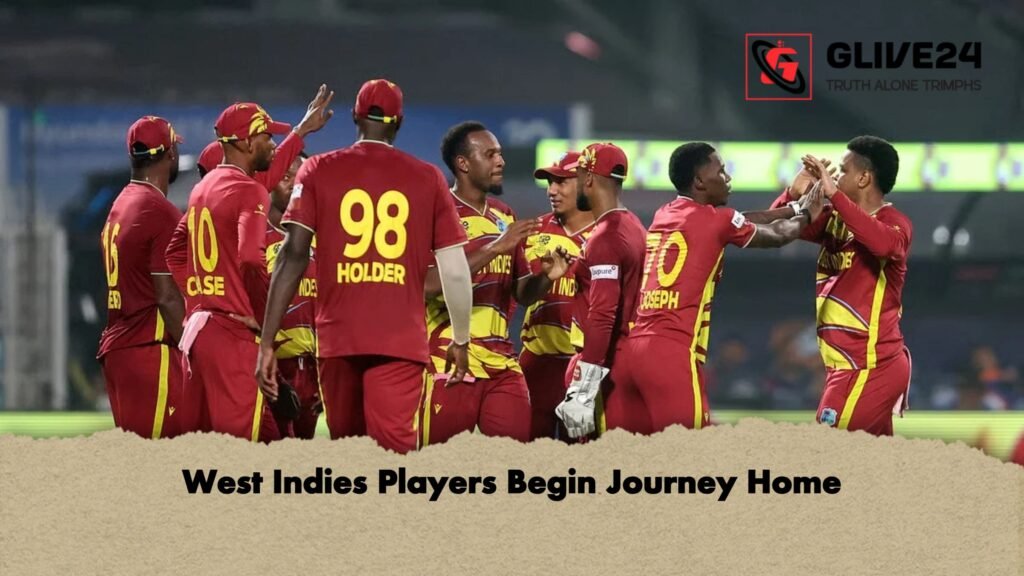
Members of the West Indies cricket team have finally begun their long-awaited journey home after being stranded in India for more than a week following the conclusion of the ICC Men’s T20 World Cup. Although the squad had initially planned to return shortly after their elimination from the tournament, unexpected disruptions in global air travel left players and officials unable to depart as scheduled. The situation arose largely due to instability in international aviation routes linked to ongoing military tensions in the Middle East.
The Caribbean side was knocked out of the tournament on 1 March after suffering defeat to India in the Super Eight stage. Ordinarily, teams departing from major international tournaments arrange their return flights well in advance, enabling them to leave the host country within a short period after elimination. However, this year’s circumstances proved unusually complicated.
Security restrictions imposed across parts of Middle Eastern airspace led to the cancellation and rerouting of numerous international flights. Several major transit hubs in the Gulf region—such as Dubai, Doha and Abu Dhabi—serve as key connection points for long-haul travel between Asia, Europe, Africa and the Caribbean. When airspace limitations disrupted these routes, airlines were forced to suspend or significantly alter many scheduled services. As a result, the West Indies team’s travel plans were thrown into disarray.
In response, Cricket West Indies (CWI) and the International Cricket Council (ICC) initially attempted to organise a charter flight to transport the team out of India. According to the proposed plan, the squad would travel from Kolkata to Johannesburg in South Africa, from where players could connect to various destinations across the Caribbean. However, the charter arrangement ultimately proved unfeasible due to complex aviation clearance procedures and restrictions affecting international flight corridors.
With the charter option abandoned, authorities arranged for players and team officials to return gradually on commercial flights. Several members of the squad have already departed India, while others are expected to follow in stages as seats become available on suitable routes.
The prolonged delay caused considerable frustration within the team. Head coach Darren Sammy publicly voiced his concerns on social media, urging relevant authorities to find a swift solution. Some players also expressed disappointment at being separated from their families longer than expected after an already demanding international campaign.
Sports analysts note that the episode illustrates how global geopolitical tensions can directly affect international sporting events. In modern professional sport, teams depend heavily on complex global transport networks. Any disruption—whether caused by security concerns, political conflict or airspace closures—can significantly hinder the movement of athletes and officials.
The key timeline of the events is outlined below:
| Event | Date/Time | Description |
|---|---|---|
| Super Eight defeat | 1 March 2026 | West Indies eliminated after losing to India |
| Travel disruption begins | Early March | Middle Eastern airspace restrictions and flight cancellations |
| Charter flight proposal | Several days later | ICC and CWI attempt to arrange a special flight |
| Charter plan abandoned | Shortly after | Aviation clearance issues prevent approval |
| Alternative arrangements | Following days | Players allocated seats on various commercial flights |
| Departure begins | More than a week later | Team members start leaving India in stages |
Overall, the incident underscores that international sporting events are influenced by far more than the action on the field. Global politics, security considerations and the reliability of international transport systems all play crucial roles in ensuring smooth tournament operations. While the West Indies players are finally making their way home, the experience has highlighted the importance of contingency travel planning for future global competitions.