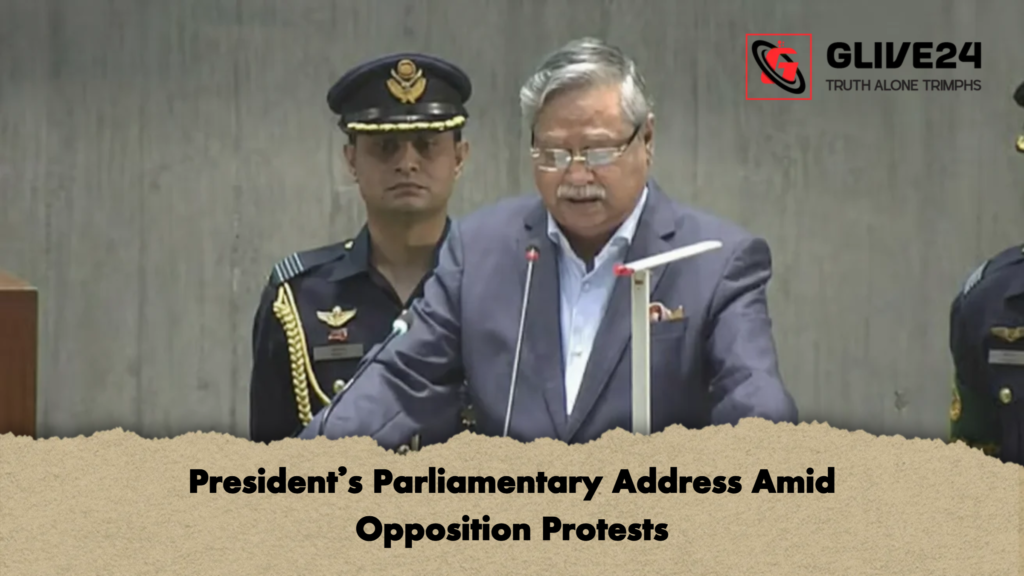
Today, in the midst of a tense parliamentary session, Speaker Hafiz Uddin formally invited President Md. Sahabuddin to deliver his address to the legislature. From the very outset, members of the opposition party, Jamaat, expressed their dissent vocally. Several MPs held placards reading slogans such as “No Betrayal over July” and “Stop Treachery Linked to July,” signalling their strong disapproval of the proceedings. The Speaker appealed for calm, urging members to maintain decorum.
President Sahabuddin entered the parliamentary chamber and took his seat beside the Speaker. Almost immediately, opposition members erupted in protest, creating a commotion that disrupted the session. The Prime Minister and several members of the ruling party, the BNP, responded by tapping on tables, while opposition MPs staged a walkout to voice their objections.
During his address, President Sahabuddin reflected on the country’s historical trajectory, noting that the fascist regime was toppled through a people’s uprising. He highlighted the events of the July Uprising and paid tribute to the martyrs, emphasising the interim government’s initiatives following the movement. Furthermore, he outlined various welfare-oriented measures currently being implemented by the government to benefit the citizenry.
The President also discussed the nation’s present circumstances, including economic conditions, foreign policy, and ongoing conflicts in the Middle East. He provided insights into inflation trends, foreign currency reserves, and potential initiatives for the advancement of the agricultural sector. His speech underscored both the challenges and the opportunities facing the country in the present global and domestic landscape.
The table below summarises the key points of President Sahabuddin’s address:
| Topic | Details |
|---|---|
| People’s Uprising | Overthrow of fascist government; July Uprising and commemoration of martyrs |
| Interim Government | Formation and activities post-July Uprising |
| Current Government | Welfare initiatives and administrative measures |
| Economy | Inflation, foreign currency reserves, agricultural development, public welfare programmes |
| International Affairs | Impact of Middle East conflict; diplomatic positioning of the country |
| Parliamentary Commotion | Opposition protests, walkouts, and table-tapping incidents |
Concluding his address, President Sahabuddin emphasised that, in accordance with the Constitution, he was presenting an overview of government achievements alongside the country’s current challenges. Despite the political turbulence in the chamber, his speech projected cautious optimism regarding social and economic progress. Parliamentary members listened attentively to the substantive points, although the opposition’s disruptive actions intensified the session’s overall tension.
The address reinforced the President’s commitment to providing clear guidance on the nation’s recent history, political transitions, and economic prospects, while underscoring the importance of future planning and welfare-oriented initiatives.