
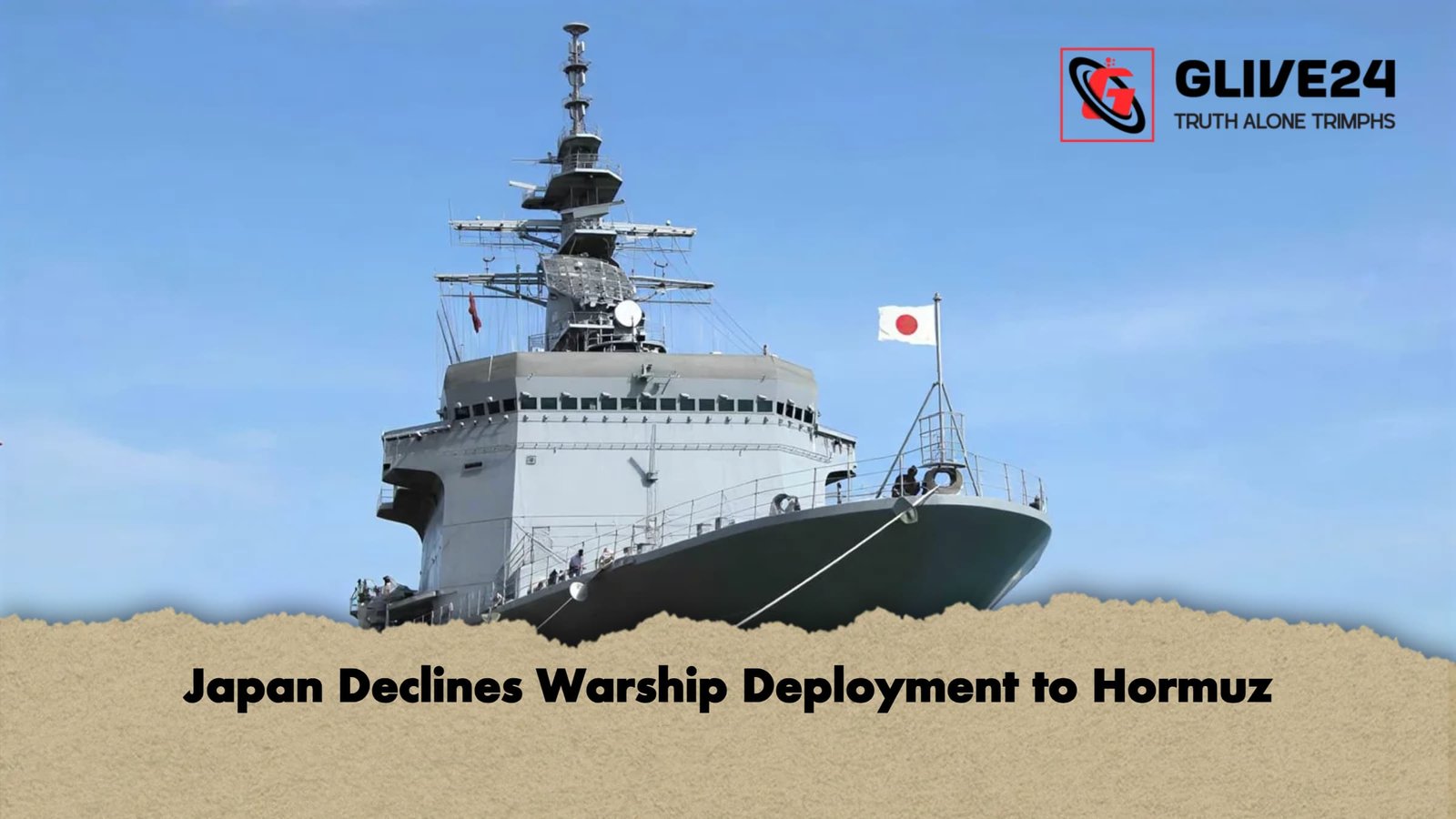
Japan has indicated that it is reluctant to send naval warships to the strategically vital Strait of Hormuz to protect oil tankers, citing legal and constitutional constraints that make such a deployment highly complex. The announcement reflects Tokyo’s cautious approach to military involvement abroad, even amid calls from the United States for allied nations to play a greater role in safeguarding shipping routes in the Middle East.
Takayuki Kobayashi, policy chief of Japan’s ruling Liberal Democratic Party, acknowledged that existing legal barriers pose one of the most significant challenges to deploying naval forces in the region. Speaking in an interview with Japan’s public broadcaster NHK, Kobayashi said that dispatching naval vessels to the Strait of Hormuz under current circumstances would be extremely difficult for Japan.
The response follows remarks by former United States President Donald Trump urging countries that rely heavily on Middle Eastern oil, including Japan, to take responsibility for protecting their own tankers. Washington has repeatedly emphasised the need for greater international cooperation to ensure the security of maritime routes through the Gulf region, which have occasionally been threatened by geopolitical tensions and incidents involving commercial vessels.
However, Kobayashi stressed that Japanese law imposes strict conditions on overseas military operations. Although the possibility of sending naval vessels cannot be entirely ruled out under certain circumstances, he noted that the standards and procedures required for such a deployment are particularly rigorous. As a result, any decision would require careful legal scrutiny and political consensus.
Japan’s cautious stance is largely shaped by its post-war constitution, particularly Article Nine, which renounces war and limits the country’s ability to engage in military activities overseas. While Japan maintains a modern and technologically advanced maritime self-defence force, its mandate is primarily defensive. Deploying warships to a region experiencing heightened tensions could therefore raise both legal and political challenges.
The Strait of Hormuz itself is regarded as one of the world’s most critical maritime chokepoints for energy transportation. A significant share of globally traded crude oil passes through this narrow waterway connecting the Persian Gulf with the Gulf of Oman and the wider Indian Ocean. Any disruption in the area can have immediate consequences for global energy markets and international trade.
The importance of the strait is illustrated by several key indicators:
| Key Aspect | Details |
|---|---|
| Geographic Location | Connects the Persian Gulf with the Gulf of Oman |
| Strategic Importance | One of the world’s most critical oil transit chokepoints |
| Approximate Width | Around 33 kilometres at its narrowest point |
| Major Oil Importers Dependent on Route | Japan, China, South Korea, and other Asian economies |
| Share of Global Oil Transit | A substantial proportion of seaborne oil shipments |
Japan relies heavily on imported energy resources, with a significant portion of its crude oil supplies originating in the Middle East and transported through the Strait of Hormuz. Consequently, maintaining stability and secure shipping routes in the region remains a vital national interest.
Despite this dependence, Tokyo has traditionally preferred diplomatic engagement and multilateral cooperation over direct military involvement in overseas conflicts. Analysts note that Japan often seeks to balance its alliance with the United States against domestic legal limitations and public opinion, which tends to favour a restrained security policy.
For now, Japan appears determined to maintain a cautious diplomatic posture. While acknowledging the strategic importance of the Strait of Hormuz and the concerns raised by its allies, Tokyo is signalling that any decision involving military deployment must comply strictly with its legal framework and longstanding commitment to a defensive security policy.