
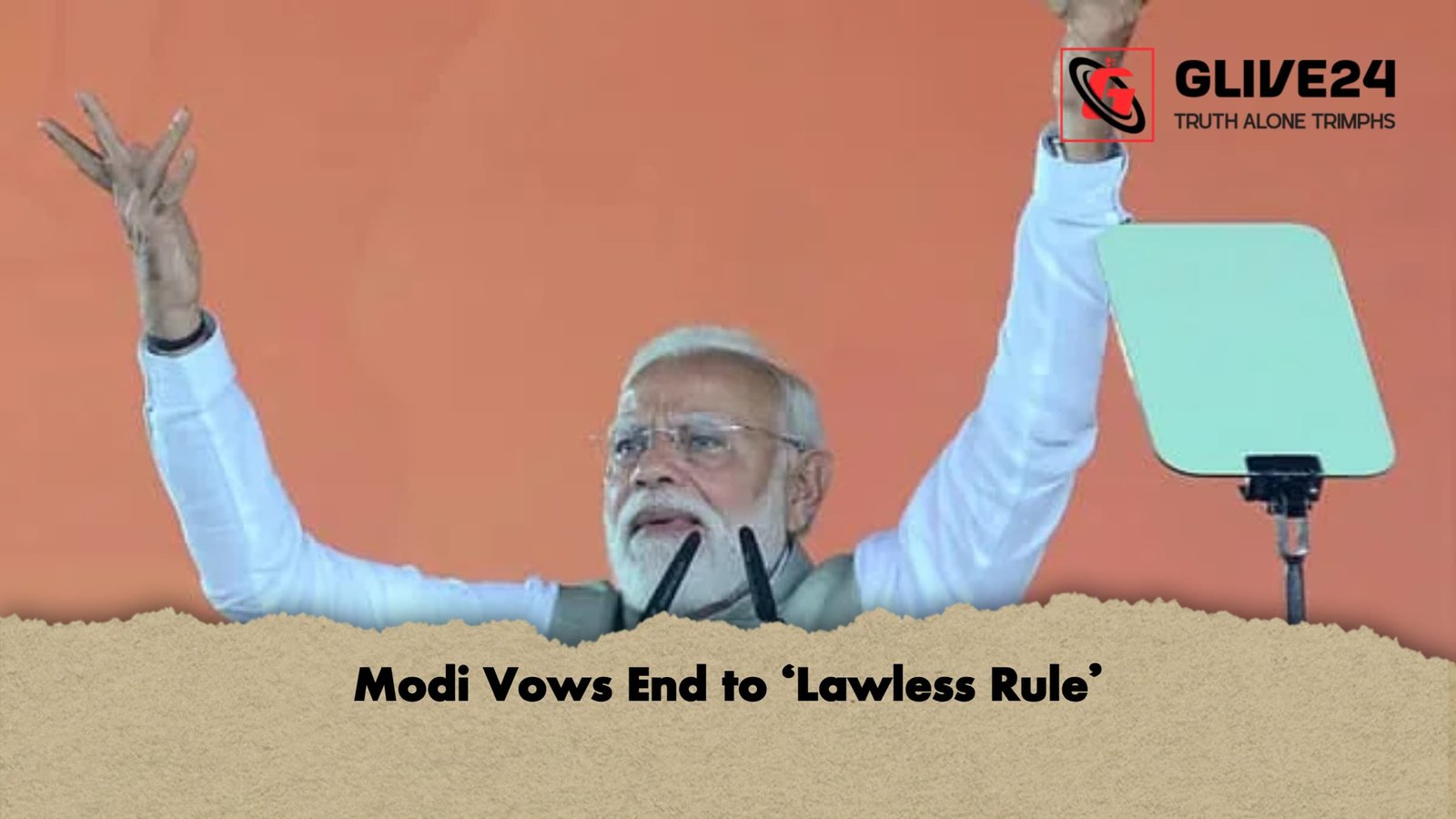
India’s Prime Minister Narendra Modi has declared that what he described as “lawless rule” in the eastern state of West Bengal would come to an end, asserting that the countdown to the fall of the state’s current administration has already begun. Speaking at a massive political rally in Kolkata, Modi said voters would deliver a decisive verdict against the ruling party in the forthcoming state legislative assembly election.
The rally was held on Saturday afternoon at the historic Brigade Parade Ground in Kolkata, a venue long associated with major political gatherings. The event drew large crowds and marked the culmination of a statewide political mobilisation campaign organised by Modi’s party ahead of the anticipated assembly elections. The election schedule for West Bengal is widely expected to be announced in April, and political parties have already begun preparing intensively.
Addressing supporters, Modi accused the state’s governing leadership of corruption, mismanagement and abuse of power. He argued that the people of West Bengal were ready for political change and would use the ballot box to remove the current administration. According to the prime minister, a new government led by his party would prioritise governance reforms, economic development and social welfare.
Modi promised that a future administration under his party would focus on ensuring food security, employment opportunities and basic necessities for the state’s population. He also pledged expanded housing support for low-income families and greater access to public welfare programmes.
During his speech, Modi also criticised the state government for allegedly obstructing or misrepresenting several national welfare initiatives. He claimed that certain central government schemes had not been implemented effectively in West Bengal and that some programmes were being presented as state initiatives rather than national ones. Among the programmes he referenced were public health initiatives and welfare support designed for tea plantation workers and other economically vulnerable communities.
The prime minister further alleged irregularities in recruitment for government jobs and accused the state administration of allowing corruption to influence the delivery of development programmes in rural areas. According to him, the removal of the current government would lead to improved governance, transparency and accountability in public administration.
On the same day, Modi announced the launch of multiple development projects in the state with a combined investment of approximately 188.6 billion rupees. These projects are expected to focus on infrastructure expansion, including improvements in transport networks, public utilities and regional development initiatives aimed at strengthening economic growth.
However, the day’s political activities were not without tension. Clashes were reported near the Girish Park area of Kolkata when supporters of rival political groups confronted each other as rally participants travelled toward the venue. According to reports, both sides allegedly threw stones during the confrontation before security forces intervened to restore order.
Modi also criticised what he described as disrespect shown toward the President of India, Droupadi Murmu. He said the matter had deeply offended many citizens, particularly members of indigenous communities, and warned that voters would remember the incident.
The rally also marked the conclusion of a political outreach campaign launched earlier in March. The campaign began simultaneously from nine locations across West Bengal and concluded in Kolkata after several days of rallies and processions across the state.
West Bengal has witnessed intense political competition in recent years, with the ruling party and Modi’s party emerging as the principal rivals. Electoral data from recent elections illustrate how the balance of power has evolved over the past decade.
| Election Year | Election Type | Total Seats | Ruling Party Seats | BJP Seats | Other Parties |
|---|---|---|---|---|---|
| 2016 | State Assembly | 294 | 211 | 3 | Left Front 32, Congress 44 |
| 2021 | State Assembly | 294 | 213 | 77 | Others small numbers |
| 2019 | National Parliament | 42 | 22 | 18 | Others 2 |
| 2024 | National Parliament | 42 | 29 | 12 | Others 1 |
Political analysts note that although the ruling party retained a commanding majority in the 2021 state election, the rapid rise of the opposition in recent years has significantly intensified the political contest in West Bengal. As preparations for the next assembly election accelerate, both sides are expected to step up their campaigning across the state.
The upcoming election is therefore likely to become one of the most closely watched political contests in India, with national implications as well as regional significance.