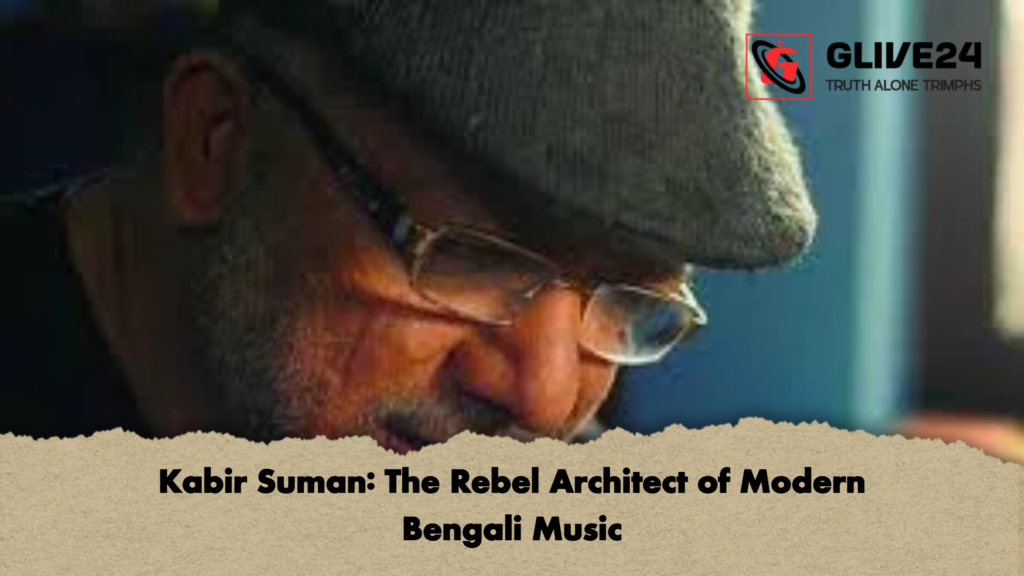
In the musical landscape of Bengal, certain individuals arrive not merely to create songs but to reshape the very language, thought, and cultural horizon of their era. Kabir Suman stands as one such rare artist—a true revolutionary.
In the early 1990s, Bengali music had become entrenched in repetitive formulas. Songs largely revolved around the familiar cycles of love and heartbreak, bound by traditional melodies and predictable arrangements. Suman, however, arrived like a storm, injecting fresh life into a stagnant scene. He dared to challenge the conventional harmony of the harmonium and the cosy confines of drawing-room performances, introducing a new, pulsating lifeblood into Bengali music. On his birthday today, we commemorate not just a singer but a visionary who single-handedly transformed the musical horizon.
The release of his 1992 album Tomake Chai marked a watershed moment in modern Bengali music. Until then, the contemporary scene had been dominated by two streams: Rabindra Sangeet and Nazrul Geeti on one hand, and film-inspired modern songs on the other. Suman demonstrated that music could transcend conventional themes of love and separation. His compositions captured urban life in its raw immediacy—the bustling streets, crowded buses, footpaths teeming with people, political rallies, and the solitude of the individual.
Suman’s music reflected the language of the city. Elements such as telephones, tramlines, coffee houses, small towns, and political unrest became integral to his songs—subjects rarely explored in Bengali music before. Accompanied by guitar and keyboard, he developed a personal, almost conversational singing style, offering Bengali audiences an entirely new experience.
| Year | Album / Contribution | Significance |
|---|---|---|
| 1992 | Tomake Chai | Introduced urban realism into Bengali music |
| 1993 | Ei Besh Bhalo Achhi | Expanded narrative songwriting and social commentary |
| 1995 | Ekak Ei Bondhura | Popularised solo live performance culture |
| 1997–2000 | Journalism | Worked with Voice of America and Deutsche Welle, enriching his global perspective |
| 2000s onward | Multi-instrumental mastery | Excelled in guitar, piano, flute, and digital music production |
Suman’s impact extends beyond music. He is a multidimensional cultural figure whose journalism experience—spanning international media such as Voice of America and Deutsche Welle—enriched his understanding of global politics, society, and culture. His essays, memoirs, and political analyses exhibit the same sharp intellect and social consciousness evident in his songs.
Perhaps most notably, Suman popularised solo performances where a single artist stands on stage with a guitar or keyboard, blending music, storytelling, and commentary into a unique artistic universe. Today, many young musicians follow the path he pioneered.
Equally important is his unwavering political and humanitarian stance. Suman has consistently opposed religious, racial, and social divisions. His songs speak of humanity, and his personal life reflects the same principles. In the post-Nazrul era, Bengal required a bold, secular voice—many agree that Kabir Suman partially filled this void. His music serves both as protest and as a celebration of humanism.
Throughout his career, Suman has evolved with the times, embracing modern technology, digital recording, and experimentation with classical and contemporary forms. His relentless creative curiosity has kept his work perpetually fresh. Controversy has often accompanied his revolutionary approach—political stances, personal decisions, and outspoken lyrics have invited criticism. Yet, his songs continue to resonate deeply whenever love, civic pride, or social protest seeks expression.
Songs such as Halo Chhero Na Bondhu, Jatismriti, and Tomake Chai are no longer mere melodies—they are the emotional archive, memory, and history of Bengal. Kabir Suman has taught us that music is not merely sound; it is poetry, protest, self-expression, and the chronicle of an era.
On his birthday, we extend our gratitude as well as our greetings—to the artist who taught Bengali music to think and feel anew. Long may he live, stay healthy, and continue to show us the courage to live life on our own terms.
Happy Birthday, Kabir Suman. A salute to the man who gave Bengali ears a new language of sound.