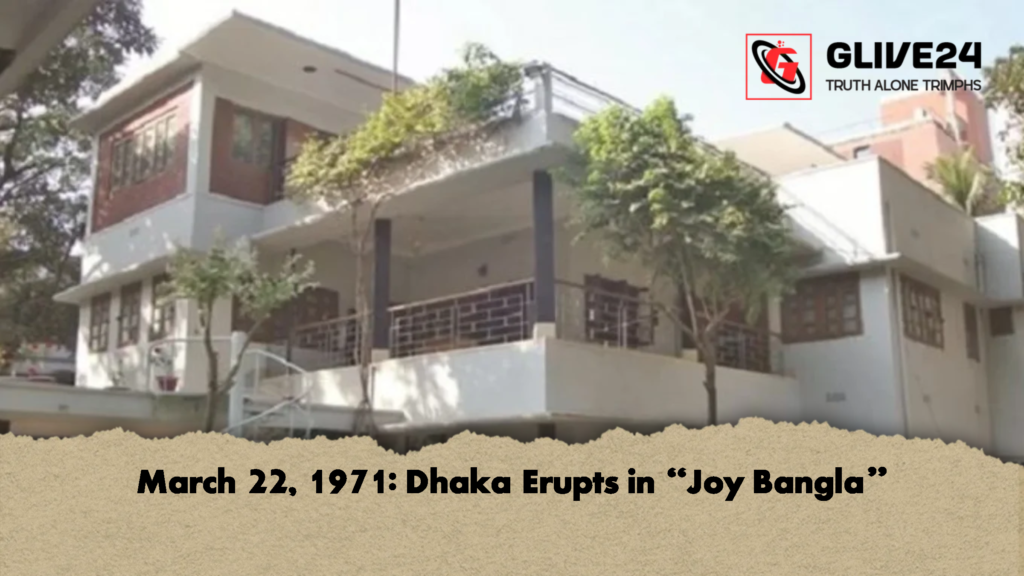
On 22 March 1971, Dhaka witnessed an unprecedented outpouring of political fervour, as the streets surrounding Dhanmondi 32 vibrated with the historic cry of “Joy Bangla.” Tens of thousands of demonstrators converged to demand Bengali rights and self-determination, transforming the capital into a theatre of mass mobilisation. Sheikh Mujibur Rahman, addressing the crowd multiple times from his residence, delivered impassioned speeches that resonated amid deafening slogans and thunderous applause.
In one address, Sheikh Mujibur declared, “When seven crore Bengalis are united, I will undoubtedly achieve our demands.” In another, he proclaimed, “I have endured oppression for 23 years, and I will no longer accept it. The blood of our martyrs will not go in vain. If necessary, I will shed more blood, but this time, Bengal’s demand will be realised.” Newspapers the following day emphasised the scale of the demonstration, noting that never before had such a vast procession reached Dhanmondi 32 in a single day.
Key Events of 22 March 1971
| Time | Event | Key Figures | Outcome / Significance |
|---|---|---|---|
| Morning | Mass gathering and speeches at Dhanmondi 32 | Sheikh Mujibur Rahman | Mobilised public support; galvanised unity among citizens |
| Midday | Historic meeting at Presidential Palace | Sheikh Mujibur Rahman, Zulfikar Ali Bhutto | Discussed political reconciliation; reaffirmed ongoing movement |
| Afternoon | Bhutto convenes advisers at hotel | Zulfikar Ali Bhutto | Public protest outside hotel; demonstrated popular pressure |
| Evening | PPP leaders meet President Yahya Khan | Sheikh Mujibur Rahman, PPP leaders | Political consensus on negotiation framework, contingent on party approval |
| Throughout Day | Parades and assemblies at Baitul Mokarram | Ex-Bengali soldiers, activists | Symbolic display of military and civilian unity; pledge for independence |
Responding to the mounting public pressure, Pakistan’s President Yahya Khan postponed the National Assembly session scheduled for 25 March, citing the need to foster consensus between political parties from both wings of Pakistan. Meanwhile, at Baitul Mokarram, former Bengali soldiers participated in parades and assemblies under Sheikh Mujibur Rahman’s leadership, pledging solidarity in the pursuit of national independence.
The day was further amplified by the publication of special newspaper bulletins under the headline “Banglar Swadhikar” (“Bengal’s Rights”), featuring Sheikh Mujibur’s statements alongside essays by prominent intellectuals, including Professors Mozzaffar Ahmad Chowdhury and Rehman Sobhan. Cultural activists, including theatre movement leader Ramendu Majumdar, played a pivotal role in mobilising public engagement and disseminating information, ensuring the momentum of the liberation movement reached every corner of Dhaka.
The events of 22 March 1971 stand as a decisive chapter in Bangladesh’s struggle for independence, demonstrating both the extraordinary unity of its people and the resolute leadership of Sheikh Mujibur Rahman in the face of imminent political upheaval. The day’s demonstrations, speeches, and civic mobilisation set the stage for the subsequent historic events that would ultimately lead to the birth of Bangladesh.