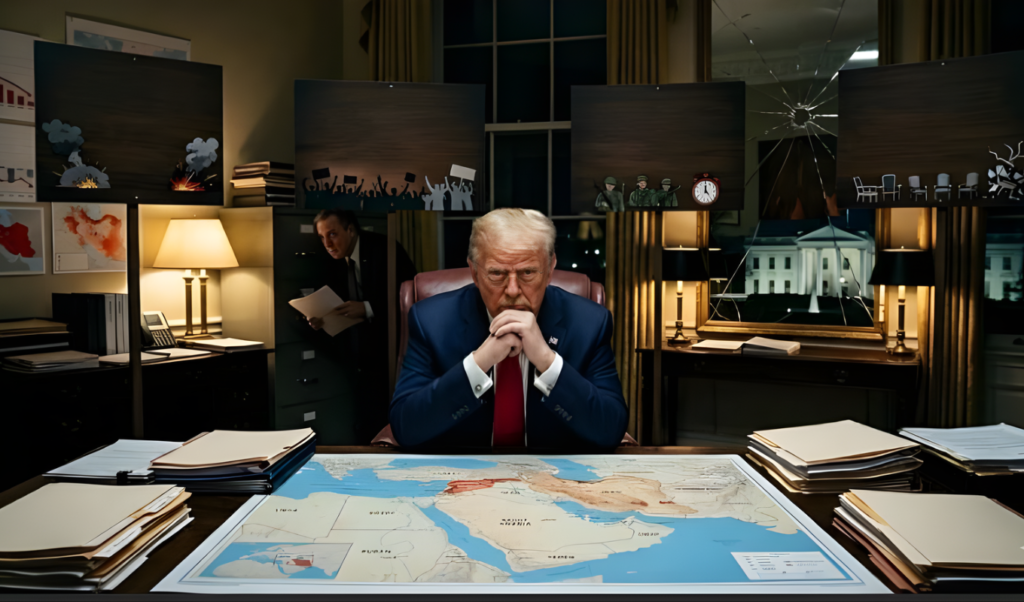
U.S. former President Donald Trump faces mounting uncertainty in managing the ongoing conflict with Iran, a situation the British magazine The Economist has compared to Florida’s notoriously unpredictable weather. The crisis escalated sharply last week: on Friday, 20 March, Trump suggested that military objectives could swiftly end hostilities, only to issue a 48-hour ultimatum the following day demanding that Iran reopen the strategic Strait of Hormuz—threatening strikes on Iran’s power infrastructure if ignored.
As the confrontation enters its fourth week, Trump confronts four primary strategic options, each fraught with risk and none guaranteeing a decisive or lasting resolution.
1. Pursue Diplomatic Negotiation
Diplomatic engagement remains the least destructive path but is widely considered almost impossible under current circumstances. Deep mutual distrust between the United States and Iran, coupled with directly opposing demands, presents formidable obstacles: the U.S. seeks a halt to Iran’s missile programmes and militia support, while Iran insists on reparations for wartime damages and the removal of all U.S. military bases from the Middle East.
2. Declare Victory Unilaterally
Trump could attempt to end the conflict by declaring victory, claiming that Iran’s naval and missile capabilities have been neutralised. While politically appealing domestically, such a declaration risks appearing hollow internationally if Iran continues to block the Strait of Hormuz or strike U.S. and Israeli targets, potentially undermining U.S. credibility and strategic influence.
3. Maintain the Status Quo
Continuing airstrikes at the current intensity represents a third option. Proponents argue sustained pressure might destabilise Tehran’s government. Yet there is significant risk that Iran will adopt prolonged asymmetric warfare tactics, targeting shipping lanes and infrastructure, thereby disrupting global energy supplies and straining U.S. and Israeli defence systems without guaranteeing regime change.
4. Escalate the Conflict Intensely
The most extreme option involves full-scale escalation, including strikes on Iran’s power plants, seizing Kharg Island, and confiscating enriched uranium—measures proposed by U.S. Treasury Secretary Scott Bessent. Analysts warn this could trigger catastrophic regional consequences. Iran has already threatened retaliatory attacks on neighbouring countries’ power and water infrastructure. The 18 March missile strike on Qatar’s LNG plant, which temporarily jeopardised nearly 3% of global LNG supply, underscores the risk of widespread economic disruption if critical facilities are targeted.
The Economist observes that while initiating military action may be relatively straightforward, concluding the conflict honourably and safely represents Trump’s most formidable challenge. No current strategy offers stability or lasting peace, leaving both the Middle East and global markets highly vulnerable.
Trump’s Iran Conflict: Strategic Options Overview
| Option | Description | Potential Risk |
|---|---|---|
| Diplomatic Negotiation | Engage in talks with Iran | Low likelihood of success due to mutual distrust and conflicting demands |
| Declare Victory | Unilateral end of hostilities | May be perceived as hollow; Iran could continue attacks |
| Maintain Status Quo | Continue airstrikes at current intensity | Prolonged conflict, asymmetric attacks, economic disruption |
| Escalate Conflict | Intensify military operations (power plants, Kharg Island, uranium) | Regional catastrophe, retaliatory strikes, energy supply shocks |
The unfolding scenario demonstrates that military action alone cannot ensure peace. Trump’s strategy must balance immediate tactical objectives against long-term geopolitical stability, with global energy security and regional safety hanging in the balance.
Source: The Economist