
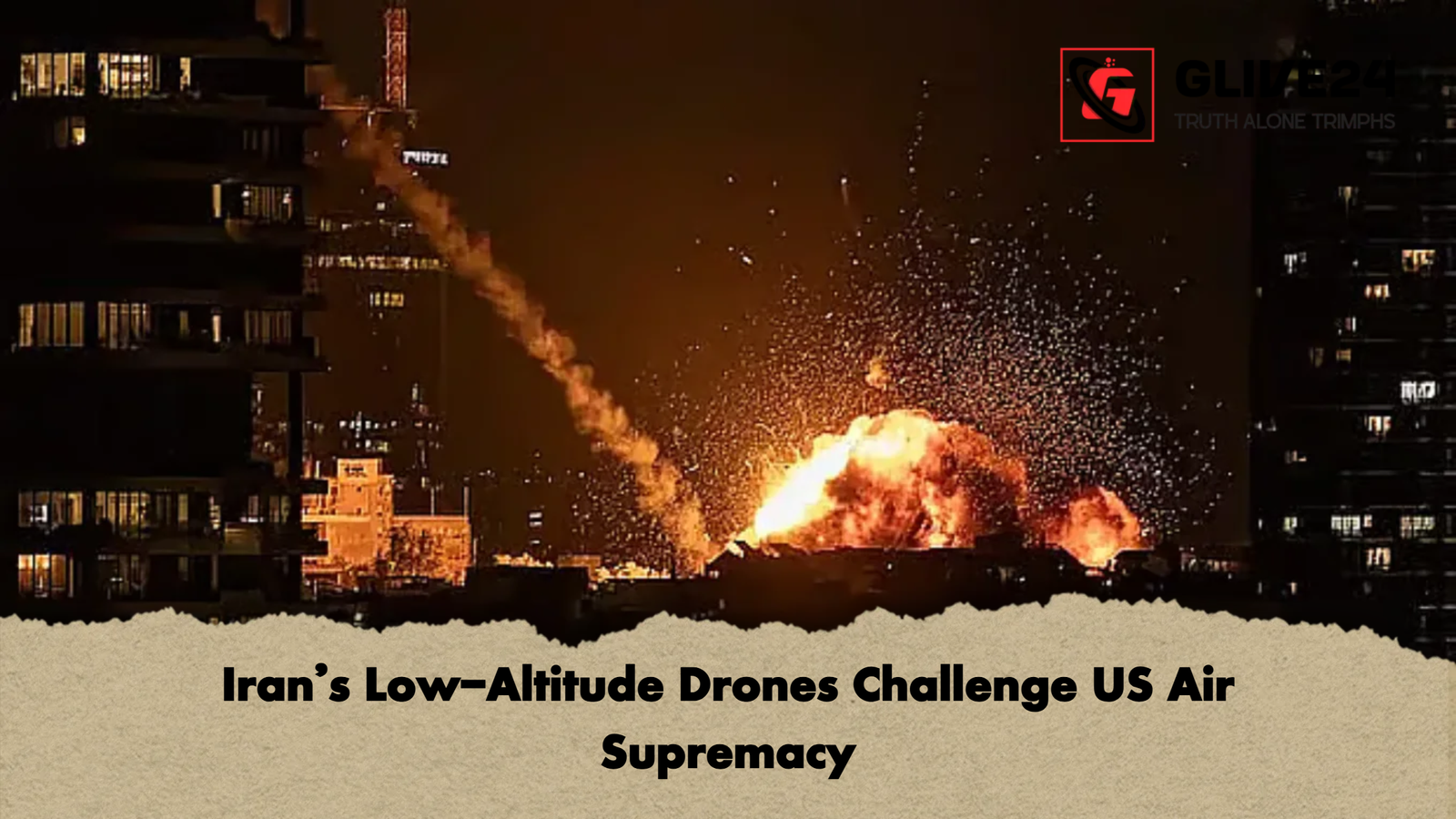
US forces are struggling to maintain air dominance over Iranian territory, as military experts highlight the challenges posed by low-altitude threats. During a virtual panel hosted by the Middle East Institute on Tuesday, specialists explained that Washington’s limited investment in countering these threats has allowed Iran to exploit this vulnerability effectively.
Kelly Grieco, senior fellow at the Stimson Center’s “Reimagining US Grand Strategy” programme, noted, “The peculiar aspect of this conflict is that the United States and Israel are succeeding where success was expected—primarily in high-altitude operations against Iran’s integrated air and missile defence systems. But in the low-altitude domain, their performance falters.”
Grieco emphasised that Iran relies on highly mobile, low-cost systems capable of disrupting US air control in strategically significant areas. “This is where the US has underinvested and underestimated the challenge,” she added. Just hours after this discussion, US President Donald Trump asserted that Iran had lost much of its capability since the conflict began on 28 February. Trump stated, “We now operate freely in Tehran’s airspace,” challenging journalists to identify any remaining Iranian capabilities.
Destructive versus Disruptive Warfare
Unlike the US and Israel, which focus on what Grieco calls “destructive warfare”—targeting launchers, missiles, and drone stockpiles—Iran has adopted a strategy of “disruptive warfare.” By deploying Shahid drones at low altitudes, Tehran imposes widespread disruption on Gulf states, inflicting logistical and economic costs far exceeding the drones’ minimal production expense.
The table below summarises regional air-defence capacities against these low-altitude threats:
| Country/Technology | Defence System Used | Coverage | Limitations | Cost Impact |
|---|---|---|---|---|
| United States | Patriot, THAAD | Medium & High Alt. | Poor low-altitude drone detection | Very High |
| Russia | S-300 | Medium & High Alt. | Not interoperable with Patriot systems | High |
| Gulf States | Anti-missile and anti-drone units | Low & Medium Alt. | Limited interceptor stockpiles | Medium-High |
| Iran | Shahid drones, mobile systems | Low Altitude | Limited destructive power, reusable | Low |
Grieco highlighted that Gulf states primarily invested in ballistic missile defences, leaving them less prepared for low-flying Iranian drones, which require specialised radar and sensor systems. Consequently, intercepting a single drone often consumes multiple high-cost interceptors, including Patriot missiles or Russia’s S-300 systems.
Michael O’Hanlon, director of Defence and Strategy at the Brookings Institution, stressed the urgent need to replenish depleted air-defence inventories, estimating that restoring US stocks of interceptors could cost up to $75 billion. He also underscored the potential of laser-based systems for drone defence, though weather conditions can limit their effectiveness.
Grieco concluded that Iran’s long-term strategy is to sustain a protracted, costly campaign. Its strength lies not in the size of daily attacks, but in the ability to persist, gradually increasing economic and operational pressure.
Meanwhile, US Defence Secretary Pete Hegseth offered a contrasting assessment, claiming that Iran’s modern military—including its air force and navy—was swiftly neutralised, asserting that US and Israeli operations “will be recorded in history.”
This analysis highlights a growing strategic gap in low-altitude air-defence capabilities, suggesting that even technologically superior forces face challenges against asymmetric, low-cost aerial threats.