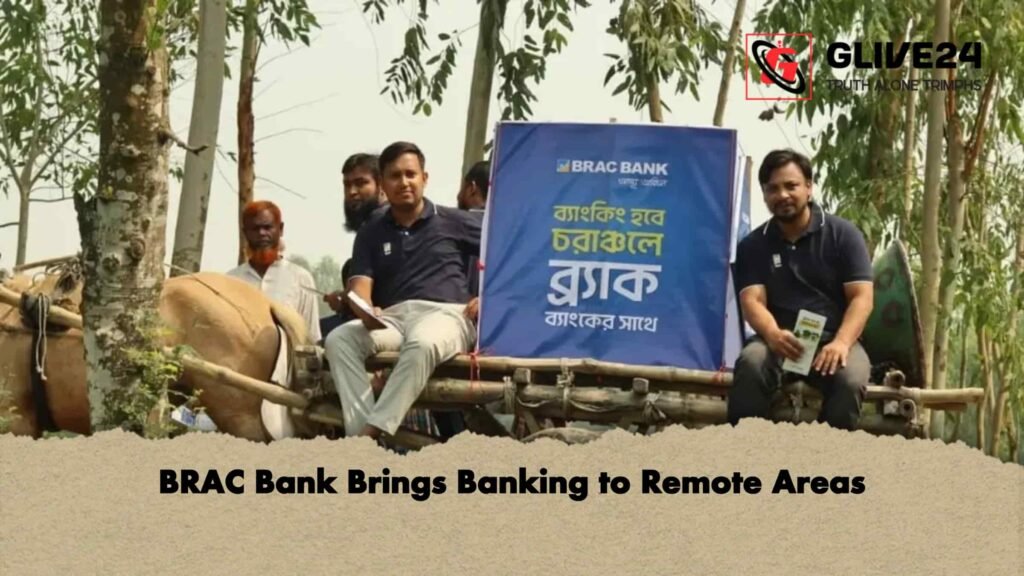
Banking in Bangladesh has undergone a significant transformation, evolving from an urban-centred service into one that now reaches some of the country’s most remote and challenging regions. Where banking was once associated with paved city streets, tall buildings, and formal branches, financial services are now accessible in forest settlements, river islands, isolated hill tracts, and vulnerable coastal areas.
This shift has been driven largely by BRAC Bank’s agent banking initiative, which enables financial services to be delivered through authorised local representatives. These agents operate from small, community-based outlets, often located along rural roads, yet they provide essential banking services to people who previously had little or no access to formal financial institutions.
Bangladesh’s diverse geography has long posed obstacles to traditional banking expansion. River erosion frequently displaces communities, forest regions remain sparsely populated, and many coastal and upland areas are difficult to access. Establishing conventional bank branches in such locations is both costly and complex, leaving millions of people outside the formal financial system for many years.
Through its agent banking network, BRAC Bank has effectively addressed these challenges by bringing banking services directly to local communities. Customers can now open savings and current accounts, invest in deposit schemes, send and receive remittances, access small business and personal loans, and receive government social security payments close to home.
Agent Banking Network Overview
| Region Type | Key Locations | Number of Outlets |
|---|---|---|
| Forest-adjacent areas | Shyamnagar, Paikgacha, Dacope, Fakirhat, Koyra | 17 |
| Coastal and island areas | Charfassion, Teknaf, Kutubdia, Hatiya, Subarnachar, Mongla, Kalapara | 76 |
| Hill tracts | Ramgarh, Panchhari, Manikchhari, Matiranga, Longadu, Dighinala | 11 |
| Nationwide total | Across Bangladesh | 1,120 |
In regions near the Sundarbans, such as Shyamnagar and Koyra, agent banking outlets have become an integral part of daily life. Where secure savings options were once limited, residents can now manage their finances with confidence.
The impact is equally evident in coastal and island regions such as Teknaf and Hatiya, as well as in remote hill tracts. Access to banking services has supported local commerce, reduced reliance on cash transactions, and improved financial transparency.
More than 60,000 customers have opened new accounts through this network, with many entering the formal banking system for the first time. This expansion has led to deposits exceeding 200 crore taka and loan disbursements surpassing 65 crore taka, contributing to stronger local economies.
Beyond transactions, agent banking is also improving financial awareness. Local agents act as trusted advisers, guiding customers on savings, investment, and responsible borrowing. This has helped build lasting trust between financial institutions and the communities they serve.
Supported by modern digital technology, BRAC Bank ensures that services remain both fast and secure. Biometric verification, real-time processing, and integration with centralised systems allow customers in remote areas to receive reliable services comparable to those available in urban centres.
For people living in forests, river islands, hill tracts, and coastal regions, banking is no longer a distant concept. It has become a familiar and dependable presence in everyday life. By overcoming geographical barriers, BRAC Bank’s agent banking initiative is fostering a more inclusive, resilient, and sustainable financial system across Bangladesh.