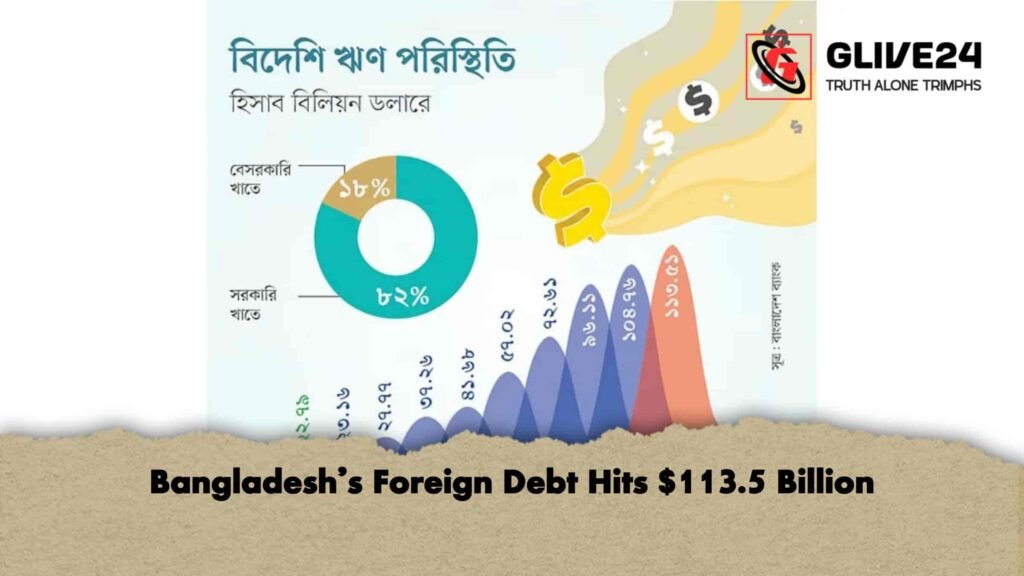
By December 2025, Bangladesh’s total foreign debt had risen to $113.51 billion, equivalent to 13,96,173 crore Bangladeshi taka. This represents an increase from $112.21 billion recorded in September 2025, although it is slightly lower than the $113.58 billion noted at the end of June 2025. Analysts point out that while foreign debt has marginally declined over the year, quarterly fluctuations reflect continuing borrowing to meet both government and private sector needs.
According to a Bangladesh Bank report, both public and private sector borrowing contributed to the rise in the October–December 2025 quarter, with most loans being long-term in nature.
Sector-wise Breakdown of Foreign Debt
The December report reveals that 82% of the country’s foreign debt is held by the public sector, with the remaining 18% accounted for by private sector enterprises. Public sector borrowing primarily funds infrastructure projects and development programmes, whereas private sector loans largely support industrial investment and trade financing.
| Sector | Total Debt (Billion USD) | Share (%) | Long-term Debt (Billion USD) | Short-term Debt (Billion USD) |
|---|---|---|---|---|
| Public | 93.46 | 82 | 80.94 | 12.52 |
| Private | 20.05 | 18 | 9.87 | 10.18 |
| Total | 113.51 | 100 | 90.81 | 22.30 |
Within the public sector, the government has borrowed $80.94 billion directly, while $12.52 billion is held by Bangladesh Bank, state-owned banks, and other public institutions. The private sector saw a notable rebound in borrowing in the last quarter of 2025, surpassing the $20 billion mark after three consecutive quarters of decline. Short-term loans in this sector total $10.18 billion, including $6.06 billion in commercial credit, while long-term private sector debt stands at $9.87 billion.
Debt Pressures and Management
Bangladesh Bank officials note that foreign borrowing has been essential to address dollar shortages, with loans sourced from the International Monetary Fund, the World Bank, and other multilateral institutions during the caretaker government. Previous government projects financed through foreign loans have yet to generate significant foreign exchange, intensifying repayment pressure. Both public and private sectors rely on remittance inflows and export revenue to service debt obligations.
In the first seven months of the 2025–26 fiscal year (July–January), Bangladesh received $26.416 billion in foreign loans and grants but repaid $26.768 billion to creditors. Over the past few years, debt repayment pressure has increased significantly, with over $4 billion repaid during the 2024–25 fiscal year alone.
The foreign exchange shortage, triggered by the Russia–Ukraine war in 2022, saw the exchange rate rise from 85 BDT to 123 BDT per USD, fueling inflation and raising the cost of living. Measures taken by the caretaker government stabilised reserves and the exchange rate, but foreign debt continues its upward trajectory, reaching $113.51 billion by the end of 2025, up from $104.76 billion in 2024.