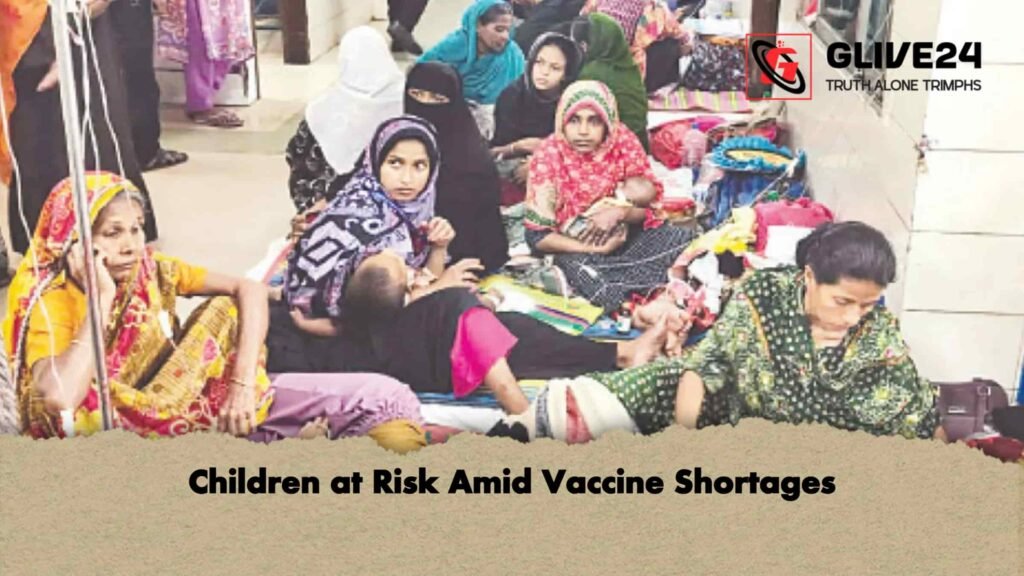
A severe measles outbreak has re-emerged across the country, with children under the age of one most affected. The resurgence is evident in the capital and several other districts, prompting widespread concern among healthcare professionals. Experts attribute the crisis to gaps in the vaccination programme, administrative inefficiencies, and limited healthcare resources.
The Expanded Programme on Immunisation (EPI) reports that nearly two crore doses of the Measles-Rubella (MR) vaccine arrived in Bangladesh in February, yet they remain largely unused. Shortages of trained personnel, essential equipment such as syringes, and funding constraints have prevented timely distribution to children nationwide.
The disruption traces back to August 2024, when political transitions caused a temporary suspension of key health programmes. Subsequently, MR vaccines were purchased using revenue funds in December 2024, sufficient to last until June 2025. After this period, vaccine supply lapsed, leaving nearly nine months during which children missed critical doses.
Many infants under 12 months remain unprotected against measles and rubella, while some 18-month-old children have not received their second MR dose. Bangladesh’s MR immunisation programme, launched in 1988, schedules the first dose at nine months and the second at fifteen months.
Dr. Mohammad Shahriar Sajjad, Deputy Director of EPI, told reporters: “Gavi, the global vaccine alliance, supplied two crore MR vaccine doses last month. However, insufficient staff, inadequate training, and a lack of logistics and funding have delayed administration. We have communicated these challenges to Gavi and hope for rapid support to resume vaccinations.”
The Ministry of Health has allocated around 600 crore taka to mitigate the current shortage. Health Minister Sardar Mohammad Sakawat Hossain Bakul highlighted a tragic incident at Rajshahi Medical College Hospital, where 33 children died over 11 days due to ventilator shortages or equipment failures.
District-wise Measles Outbreak
| District | Reported Cases | Deaths | Notes |
|---|---|---|---|
| Dhaka | High | 19 | Treated at Infectious Diseases Hospital |
| Mymensingh | 106 | 5 | Hospital admissions increasing |
| Rajshahi | 100+ | 12 | Ongoing hospital treatments |
| Pabna | Moderate | – | Rising number of cases |
| Chattogram | Moderate | – | Patients seeking hospital care |
| Jashore | Moderate | – | Outbreak ongoing |
| Natore | Moderate | – | Patients treated locally |
| Narayanganj | – | – | Patients referred to Dhaka hospital |
| Narsingdi | – | – | Patients referred to Dhaka hospital |
| Gazipur | – | – | Patients referred to Dhaka hospital |
| Bhola | – | – | Patients referred to Dhaka hospital |
| Patuakhali | – | – | Patients referred to Dhaka hospital |
Dr. Mushtaq Hossain, advisor to the Institute of Epidemiology, Disease Control and Research (IEDCR), emphasised that lapses in routine vaccination campaigns have left a large number of children vulnerable. Dense populations, malnutrition, and incomplete immunisation have accelerated the virus’s spread.
Dr. Nizam Uddin, Chairperson of Gavi’s constituency steering committee, warned: “The current outbreak disproportionately affects children who missed their scheduled vaccinations. With EPI staff shortages and supply interruptions, it is essential to strengthen the programme immediately to prevent further deaths.”