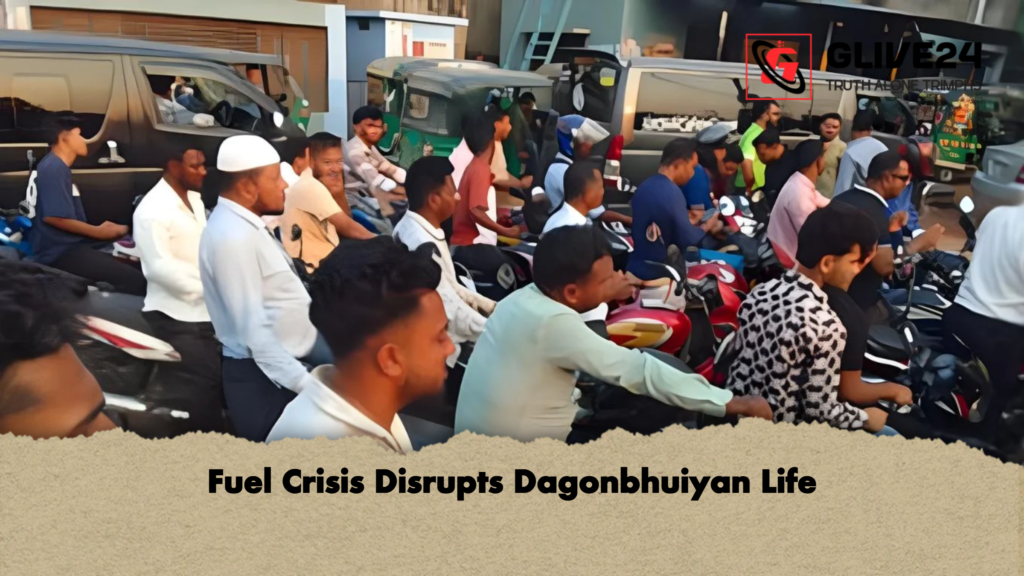
A severe shortage of petrol and octane at filling stations in Dagonbhuiyan Upazila has brought daily life and local transport services to a near standstill, causing widespread inconvenience for commuters, particularly motorbike riders and private vehicle users.
The crisis has forced several fuel stations to suspend sales entirely, while others are operating under strict rationing. As a result, long queues of vehicles are forming from early morning, with many customers waiting for hours only to return with minimal fuel or, in some cases, none at all.
On-site observations reveal multiple filling stations displaying “No Fuel Available” signs, reflecting the severity of the shortage. Where limited stock remains, operators are restricting sales to small fixed amounts, often insufficient for regular commuting needs. This has significantly disrupted routine travel, especially for workers dependent on motorcycles for their livelihoods.
Local rider Abu Naser, who works in marketing, explained that his daily requirement exceeds two litres of petrol. However, he is currently being allocated fuel worth only 150–200 taka per visit, which is far below his operational needs. Another commuter, Sohel, noted that while one litre of petrol typically allows 30–35 kilometres of travel, the restricted supply has led to wasted time, reduced productivity, and increased travel uncertainty.
Fuel station owners attribute the crisis primarily to inadequate supply from distribution depots. According to them, deliveries have not matched local demand in recent days. They also point to a sudden increase in the number of private vehicle users and motorcyclists, which has accelerated stock depletion.
The owner of “Shottota Filling Station,” Uttam Pal, stated that although allocations are being received as per schedule, the stock is exhausted quickly due to excessive demand. Similarly, Azmol Haque Suman, proprietor of “Dagonbhuiyan Filling Station,” alleged that some customers are attempting to join queues multiple times to obtain additional fuel, further intensifying the artificial shortage.
Analysts and local observers suggest that the crisis is being driven by a combination of supply chain disruptions, transport delays, sudden spikes in demand, rumours of potential price increases, and possible hoarding practices. These factors together have created volatility in the local fuel market, directly affecting ordinary consumers.
The key causes and their corresponding impacts are summarised below:
| Causes | Impact |
|---|---|
| Supply shortage | Reduced availability at pumps and limited sales |
| Sudden rise in demand | Rapid depletion of fuel stocks |
| Transport delays | Late delivery from depots |
| Price increase rumours | Panic buying and overconsumption |
| Hoarding tendencies | Artificial scarcity in the market |
Residents of the area have urged the authorities to take immediate and effective measures to stabilise supply chains, ensure consistent fuel distribution, and restore normalcy. They stress that without swift intervention, the ongoing crisis could further disrupt economic activity and daily life across the upazila.