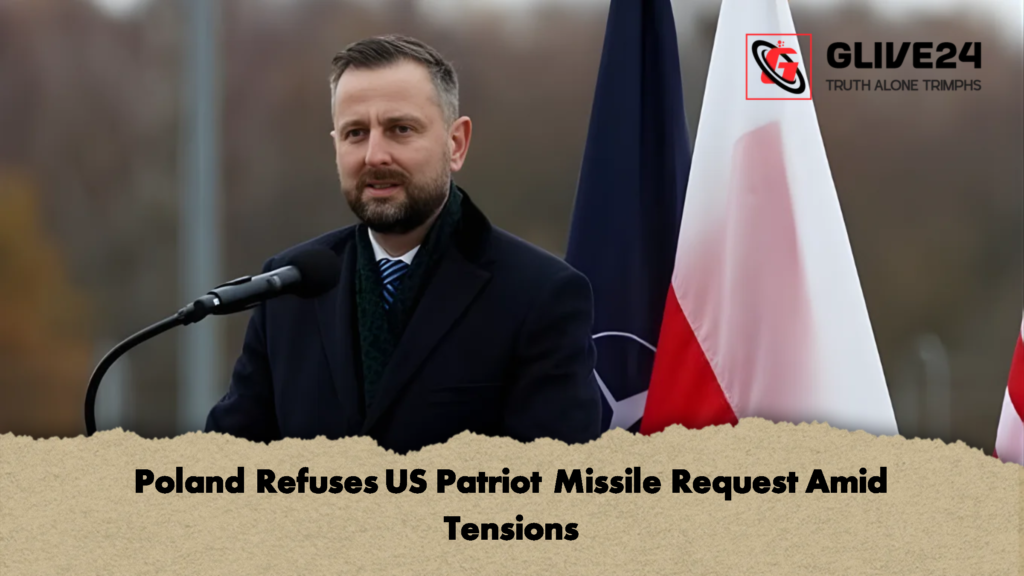
Amid escalating tensions in the Middle East linked to the ongoing confrontation involving Iran, Poland has declined a request from the United States to deploy its Patriot air defence systems abroad. The decision represents a notable moment of divergence within NATO, as Washington seeks additional allied military support to reinforce protection for its overseas installations.
Poland’s Defence Minister, Władysław Kosiniak-Kamysz, confirmed that the country’s Patriot missile systems remain fully allocated to safeguarding national airspace and NATO’s eastern flank. He stated that there are no plans to redeploy these strategic assets outside Polish territory, despite formal requests from the United States.
According to defence sources, Washington had sought at least two Patriot air defence batteries along with advanced missile systems from Poland. These were intended for deployment in the Middle East, where US military facilities are reportedly on heightened alert amid concerns over possible Iranian retaliation.
Poland’s refusal underscores its firm emphasis on territorial defence, particularly in the context of persistent security pressures along NATO’s eastern frontier. The decision also highlights the growing challenge within the alliance regarding the distribution of high-value defence capabilities at a time of overlapping global crises.
Summary of the Defence Dispute
| Category | Details |
|---|---|
| Requesting country | United States |
| Responding country | Poland |
| Equipment requested | Patriot air defence systems (minimum two batteries) |
| Intended deployment region | Middle East (US military bases) |
| Decision | Request declined |
| Stated justification | Protection of Polish airspace and NATO eastern flank |
| Polish Defence Minister | Władysław Kosiniak-Kamysz |
The request came during a period of heightened military activity involving Iran, with both the United States and Israel reportedly carrying out operations against Iranian-linked positions. Despite these actions, the situation remains volatile, with continued reports of retaliatory strikes affecting US assets and installations in the region.
The broader geopolitical climate has also drawn political commentary from former US President Donald Trump, who criticised European NATO members for what he described as insufficient defence burden-sharing. In controversial remarks, he referred to NATO as a “paper tiger” and suggested that Washington could reconsider its long-term commitment to the alliance.
These tensions have added further strain to transatlantic relations, as European countries reassess their defence priorities amid rising global instability. While some NATO members have indicated willingness to support US-led operations in the Middle East, others have adopted a more cautious stance, citing concerns over overstretching their own defensive resources.
Elsewhere in Europe, similar reluctance has emerged. Spain has reportedly refused to grant the United States access to its airspace and military bases for related operations, signalling broader hesitation among certain allies to become directly involved in potential regional escalation.
Poland’s decision is therefore seen as part of a wider recalibration within NATO, as member states attempt to balance collective defence commitments with national security imperatives. The divergence highlights the increasingly complex nature of alliance coordination in an era marked by multiple, simultaneous security challenges.
As diplomatic and military pressures continue to mount, the dispute over Patriot missile deployment reflects deeper questions about burden-sharing, strategic priorities, and the cohesion of NATO in responding to evolving global threats.