Bangladesh’s current account balance surged sharply in the 2024-25 fiscal year, reflecting strong remittance inflows and sustained export growth. Yet, a persistent trade deficit continued to weigh on the country’s external position.
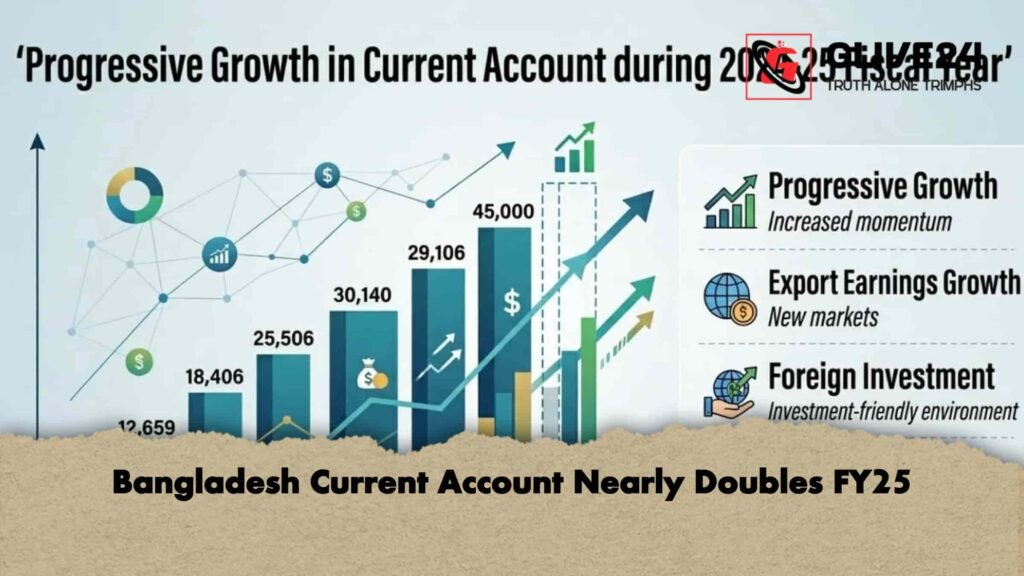
Official data from the Bangladesh Bank showed that the current account balance rose by nearly 98 per cent year-on-year, reaching Tk 15.1 billion. This improvement was largely driven by a 38.1 per cent increase in net workers’ remittances and a 17.1 per cent growth in export earnings on a free-on-board (f.o.b.) basis.
Despite the improvement, the country’s external position remains under pressure due to a substantial trade deficit, which stood at Tk 2.47 trillion in FY25—marginally lower than Tk 2.49 trillion recorded in the previous fiscal year.
Key External Sector Indicators (FY24–FY25)
| Indicator | FY24 | FY25 | YoY Change |
|---|---|---|---|
| Current Account Balance | Tk 7.6 bn | Tk 15.1 bn | +98% |
| Trade Deficit | Tk 2.49 tn | Tk 2.47 tn | -0.8% |
| Export Earnings (f.o.b.) | Tk 4.54 tn | Tk 5.31 tn | +17.1% |
| Import Payments | Tk 7.56 tn | Tk 7.78 tn | +2.9% |
| Net Remittances | Tk 2.72 tn | Tk 3.75 tn | +38.1% |
| Services Outflows | Tk 645.2 bn | Tk 688.1 bn | +6.6% |
| Primary Income Outflows | Tk 578.4 bn | Tk 609.8 bn | +5.5% |
Exports reached Tk 5.31 trillion, maintaining a long-term upward trend despite fluctuations. Meanwhile, imports grew to Tk 7.78 trillion, reflecting the country’s ongoing reliance on foreign goods and industrial inputs for domestic production. The inflow of remittances, reaching Tk 3.75 trillion, acted as a vital stabilising force for the external account.
However, substantial outflows in trade, services, and primary income partially offset the gains, keeping the current account slightly in deficit. Economists note that Bangladesh’s trade deficit has been structurally high since the mid-2010s, with peaks in FY21–FY23 coinciding with elevated current account deficits.
“The rise in the current account balance is a positive development but remains fragile,” said Dr Zahid Hussain, an independent economist. “Without export diversification and tighter control over import demand, external vulnerabilities will persist.” He also warned that geopolitical tensions, particularly the Iran–US–Israel conflict, could pose additional challenges in the near term.
Overall, while the current account improvement highlights Bangladesh’s growing integration into global trade, policymakers must navigate a delicate balance between fostering growth, meeting import needs, and maintaining external stability.