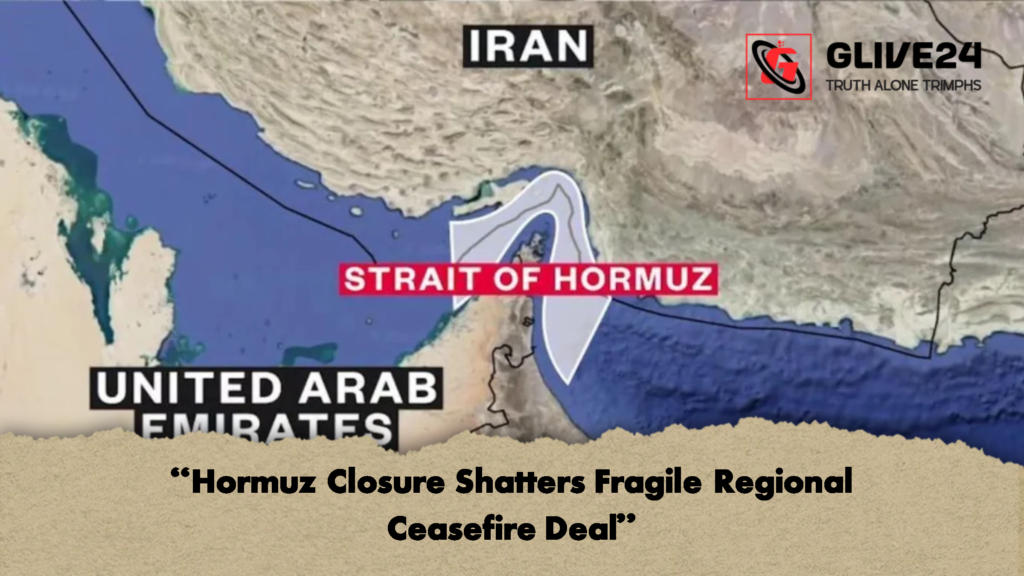
A fragile two-week ceasefire, reportedly brokered through international mediation involving former United States President Donald Trump, has rapidly unravelled after Iran reinstated restrictions on oil tanker movements through the strategically vital Hormuz Strait.
The decision, confirmed on Wednesday (8 April) by Iran’s semi-official Fars News Agency, comes amid escalating regional tensions following renewed Israeli military operations in Lebanon. The sudden reversal has intensified fears of a broader Middle East escalation and triggered fresh volatility across global energy markets.
The ceasefire framework, according to earlier statements attributed to mediators including Pakistan’s Prime Minister Shehbaz Sharif, was intended to encompass hostilities involving Israel, Iran, and the United States, with an implied extension to Lebanon. Under this interpretation, military activity involving Hezbollah was expected to be included within the scope of the truce.
However, the Israeli Defence Forces (IDF) rejected this reading, insisting that the agreement applied strictly to direct confrontation with Iran and did not constrain Israeli operations in Lebanon. Shortly afterwards, Israel launched what it described as its most extensive coordinated air campaign in Lebanon since the escalation of hostilities, targeting sites linked to Hezbollah.
Escalation Timeline
| Phase | Development |
|---|---|
| Ceasefire announcement | Two-week truce reportedly agreed through international mediation |
| Early implementation | Partial easing of tanker movement through Hormuz Strait |
| Within hours | Israeli air operations intensify in Lebanon |
| Immediate response | Iran suspends tanker passage through Hormuz Strait |
| Ongoing | Hundreds of vessels reportedly stranded in surrounding waters |
Following the Israeli strikes, Tehran adopted a significantly harder stance. According to reports from Fars News Agency, only two oil tankers were initially permitted to pass through the Strait on Wednesday morning before authorities abruptly halted all commercial traffic indefinitely.
The Hormuz Strait, a narrow maritime corridor connecting the Persian Gulf to the Arabian Sea, is one of the world’s most critical energy chokepoints. A substantial share of global crude oil and liquefied natural gas shipments passes through this route daily. Any disruption therefore has immediate and far-reaching consequences for global supply chains, freight costs, and energy price stability.
Iranian Foreign Minister Abbas Araghchi reportedly held urgent discussions with Pakistan’s Chief of Army Staff, General Asim Munir, during which he accused Israel of breaching the ceasefire arrangements. Tehran has warned that continued Israeli strikes in Lebanon could prompt Iran to withdraw from the agreement entirely and potentially escalate its response through further strategic measures.
Global Economic Impact
The brief reopening of the Strait earlier in the week had initially helped stabilise global oil prices, as markets reacted positively to signs of de-escalation under the proposed truce. However, the abrupt closure has once again injected significant uncertainty into global energy markets.
Industry analysts estimate that several hundred oil and gas tankers are currently stranded in the Arabian Sea and nearby waters, awaiting clearance to proceed. These delays are already beginning to disrupt shipping schedules and contractual delivery timelines, with traders warning of upward pressure on global fuel prices if the situation persists.
Energy market observers emphasise that even short-term disruptions in the Hormuz Strait tend to produce outsized effects on global pricing due to the corridor’s strategic importance. As a result, governments, shipping operators, and major oil-importing economies are closely monitoring the evolving situation.
Fragile Diplomatic Outlook
The rapid collapse of coordination surrounding the ceasefire underscores the fragility of diplomatic efforts aimed at containing wider regional conflict. With Israeli military operations continuing in Lebanon and Iran responding through strategic pressure on global energy routes, the prospects for sustained de-escalation remain highly uncertain.
As tensions continue to rise, international concern is mounting over the stability of one of the world’s most critical maritime trade arteries, with analysts warning that any further escalation could carry significant global economic and security repercussions.