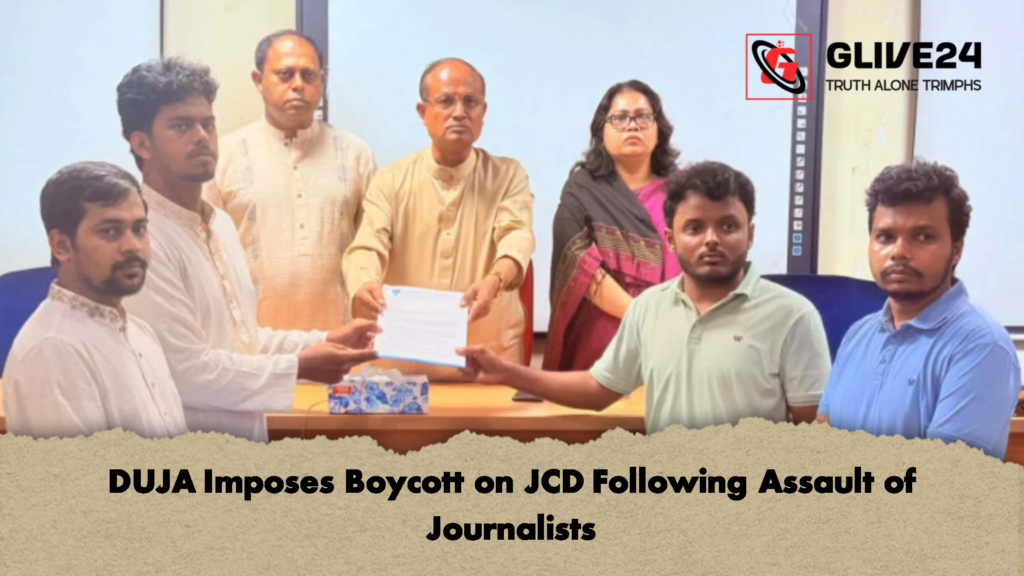
DHAKA — The Dhaka University Journalists’ Association (DUJA) has formally declared an indefinite boycott of all events and activities involving the Jatiyatabadi Chhatra Dal (JCD), the student wing of the Bangladesh Nationalist Party. This institutional embargo will remain in force until the JCD leadership identifies and takes documented disciplinary action against the activists involved in the physical assault of journalists on the university campus.
The resolution was announced on Friday, 24 April 2026, following a formal protest by members of the association. Earlier that morning, a delegation of senior journalists submitted a memorandum to the Vice-Chancellor of Dhaka University, demanding immediate administrative intervention and a pursuit of justice for the casualties sustained by reporters in the line of duty.
Table of Contents
Declaration of the Boycott and Criminal Prosecution
Speaking to the press after the submission of the memorandum, DUJA President Manjur Hossain Mahi articulated the association’s firm position. He stated that the safety of media workers is a fundamental prerequisite for reporting and that the boycott was a direct consequence of the JCD’s failure to provide immediate accountability for its members’ actions.
“We will boycott all types of programmes of the Chhatra Dal until those involved in the attacks on journalists are identified and organisational measures are taken against them,” Mahi affirmed.
Beyond the media blackout, DUJA leadership confirmed that they are pursuing criminal litigation. The association is currently finalising a formal case to be filed at Shahbag Police Station regarding the assault, seeking legal retribution for the physical injuries and harassment inflicted upon reporters during the confrontation.
Background: The Conflict at Shahbag
The violent encounter occurred on Thursday, 23 April 2026, at the Shahbag Police Station. The unrest was reportedly ignited by a contentious and “distasteful” social media post on Facebook, which prompted a large, volatile gathering of JCD activists at the station. As journalists from the university association arrived to cover the friction between JCD members and other political factions—including former student union leaders—they were reportedly targeted by the agitated crowd.
Witness accounts indicate that activists actively obstructed reporters from documenting the scene, including the confiscation of equipment and the prevention of filming. The situation rapidly deteriorated into a physical affray, resulting in several media personnel sustaining injuries that required medical attention.
Response from the JCD Central Committee
Amidst the growing institutional pressure and the public declaration of the boycott, Nasir Uddin Nasir, the General Secretary of the JCD Central Committee, issued a formal apology. In a statement published on his official Facebook profile, he described the injuries to the journalists as “unintended.”
Nasir explained that the casualties occurred amidst a “heightened and exciting situation” involving various parties at the precinct. Offering apologies on behalf of the organisation, he stated:
“The Chhatra Dal believes in the protection of journalists and the freedom of the press. We will remain diligent in preventing the recurrence of such incidents in the future.”
The JCD has reportedly constituted a four-member internal inquiry committee to investigate the matter. However, DUJA remains steadfast, asserting that formal apologies are inadequate without the public identification and expulsion of those responsible.
Implications for Campus Media and Freedom of the Press
The boycott represents a severe escalation in tensions between the press and student political organisations at Bangladesh’s premier academic institution. As DUJA comprises correspondents from major national print, electronic, and digital news outlets, the move severely hampers the JCD’s ability to garner media coverage or disseminate political messaging through accredited campus channels.
While the Vice-Chancellor’s office has acknowledged receipt of the journalists’ memorandum, the university administration has not yet specified whether it will launch an independent disciplinary investigation. As of Friday afternoon, DUJA remains firm: the boycott will only be rescinded upon the presentation of documented proof that disciplinary measures have been enforced against the perpetrators. The incident has raised significant concerns regarding the safety of the press during volatile political periods in the capital.