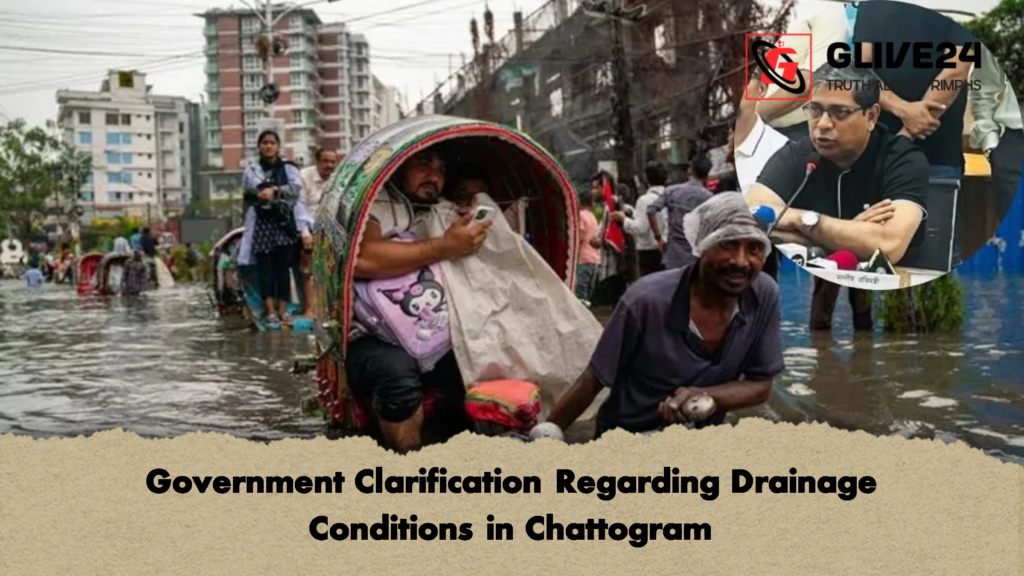
In a formal address to the National Assembly on Thursday, 30 April 2026, the State Minister for Local Government, Mir Shah Alam, officially dismissed reports of extensive waterlogging in Chattogram Metropolitan as “unfounded.” Delivering his statement under Rule 300, the Minister contended that the recent inclement weather resulted in temporary “water congestion” at only five specific locations, rather than a systemic inundation of the city.
This clarification follows a period of heightened political discourse. On 28 April, reports of significant flooding in the port city began to circulate, prompting Sayeed Al Noman, a Member of Parliament for the Bangladesh Nationalist Party (BNP), to raise the issue on a “point of order” during Wednesday’s parliamentary session. In response to the initial accounts, Prime Minister Tarik Rahman had expressed his formal regrets to the residents of Chattogram and directed an immediate investigation.
On-Site Inspection and Fact-Verification
Acting on the Prime Minister’s instructions, State Minister Mir Shah Alam conducted a comprehensive on-site inspection of the metropolitan area from Wednesday through to Thursday afternoon. Addressing the House, the Minister categorised the narrative of a submerged city as a product of digital misinformation.
“The reports are entirely baseless, fabricated, and imaginary,” the State Minister asserted. “Our investigations revealed that photographs from 2024 were being recirculated on social media to misrepresent the current situation. Whilst the Prime Minister offered his apologies based on the information initially presented to him, a first-hand assessment of the city reveals a vastly different reality.”
The Minister further reported that during his visit, local residents reacted positively to the Prime Minister’s empathetic gesture, viewing it as a mark of administrative integrity. He noted that citizens acknowledged a marked improvement in urban drainage, with the severity of water accumulation being significantly lower than that experienced in previous years.
Technical Evaluation of Recent Rainfall
The State Minister provided the Assembly with a technical breakdown of the events on 28 April, noting that Chattogram was subjected to an extraordinary 220 millimetres of rainfall. He explained that the resulting “congestion” was not a failure of existing infrastructure but rather an incidental side effect of active development works.
Chattogram possesses a network of 57 canals. Currently, the Bangladesh Army is executing a major drainage and development project valued at 12,000 crore BDT, overseen by the Chittagong Development Authority (CDA). The status of this project is as follows:
-
30 canals have successfully completed renovation and development.
-
6 canals are currently undergoing active construction and structural work.
Minister Mir Shah Alam clarified that temporary embankments and dams had been erected to facilitate the ongoing engineering work. The high-intensity rainfall caused water to pool behind these temporary structures, leading to localised congestion at five key points, including the Prabartak Moer intersection. He emphasised that this was a transient issue, as joint operations ensured the water receded within three to four hours.
Infrastructure Progress and Future Safeguards
The 12,000 crore BDT investment serves as the cornerstone of the government’s long-term plan to modernise the port city’s hydraulic capacity. The completion of the final six canals is expected to provide a fully integrated drainage system capable of handling monsoon-level precipitation.
The State Minister concluded by assuring the National Assembly that the government remains vigilant. He reiterated that the portrayal of Chattogram as a “floating city” was an exaggeration of a manageable urban event and pledged that the Ministry would continue to monitor the Bangladesh Army’s progress to ensure the project meets its objectives without further inconvenience to the city’s five million residents.