
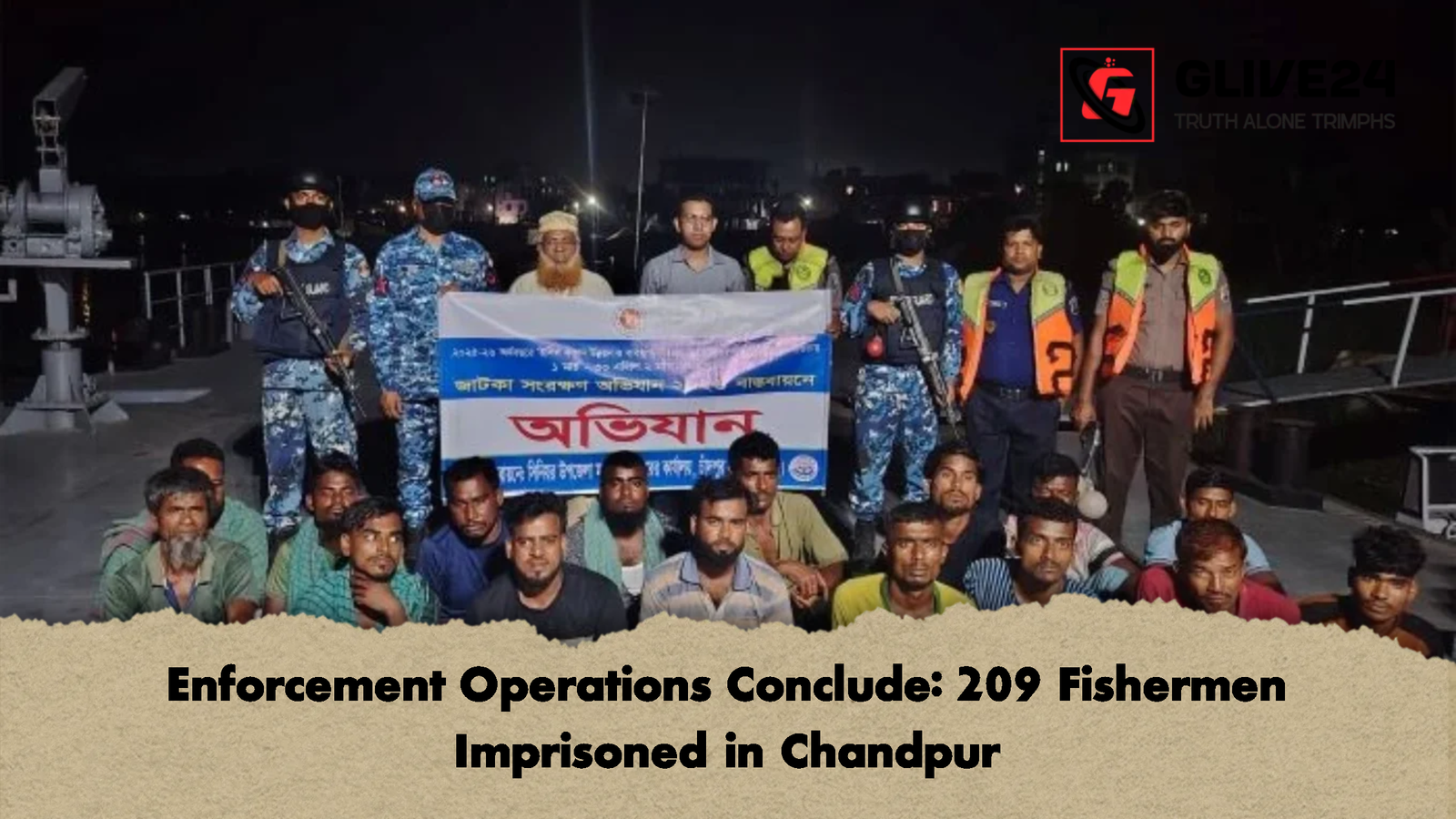
The Chandpur District Fisheries Department has announced the conclusion of a rigorous two-month enforcement campaign, resulting in the imprisonment of 209 fishermen. These individuals were sentenced to varying custodial terms for violating the seasonal ban on catching Jatka (juvenile Hilsa) within the protected sanctuary areas of the Padma and Meghna rivers.
In a briefing delivered at 8:30 pm on Thursday, 30 April 2026, District Fisheries Officer Mohammad Fakhrul Islam confirmed that, alongside the jail sentences, the authorities imposed collective fines amounting to 469,900 BDT. The operation was part of a national strategy to safeguard the reproductive cycle of the Hilsa, a cornerstone of the Bangladeshi economy.
Extensive Surveillance of Riverine Sanctuaries
The enforcement window, spanning from 1 March to 30 April 2026, focused on a 70-kilometre aquatic corridor. This critical sanctuary zone stretches from Shatnol in the Matlab North Upazila to Char Bhairabi in the Haimchar Upazila.
During the 61-day prohibition period, the combined district and upazila task forces achieved the following operational milestones:
Patrols: A total of 609 separate operations were conducted.
Legal Proceedings: Officials initiated 237 legal cases against those apprehended.
Mobile Courts: To expedite judicial processing, 36 mobile courts were convened on-site. These were presided over by Executive Magistrates and Upazila Nirbahi Officers (UNOs) from the affected regions.
The task force maintained a continuous 24-hour vigil, supported by the Bangladesh Coast Guard and local police units, to ensure that the sanctuary remained free from industrial and subsistence poaching.
Asset Seizures and Humanitarian Distribution
The crackdown led to the substantial confiscation of illegal fishing apparatus. In Matlab North Upazila, seized vessels were disposed of through public auctions, contributing 28,000 BDT to the state exchequer. Prohibited fishing nets, often harmful to the riverine ecosystem, were destroyed by fire under official supervision.
In accordance with government policy, the biological resources recovered during these raids were not wasted. The confiscated fish were distributed to local orphanages, madrasas, and underprivileged families, providing nutritional support to the most vulnerable members of the community.
National Strategy for Hilsa Sustainability
The fundamental goal of the March–April ban is to allow Jatka to reach maturity. As the national fish of Bangladesh, the Hilsa (Tenualosa ilisha) is vital for both domestic food security and export revenue.
Officer Mohammad Fakhrul Islam emphasised that the success of the Chandpur operations is a critical component in reaching the national production target of 600,000 metric tonnes. By ensuring the survival of juvenile fish during these two months, the government secures a more bountiful harvest for the coastal fishing communities in the subsequent season.
To support the local fishing population during this period of restricted activity, the government provided food aid via the Vulnerable Group Feeding (VGF) programme. Registered fishermen in Chandpur were issued rice allotments to mitigate the loss of income, encouraging compliance with the conservation laws. As the ban expires at midnight on 30 April, the region prepares for the resumption of legal fishing, with officials optimistic regarding the year’s projected yields.