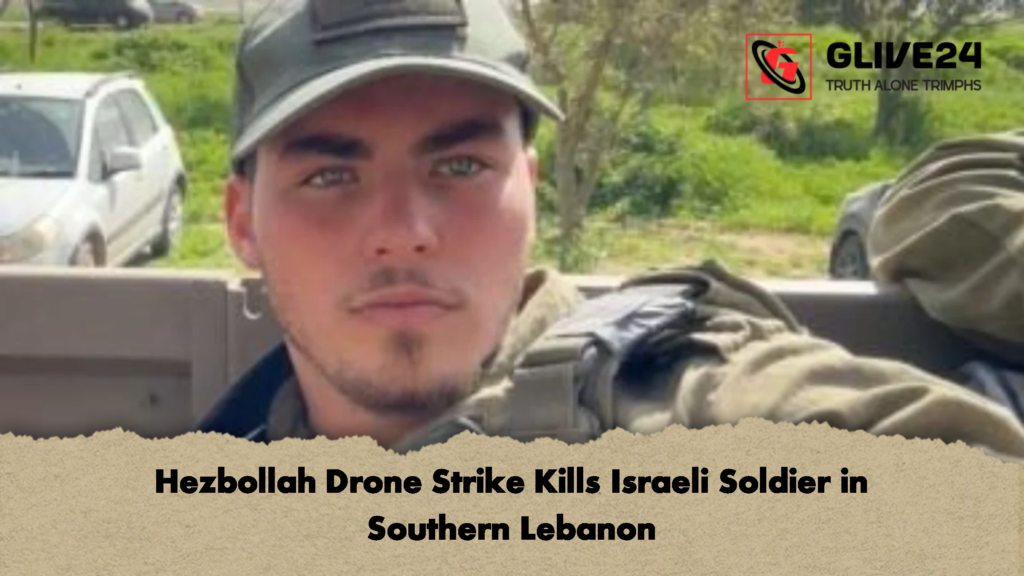
An Israeli soldier was killed and another injured following an explosive drone attack launched by Hezbollah in Southern Lebanon. The incident, confirmed by the Israel Defence Forces (IDF), occurred on the morning of Thursday, 30 April 2026.
The fallen soldier has been identified as Sergeant Liem Ben Hamo, 19, a member of the Golani Brigade’s 13th Battalion. The strike took place during operational activities near the village of Qantara, a frontline location in the ongoing regional friction.
Table of Contents
Analysis of the UAV Incursion and IDF Retaliation
According to military sources, Hezbollah deployed two “one-way” attack drones—explosive-laden Unmanned Aerial Vehicles (UAVs)—targeting Israeli military positions. While one of the munitions was successfully intercepted by IDF air defences, the second bypassed the security perimeter. The drone detonated near a group of soldiers, resulting in the fatality of Sergeant Ben Hamo and causing injuries to another serviceman.
In response, the IDF conducted immediate retaliatory strikes. Israeli artillery and aircraft targeted the launch sites and known Hezbollah military infrastructure in Southern Lebanon. Hezbollah later claimed responsibility for the strike, stating that their intended targets were two Israeli tanks stationed in the vicinity of Qantara.
Strategic Context: A Volatile Truce
This escalation occurs against the backdrop of a broader conflict that intensified significantly after 28 February 2026, following a joint Israel-US operation that drew Iran and its regional proxies into more direct engagement. While a technical ceasefire exists, the border region remains a “grey zone” of frequent combat.
Several factors contribute to this persistent instability:
-
Asymmetrical Tactics: Hezbollah has increasingly relied on loitering munitions (kamikaze drones) to bypass traditional air defences and strike IDF ground units.
-
Territorial Presence: Despite diplomatic efforts to establish a buffer zone, IDF units remain in several southern Lebanese sectors, which Hezbollah identifies as “occupation zones” to justify continued attacks.
-
Tactical Flashpoints: Strategically positioned villages like Qantara serve as primary sites for these exchanges as Hezbollah attempts to push Israeli forces back to the Blue Line.
Geopolitical Constraints and the Litani River Objective
The death of Sergeant Ben Hamo has renewed debates within Israel regarding the feasibility of the current defensive posture. Hardliners within the Israeli security establishment have called for a major offensive to push Hezbollah forces north of the Litani River to secure Northern Israel.
However, international political dynamics are playing a restraining role. Reports from the Times of Israel suggest that United States President Donald Trump has expressed reluctance to support a full-scale Israeli ground invasion of Lebanon. The current US administration appears focused on a containment strategy to prevent the skirmishes from devolving into a wider conventional war that could further destabilise the Middle East.
Summary of Recent Casualties
As of late April 2026, the border between Israel and Lebanon remains one of the most heavily militarised zones in the world. Sergeant Ben Hamo is the latest casualty in a year-long cycle of violence that has seen thousands of rockets and hundreds of drone incursions. The IDF remains on high alert, anticipating further UAV threats, while the diplomatic community continues to struggle with a framework that can ensure a lasting withdrawal of armed militants from the border area.