
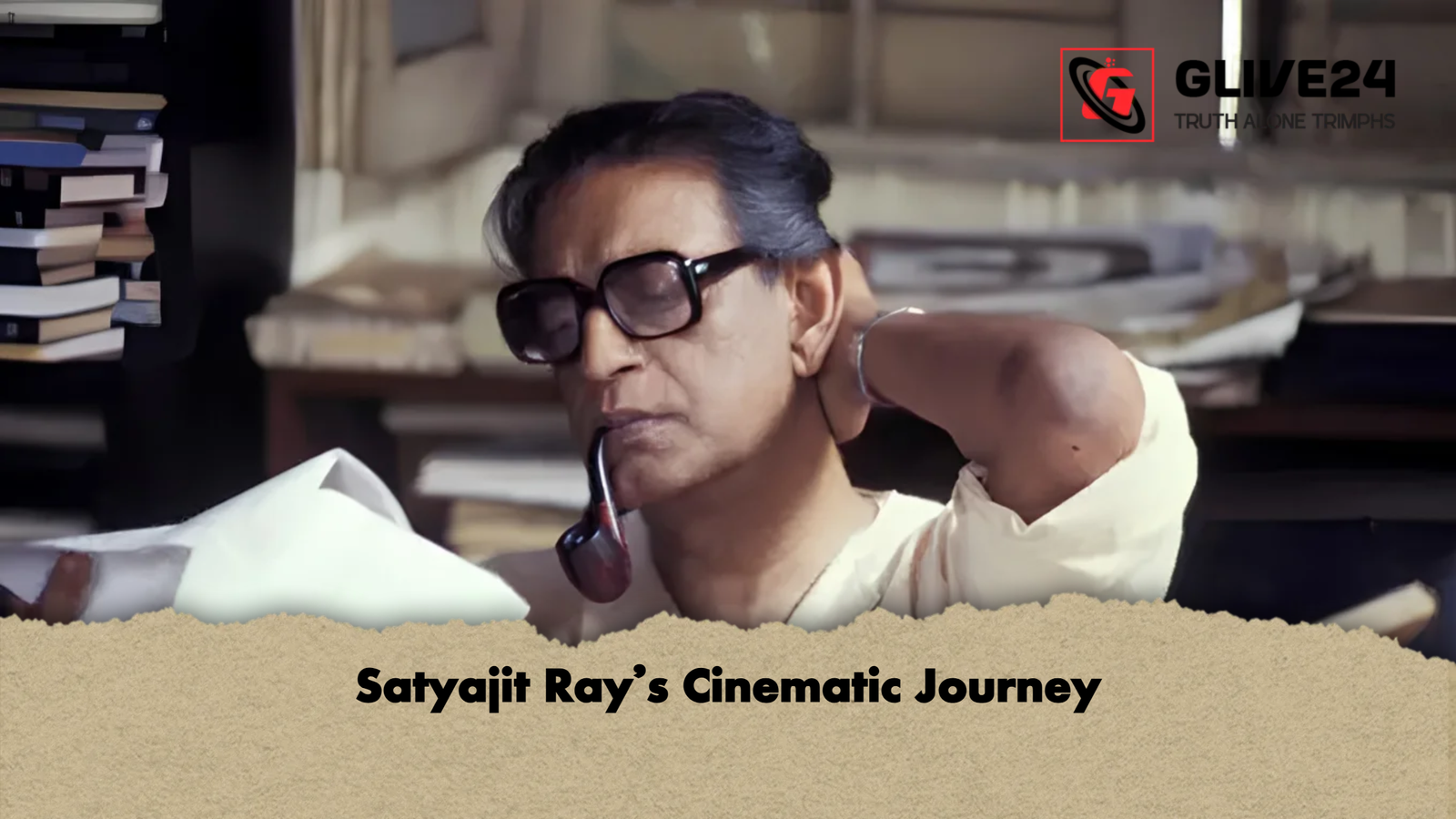
Satyajit Ray, one of the most celebrated figures in world cinema, was born in Kolkata on 2 May 1921. He was a filmmaker, writer, musician, and graphic artist whose contributions extended across multiple creative disciplines.
He came from a distinguished cultural family. His father, Sukumar Ray, was a renowned writer of Bengali children’s literature and the creator of Abol Tabol. His grandfather, Upendrakishore Ray Chowdhury, was a writer, painter, and pioneer of modern printing technology. Ray lost his father at the age of three and was raised by his mother, Suprabha Devi.
He studied at Presidency College in Kolkata and later at Visva-Bharati University in Santiniketan, founded by Rabindranath Tagore. In 1943, he left Santiniketan and returned to Kolkata, where he began working at an advertising agency.
During this period, French filmmaker Jean Renoir came to Kolkata to shoot The River. Ray worked as a part of the production team, an experience that significantly influenced his interest in filmmaking. He was also deeply inspired by the Italian film Bicycle Thieves, which strengthened his commitment to realistic storytelling.
In 1947, he co-founded the Calcutta Film Society with Chidananda Dasgupta, which exposed him to global cinema. These experiences led to his debut feature film Pather Panchali in 1955.
Major Films and Achievements
| Film | Year | Key Focus |
|---|---|---|
| Pather Panchali | 1955 | Rural life in Bengal |
| Aparajito | 1956 | Continuation of Apu’s life |
| Apur Sansar | 1959 | Adult life of Apu |
| Parash Pathar | 1958 | Satirical narrative |
| Jalsaghar | 1958 | Decline of aristocracy |
| Devi | 1960 | Social and religious beliefs |
| Teen Kanya | 1961 | Three short stories |
| Kanchenjungha | 1962 | First original colour film |
| Charulata | 1964 | Based on Tagore’s Nastanirh |
| Nayak | 1966 | Fame and identity |
| Pratidwandi | 1970 | Social unrest |
| Seemabaddha | 1971 | Corporate ambition |
| Jana Aranya | 1975 | Youth unemployment |
| Shatranj Ke Khilari | 1977 | Historical narrative in Hindi/Urdu |
| Sadgati | 1981 | Based on Premchand’s story |
| Ganashatru | 1989 | Public health and ethics |
| Shakha Proshakha | 1990 | Family values |
| Agantuk | 1991 | Identity and humanity |
Pather Panchali received 11 international awards, including the “Best Human Document” award at the Cannes Film Festival. Its sequels Aparajito and Apur Sansar form the acclaimed Apu Trilogy. Aparajito won the Golden Lion at the Venice Film Festival.
Ray directed several significant films before completing the trilogy, including Parash Pathar and Jalsaghar. He later made socially relevant films such as Devi (1960), Teen Kanya (1961), and Abhijan (1962).
In 1962, he directed Kanchenjungha, his first original screenplay and colour film. Charulata (1964), based on Rabindranath Tagore’s short story Nastanirh, is widely regarded as one of his finest works.
He continued with critically important films such as Nayak, Pratidwandi, Seemabaddha, and Jana Aranya, which examined modern urban and social realities.
In 1977, Ray made Shatranj Ke Khilari, his first non-Bengali feature film in Hindi and Urdu. It was his most expensive and star-studded production, featuring actors such as Sanjeev Kumar, Saeed Jaffrey, Amjad Khan, Shabana Azmi, Victor Banerjee, and Richard Attenborough. He later directed the one-hour Hindi film Sadgati, based on a story by Premchand.
Ray also made a significant contribution to literature. His characters Feluda, Professor Shanku, Topshe, and Jatayu remain iconic in Bengali literature.
He married Bijoya Das in 1949, and their son Sandip Ray later became a film director.
In 1983, he suffered a heart attack, which affected his work rate. Despite declining health, he completed Ghare Baire with assistance from his son. His final films were Ganashatru, Shakha Proshakha, and Agantuk.
Ray received numerous honours, including the Dadasaheb Phalke Award, the Legion of Honour from France, an Academy Honorary Award, and India’s highest civilian award, the Bharat Ratna. He passed away on 23 April 1992 in Kolkata.