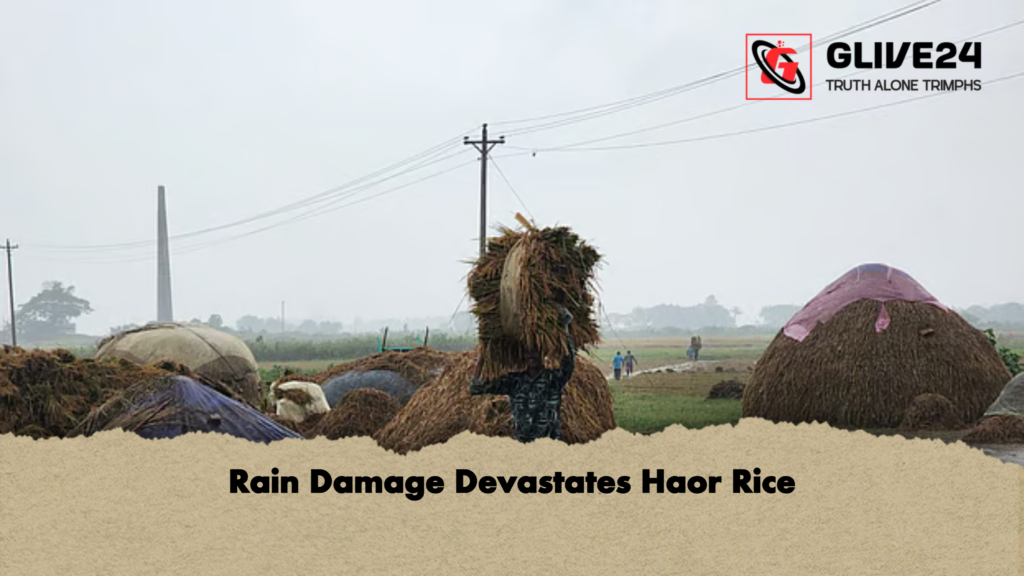
Persistent adverse weather conditions have severely disrupted rice harvesting across Bangladesh’s haor region, leaving farmers unable to collect and process their crops efficiently. Continuous rainfall, cold floodwater influx, and strong winds have combined to create hazardous working conditions, significantly affecting agricultural output.
Farmers report that prolonged waterlogging has made it extremely difficult to harvest paddy fields. Even where crops have been cut, the absence of sunshine has prevented proper drying, causing widespread post-harvest losses. In many cases, harvested rice left in heaps has begun to rot or emit foul odours due to moisture retention. In other instances, lack of drying has resulted in sprouting, rendering the grain unfit for consumption.
According to data provided by the Department of Agricultural Extension, more than 42,000 hectares of paddy fields in the haor districts of Sunamganj, Kishoreganj and Netrokona have been inundated, resulting in significant crop damage.
In several locations, farmers are still attempting to salvage what remains of their crops despite continued rainfall and rising water levels. Labour shortages have further intensified the crisis, forcing entire families—including children—to participate in harvesting activities. In some areas, both mature and partially ripe paddy are being cut and transported by boat due to extensive flooding.
Table: Reported conditions in affected haor areas
| Location | District | Reported Situation |
|---|---|---|
| Dekhar Haor | Sunamganj | Standing crops being harvested in submerged fields; water at waist level in elevated areas |
| Kalnigarh, Juri | Moulvibazar | Rice affected by lack of sunlight; sprouting observed in stored paddy |
| Fawgan | Shreepur, Gazipur | Mature paddy fields submerged; harvesting ongoing during rainfall |
| Boroatia Haor, Karimganj | Kishoreganj | Severe labour shortages; family members, including children, assisting in harvesting |
| Tangua Haor | Madhyanagar, Sunamganj | Rapid water rise; groundnut crops also damaged and being harvested urgently |
| Sonatala | Nasirnagar, Brahmanbaria | Flooded paddy fields; harvested rice being transported by boat during rain |
In Sunamganj’s Dekhar Haor, farmers have been seen cutting rice while standing in waist-deep water. The continuous inflow of water has significantly slowed down harvesting operations, increasing the risk of further crop loss.
In Moulvibazar’s Juri area, farmers reported that paddy which remains unprocessed is beginning to germinate due to persistent overcast conditions and lack of drying space. Similarly, in Suna mganj, stored paddy in heaps has developed foul odours as rainwater prevents proper drying.
In Kishoreganj’s haor areas, including Boroatia Haor in Karimganj, acute labour shortages have compounded difficulties in harvesting. As a result, entire households are participating in cutting and transporting paddy, often using boats to navigate flooded fields.
In Tangua Haor, farmers are also facing damage to groundnut crops due to rainfall and upstream water flow, prompting urgent harvesting efforts.
In Brahmanbaria’s Nasirnagar upazila, including Sonatala and nearby areas, flooded agricultural land has forced farmers to cut paddy during continuous rainfall and transport it back to their homes under difficult conditions.
Across the haor basin, the combined impact of flooding, rainfall, labour shortages, and lack of drying facilities has led to widespread disruption of the harvesting season, with significant portions of cultivated land already reported as damaged or submerged.