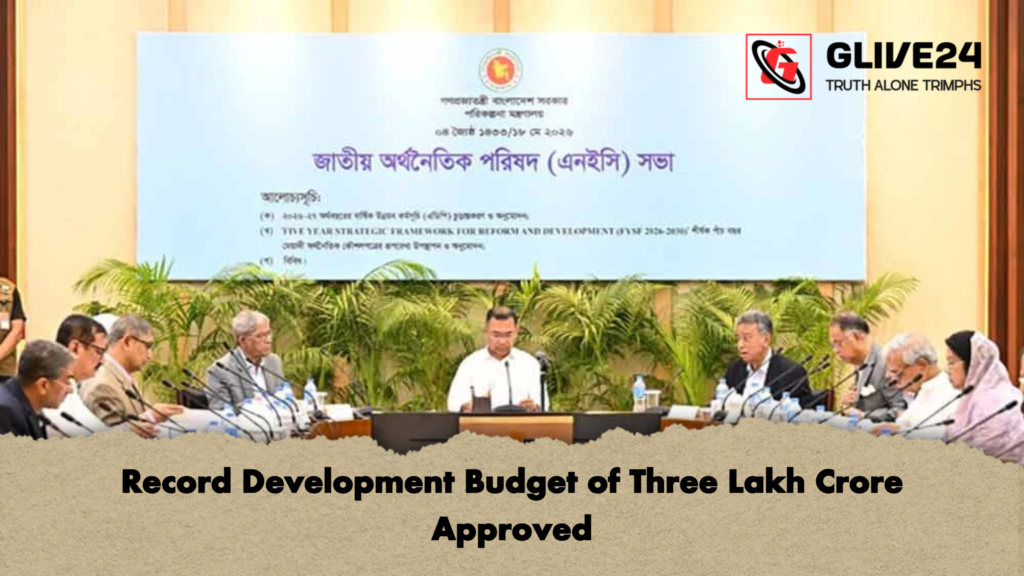
The National Economic Council (NEC) National Economic Council has approved a record Annual Development Programme (ADP) of nearly three lakh crore taka for the 2026–27 financial year, marking one of the largest development outlays in the country’s history.
The approval was made at a meeting held on Monday at the NEC conference room in Agargaon, Dhaka, chaired by the Prime Minister Tarique Rahman. The session placed strong emphasis on structural reforms, macroeconomic recovery, social protection, and balanced regional development.
According to the Planning Commission’s working paper, the total size of the ADP has been set at 300,000 crore taka. Of this, 190,000 crore taka will come from domestic financing, while 110,000 crore taka is expected from foreign loans and grants. An additional 8,924 crore taka from autonomous bodies and state-owned enterprises brings the total development expenditure to over 308,924 crore taka.
Key Allocation Overview
| Sector | Allocation (crore taka) | Share |
|---|---|---|
| Transport & Communications | 50,092 | 16.70% |
| Education | 47,591 | — |
| Health | 35,535 | — |
| Power & Energy | 32,691 | — |
| Housing & Community Facilities | 20,361 | — |
| Local Government Division | 33,735 | — |
| Roads & Highways Division | 30,741 | — |
The plan is framed within a five-year strategic reform and development framework structured around five pillars: state reform, equitable socio-economic development, economic recovery, regional balance, and strengthened social cohesion through religion, culture, and sports.
Reform and Development Priorities
Institutional reform features prominently, including expansion of judicial services, digitisation of administrative systems, modernisation of public investment management, and strengthening of law enforcement capacity. The government also plans to introduce multi-year public investment programming to improve continuity and efficiency.
Greater emphasis has been placed on equitable development, with significant allocations directed towards education, healthcare, agriculture, technical training, employment generation, and social safety nets.
The transport and communication sector receives the highest allocation at 50,092 crore taka, accounting for 16.70% of the total programme. Education follows with 47,591 crore taka, while health is allocated 35,535 crore taka. The power and energy sector receives 32,691 crore taka, and housing and community infrastructure is assigned 20,361 crore taka.
Lump-Sum Allocations Raise Debate
A notable feature of this year’s ADP is the substantial rise in lump-sum allocations. Approximately 118,288 crore taka has been earmarked under various block grant categories, including special development assistance and social development support. Of this, 59,296 crore taka is distributed across ministries as unspecified allocations.
Experts have raised concerns that such large unstructured funding may weaken financial transparency and accountability in project implementation.
For example, the Health Services Division has 6,008 crore taka allocated to ongoing projects, but an additional 20,800 crore taka is assigned as block allocation. Similarly, the Primary and Mass Education Ministry receives 5,048 crore taka for projects alongside 14,392 crore taka in lump-sum funds.
Social Protection Expansion
Within the social protection framework, 17,000 crore taka has been allocated under social development support programmes. Of this, 14,500 crore taka will fund a “family card” initiative under the Ministry of Social Welfare. The Ministry of Agriculture will receive 1,400 crore taka for a farmer card scheme, while 1,100 crore taka is allocated through the Ministry of Religious Affairs for stipends to mosque and religious institution staff.
Project Pipeline and Execution Challenges
The ADP includes 1,121 projects, comprising 949 investment projects, 107 technical assistance initiatives, and 43 projects implemented by autonomous bodies. Additionally, 1,277 unapproved projects have been listed for future consideration, while 223 projects are targeted for completion by June.
Despite the scale of the programme, implementation challenges remain a key concern. During July–March of the 2025–26 fiscal year, ADP implementation stood at only 36.19%. Domestic funding execution exceeded 33%, while foreign-funded projects reached around 40%.
Regional Balance and Infrastructure Push
The development plan prioritises balanced regional growth, particularly in northern districts, coastal zones, and the Chattogram Hill Tracts. Major initiatives include strengthening port-based logistics hubs in Chattogram and Mongla, expanding renewable energy capacity, developing coastal protection infrastructure, and establishing new economic zones.
Outlook
The government has directed implementing agencies to accelerate project execution, strengthen financial discipline, and prioritise completion of time-bound projects by June 2027. Officials hope that improved administrative efficiency, expanded human capital investment, and enhanced social protection mechanisms will support long-term economic recovery and reduce regional disparities.