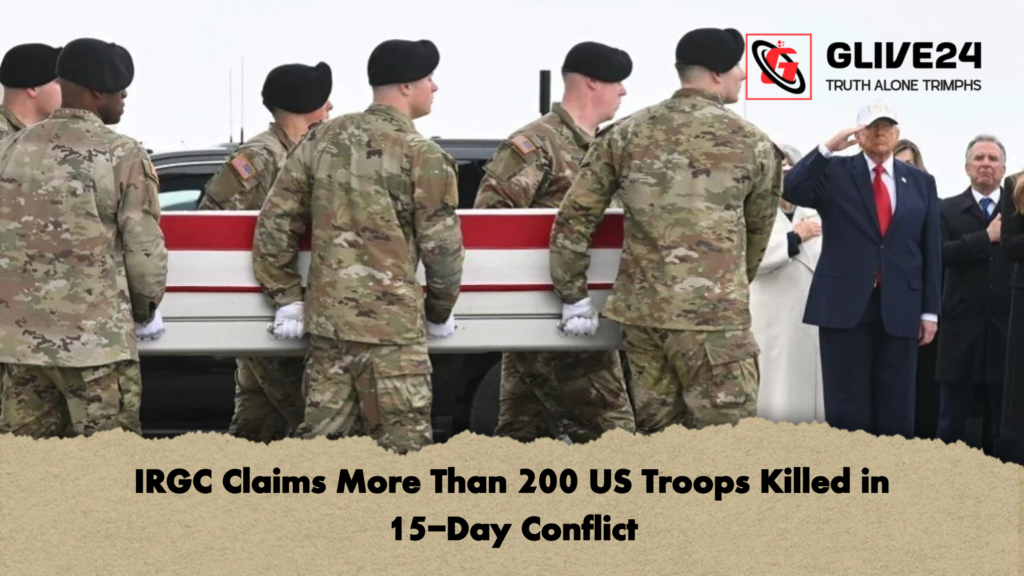
Iran’s Islamic Revolutionary Guard Corps (IRGC) has claimed that more than 200 US service members were killed during a 15-day conflict between Iran and the United States. The claim, however, has not been independently verified, and there has been no immediate official response from Washington confirming the figure or the IRGC’s separate assertions about the destruction of American military equipment.
Speaking to Iran’s state-affiliated Tasnim News Agency, IRGC spokesman Hossein Mohebbi said the scale of US casualties and military losses during Iran’s retaliatory strikes under what Tehran called “Operation Victory-2” was significantly greater than figures released by the Pentagon.
Mohebbi accused the US Department of Defence of withholding information about the true extent of the losses and presenting a reduced account of the damage suffered by American forces. He argued that allowing journalists access to US military bases that were reportedly targeted by Iranian strikes would provide a clearer picture of the extent of the destruction.
According to the IRGC spokesman, journalists would be able to assess the credibility of Iran’s claims if they were permitted to visit the affected sites, inspect the damage and independently examine the aftermath of the attacks. Such access, he suggested, would help establish whether the scale of the destruction claimed by Tehran corresponds with conditions on the ground.
The IRGC has also claimed that Iranian forces struck eight US military bases as part of Operation Victory-2. It said the attacks resulted in the destruction of a significant number of American aircraft and drones.
The Iranian force alleged that the strikes destroyed 11 fighter aircraft and helicopters, 17 intelligence and operational drones, one F-15 fighter jet, one P-8 maritime patrol aircraft, one C-17 transport aircraft and eight aerial refuelling aircraft. The claims represent a substantial level of damage to US military assets, although no independent evidence has so far been presented to conclusively establish the figures.
The dispute over the casualty figures comes amid conflicting accounts from the two sides. The IRGC’s assertion that more than 200 US troops were killed is many times higher than the casualty figures attributed to the Pentagon. Reports have also pointed to an apparent discrepancy in the US military’s publicly reported figures, with an initial figure of 18 American service members killed reportedly later revised to 14. The reasons for the reported revision were not detailed in the available account.
The wide gap between the figures has added to uncertainty over the actual human cost of the conflict. While Tehran maintains that the US military suffered considerably heavier losses than publicly acknowledged, Washington has not publicly endorsed the IRGC’s account.
The credibility of wartime casualty claims is often difficult to assess, particularly while military operations are continuing or their aftermath remains restricted. Governments and armed forces may have strategic reasons to limit information about their own losses while highlighting damage inflicted on an adversary. Military secrecy, restricted access to bases and the difficulty of independently reaching affected areas can further complicate efforts to establish the facts.
The IRGC has maintained that its strikes were directed at US military installations. Yet key details—including the precise extent of damage to those facilities, the number of American personnel killed or wounded and the quantity of military equipment destroyed—remain subject to competing claims.
The available report said the claims made by the IRGC regarding US casualties and military equipment could not be independently verified. The United States has also not, according to the report, issued an official response to the assertion that more than 200 American troops were killed.
As a result, the true scale of US military casualties and equipment losses remains unclear. Establishing a reliable account is likely to depend on access to affected military sites, independent assessments of satellite imagery and other evidence, eyewitness testimony, and official records that can be cross-checked by neutral sources.
Until such evidence becomes available, the sharply contrasting accounts from Tehran and Washington should be treated with caution. The IRGC’s figures remain unverified claims rather than independently established facts, while the absence of a detailed US response leaves significant questions about the full extent of the conflict’s military and human toll.