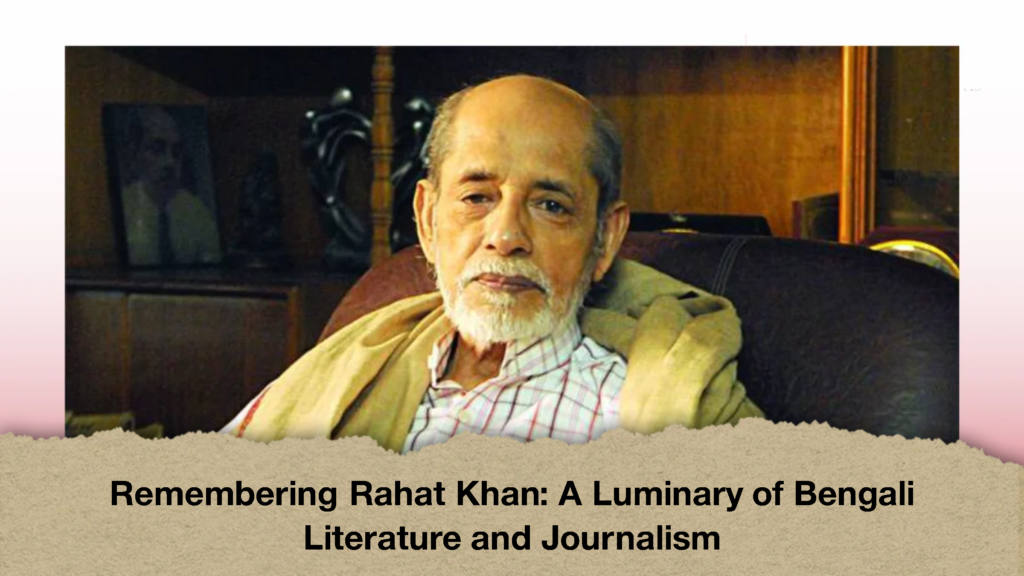
Bangladeshi literature and journalism lost one of their most formidable figures on 28 August 2020, when Rahat Khan passed away at his New Eskaton residence in Dhaka at the age of 80. Marking six years since his demise, the legacy of this Ekushey Padak-winning writer and veteran newsman remains a cornerstone of the nation’s cultural consciousness. Across a career spanning over five decades, Khan masterfully navigated the dual realms of investigative journalism and fiction, carving out a distinct space defined by intellectual rigour, sharp social commentary, and psychological insight.
Born on 19 December 1940 in the village of Purba Jawar in Tarail, Kishoreganj, Khan grew up in an aristocratic family that fostered a deep reverence for literature and academic pursuits. He pursued his higher education at Ananda Mohan College in Mymensingh, studying Economics and Philosophy, before obtaining his degree in Bengali Literature from the University of Dhaka in 1961. Initially embarking on a career in academia, he taught at several prestigious institutions, including Nasirabad College in Mymensingh, Jagannath University College, and Chittagong Government College, laying a strong intellectual foundation for his subsequent creative endeavours.
His true calling found its permanent footing in the newsrooms of Dhaka. Joining the esteemed daily newspaper Ittefaq in the 1960s, Khan spent the majority of his professional life shaping the publication’s voice during crucial historic moments for the nation. As a reporter, editorial writer, and columnist, he established a reputation for fearless, socially conscious reporting. His journalistic methodology was underpinned by a profound sense of civic responsibility, documenting political upheavals, structural inequalities, and the shifting socio-economic realities of Bangladesh. Over decades of dedicated service, he rose through the editorial ranks, serving as the paper’s Assistant Editor and eventually taking the helm as Editor, solidifying his role as an influential media figure.
Parallel to his journalistic output, Khan emerged as a pioneering voice in post-independence Bengali prose. His literary portfolio, encompassing short story collections and novels, focused heavily on the existential crises, moral dilemmas, and emotional turbulence of the urban middle class. Renowned works such as Amal Dhabal Chakri, Chhaya Dampati, Ek Priyadarshini, Mantrisabhar Patan, Dui Nari, Hey Shunyata, and Kolahal examined human relationships and psychological complexity. His signature prose style—characterised by brevity, clarity, and incisive observation—set his work apart from his contemporaries.
His personal life was deeply intertwined with the cultural sphere. His wife, Aparna Khan, was an accomplished cultural activist, reciter, and musical artist. Actively involved with organisations such as Utsho Sanskritik Parishad, Utsho Natyadal, Bangladesh Rabindra Sangeet Shilpi Sangstha, the Panchakabi music group Geethashatadal, and Sargam Sanskritik Sangathan, she served as a regular performer on state radio and television and directed the musical organisation Ganer Kheya.
In recognition of his extraordinary contributions to journalism and fiction, Khan was honoured with the prestigious Bangla Academy Literary Award in 1973 and the Ekushey Padak—Bangladesh’s second-highest civilian award—in 1996, along with numerous other national accolades throughout his lifetime. Though six years have passed since his death, Rahat Khan’s extensive body of work ensures his enduring presence in the history of Bengali letters.