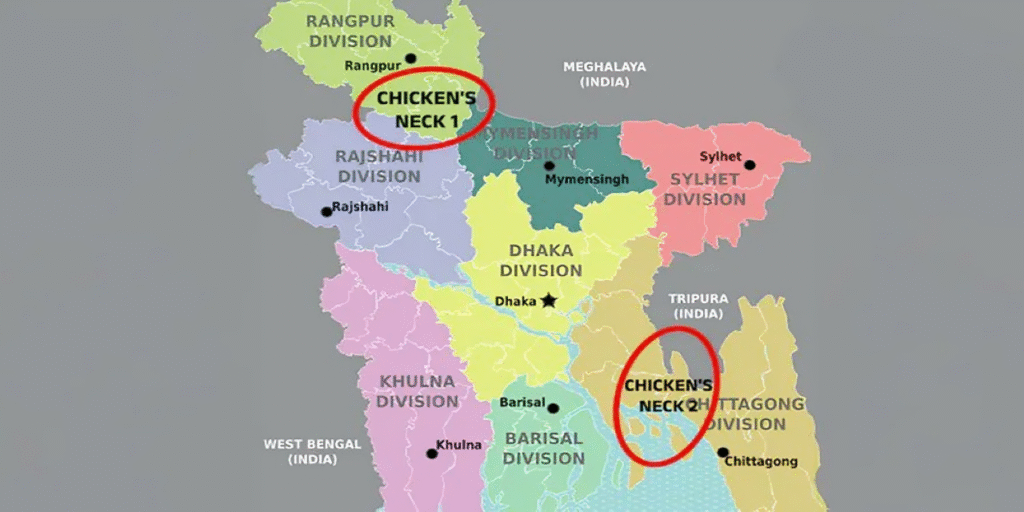
In the intricate geography of South Asia, few regions hold as much strategic weight as the so-called “Chicken Neck” — a narrow strip of land in northern India that lies precariously close to the Bangladeshi border. Known formally as the Siliguri Corridor, this slender tract connects India’s vast mainland with its seven north-eastern states. To Bangladesh, this corridor is not merely a neighbouring passage but a geopolitical hinge — one that influences its security, trade, and regional diplomacy.
Stretching roughly 200 kilometres in length and narrowing to a mere 20–22 kilometres at its thinnest point, the corridor sits between Nepal to the west, Bhutan to the north, and Bangladesh to the south. Its location makes it one of the most sensitive strategic bottlenecks in Asia, frequently described as India’s Achilles’ heel.
For Bangladesh, this narrow passage is far more than an item on the map. Its proximity affects trade routes, border management, transnational crime, and even the balance of power between South Asia’s two giants — India and China. To understand the significance of Bangladesh’s Chicken Neck, one must examine its geography, historical context, and the complex geopolitical layers that surround it.
Table of Contents
Geographic Location and Physical Description
The Siliguri Corridor lies in the northern part of India’s West Bengal state, forming the sole land link between the Indian mainland and the north-eastern states — Assam, Meghalaya, Tripura, Nagaland, Mizoram, Manipur, and Arunachal Pradesh. The corridor runs roughly parallel to the Himalayan foothills, bounded by:
- Nepal to the west,
- Bhutan to the north-east,
- Bangladesh to the south,
- and Sikkim to the north-west.
This region is intersected by major rivers such as the Teesta, Mahananda, and Jaldhaka, which flow southwards into Bangladesh. The corridor’s terrain is mostly flat, dotted with tea gardens, small towns, and military cantonments, while the Bagdogra Airport and the New Jalpaiguri Railway Station act as the logistical arteries of this fragile neck.
For Bangladesh, the nearest points to this corridor are Panchagarh and Lalmonirhat districts, lying just 20–25 kilometres away. This closeness gives Bangladesh a unique geographical vantage point: it sits directly beneath one of the most strategic corridors in Asia.
Origin of the Term “Chicken Neck”
The name “Chicken Neck” is derived from its appearance on the map. When viewed from above, the Indian mainland resembles a chicken’s body, while the north-eastern states resemble its head — connected only by a slender neck-like corridor. Hence, the colloquial term became widely accepted among strategists and scholars.
While the phrase is often used in jest, its implications are serious. The “neck” is both a lifeline and a choke point. Any military blockade, natural disaster, or political instability in this narrow region could effectively isolate more than 45 million people living in India’s north-east from the rest of the country. This potential vulnerability forms the crux of South Asia’s geopolitical anxiety.
Historical Background: From British Bengal to Modern Borders
The significance of the Chicken Neck is rooted in colonial history. During British rule, the entire region — Bengal, Assam, and parts of what are now Bangladesh, Bhutan, and India’s north-east — formed a contiguous administrative and economic zone. Goods, people, and ideas moved freely across the plains of the Ganges and the Brahmaputra.
However, the Partition of British India in 1947 dramatically redrew the map. East Bengal became East Pakistan (and later Bangladesh), severing India’s direct access to its eastern provinces. What was once a fluid, connected region was suddenly divided by political frontiers.
The newly created border forced India to rely solely on the narrow Siliguri stretch to reach its eastern territories. In the early years of independence, this was a logistical inconvenience; by the mid-20th century, it had become a strategic nightmare.
During the 1962 Sino-Indian War, India realised how vulnerable the corridor could be in a high-tension environment. Chinese forces advancing through Tibet could easily threaten the corridor from the north, while any instability in East Pakistan (modern Bangladesh) could squeeze it from the south. Thus, from the very birth of modern South Asia, the Chicken Neck became a focal point of strategic insecurity.
The Corridor and Bangladesh: A Geography of Proximity
Bangladesh’s geographical proximity to the Chicken Neck makes it a silent stakeholder in its stability. The corridor lies directly north of Bangladesh’s Rangpur Division, creating a border zone that links several trade and transport routes.
- Distance from Banglabandha (Panchagarh) Land Port to the corridor: roughly 25 kilometres.
- Rail connectivity: The Parbatipur–New Jalpaiguri line, once operational during British rule, still serves as a potential cross-border transit route.
- Road links: The Asian Highway Network (AH-2) passes through this zone, making it a key segment of the Bangladesh–Bhutan–India–Nepal (BBIN) connectivity initiative.
For Bangladesh, the corridor’s stability directly affects regional trade, border security, smuggling control, and energy cooperation. Should any crisis occur — military or natural — the spill-over effects could easily touch Bangladeshi territory.
Strategic and Military Significance
India’s Strategic Vulnerability
From a defence perspective, the Siliguri Corridor is a “geopolitical bottleneck”. It connects India’s seven north-eastern states — a region rich in resources yet politically sensitive — with the mainland. The narrowness of the corridor means that even limited military interference could sever India’s access to one-seventh of its territory.
India’s defence establishments often describe this corridor as a potential ‘doomsday choke point’. During any large-scale confrontation with China, the People’s Liberation Army (PLA) could theoretically attempt to cut off the corridor from the north via Chumbi Valley in Tibet, a tri-junction point where the borders of India, Bhutan, and China meet. This is the same area that witnessed the Doklam standoff of 2017, when Chinese and Indian forces confronted each other for over two months.
In such a scenario, the corridor’s southern flank — which borders Bangladesh — becomes equally vital. Maintaining cordial relations with Dhaka thus serves India’s strategic interest, ensuring that no external power can exploit Bangladesh’s territory to threaten the corridor.
Bangladesh’s Security Implications
For Bangladesh, the proximity of the Chicken Neck means being adjacent to one of South Asia’s most militarised zones. The Indian Army, Air Force, and Border Security Force (BSF) all maintain strong positions around Siliguri, Jalpaiguri, and Hasimara.
While Bangladesh faces no direct threat from this militarisation, it inevitably affects cross-border dynamics. Surveillance systems, restricted movement, and heightened security protocols along the border can influence trade, migration, and even local livelihoods.
Economic Importance and Regional Connectivity
The Chicken Neck is not only a military flashpoint but also an economic artery. Every rail wagon, truck, or flight connecting India to its north-eastern states passes through this corridor. For Bangladesh, this holds immense opportunity.
Gateway to North-East India
If Bangladesh allows transit through its territory — particularly via routes like Banglabandha–Fulbari and Burimari–Changrabandha — the journey between Kolkata and Guwahati could be reduced by more than 1,000 kilometres. Such an arrangement would benefit both countries, turning Bangladesh into a logistics hub for the sub-region.
BBIN and BIMSTEC Corridors
The proposed BBIN (Bangladesh–Bhutan–India–Nepal) transport initiative and the broader BIMSTEC framework see the Chicken Neck as a linchpin. As road and rail networks modernise, the Siliguri Corridor may soon transform from a bottleneck to a trade gateway linking the Bay of Bengal to the Himalayas.
Border Trade and Informal Economy
Around the Banglabandha, Burimari, and Hili border points, hundreds of small traders depend on the cross-border flow of goods — from agricultural produce to textiles. Any congestion or security tension in the corridor often disrupts these micro-economies, illustrating how deeply Bangladesh’s northern districts are tied to the Chicken Neck’s stability.
The Corridor in China–India–Bangladesh Triangular Relations
The China Factor
China’s infrastructure expansion in Tibet and its Belt and Road Initiative (BRI) projects in Nepal and Myanmar have raised India’s concerns. Chinese road and rail networks now approach within 100 kilometres of the corridor, increasing New Delhi’s sense of encirclement.
For Bangladesh, this presents a strategic tightrope. Dhaka maintains strong economic ties with Beijing — particularly through BRI projects — yet relies heavily on India for transit, power, and security cooperation. Balancing these relationships demands cautious diplomacy.
Doklam and Regional Ripples
The 2017 Doklam crisis illustrated how swiftly tensions near the corridor can escalate. Although the standoff was resolved diplomatically, it highlighted the vulnerability of this tiny strip. Any instability there could inadvertently draw Bangladesh into a broader regional crisis, especially if refugee flows, border restrictions, or trade disruptions ensue.
Environmental and Human Dimensions
Beyond strategy and politics, the corridor’s ecological and social aspects are equally significant. The region forms part of the Eastern Himalayan biodiversity hotspot, containing forests, tea plantations, and fertile plains. Yet rapid militarisation, unplanned urban growth, and infrastructure expansion are placing severe pressure on its fragile ecosystem.
On the human side, migration from Bangladesh into India’s northern districts and vice versa has historically shaped local demographics. Border fencing, cross-border trade, and informal labour flows remain contentious but deeply interwoven aspects of daily life.
Future Scenarios: Cooperation or Confrontation?
The future of the Chicken Neck region — and by extension, Bangladesh’s northern frontier — may evolve along two divergent paths.
Scenario 1: Corridor of Connectivity
In an optimistic vision, Bangladesh and India could transform this narrow corridor into a hub of connectivity.
With improved railway links, joint customs facilities, and integrated logistics, the corridor could serve as the gateway to East Asia, linking the Bay of Bengal ports (Chattogram and Mongla) with the north-eastern Himalayas. Such development would align with Bangladesh’s aspiration to become a regional transit and trade centre.
Scenario 2: Corridor of Confrontation
Alternatively, heightened Sino-Indian rivalry, regional nationalism, or political mistrust could turn the corridor into a zone of confrontation.
In such a scenario, any conflict near the tri-junction would severely disrupt trade, refugee management, and regional security — directly affecting Bangladesh’s northern border districts.
Policy Implications for Bangladesh
Bangladesh, while not a direct actor within the corridor, can adopt several strategic measures to safeguard its interests:
- Promote Regional Connectivity:
Active participation in BBIN and BIMSTEC corridors can help Bangladesh convert proximity into economic advantage. - Enhance Border Diplomacy:
Maintaining a stable, cooperative relationship with India ensures that the corridor remains peaceful and secure. - Balance External Relations:
As China’s influence grows, Dhaka must pursue a nuanced policy that benefits from Chinese investment without undermining Indian trust. - Develop Northern Infrastructure:
Upgrading roads, railways, and land ports in Panchagarh, Lalmonirhat, and Kurigram will integrate Bangladesh more effectively into regional supply chains. - Encourage People-to-People Exchanges:
Cultural and educational ties across the border can transform a historically tense frontier into a zone of collaboration.
Bangladesh’s Chicken Neck — the Siliguri Corridor — is both a symbol of connection and constraint. For India, it is a narrow lifeline; for Bangladesh, it is a geopolitical frontier; and for the broader South Asian region, it is a test of how geography shapes destiny.
While the corridor embodies vulnerability, it also holds immense potential. If managed with foresight, it could transform from a fragile neck into the spine of regional cooperation, binding together the economies of South Asia and South-East Asia.
But that transformation depends on trust, diplomacy, and shared vision — virtues that South Asia has often lacked. For Bangladesh, the challenge and opportunity lie side by side: to remain an anchor of stability while turning its geographic closeness to the Chicken Neck into a strategic asset rather than a liability.