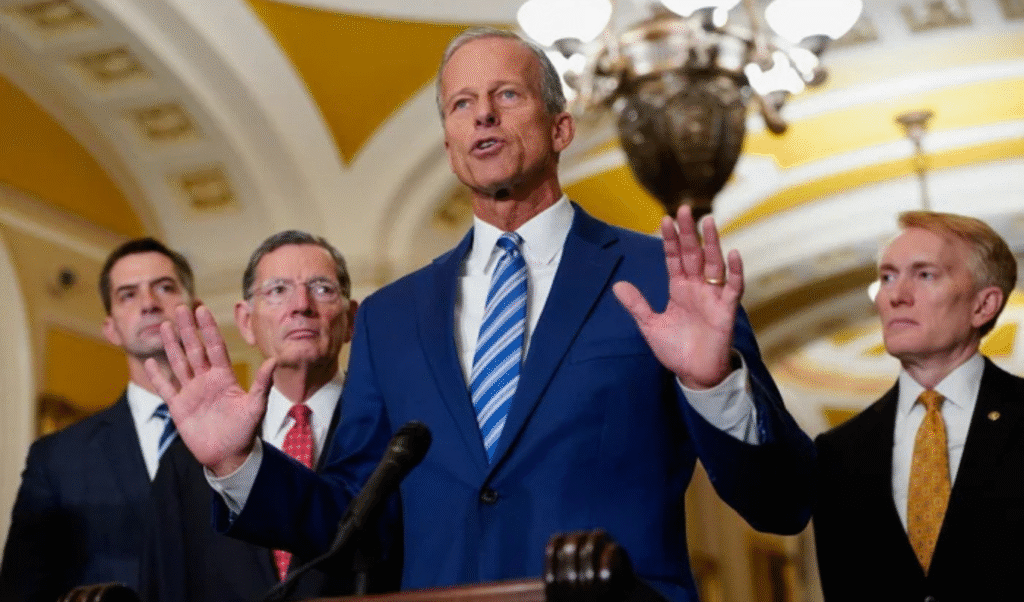
The US Senate took a crucial step on Sunday towards ending the longest government shutdown in American history by clearing the path for formal debate on a motion to resume funding for federal agencies.
The Republican-controlled chamber approved a procedural vote by a margin of 60 votes to 40, establishing a firm limit on how long senators can discuss the legislative measure. Lawmakers were given a maximum of 30 more hours to debate before a vote is held on the motion, which requires only 50 votes to pass.
However, the measure still needs approval from the Republican-led House of Representatives before reaching President Donald Trump’s desk – a process that could take several days.
Despite this, the move marks significant progress towards ending the shutdown, which has lasted for over 40 days, halted funding to federal programmes, and disrupted air travel and other essential industries.
The breakthrough followed a stopgap agreement between Republican and Democratic lawmakers to fund the government until January, after lengthy negotiations over issues such as healthcare subsidies, food assistance, and Trump’s firings of federal employees.
Upon hearing the news, Trump told reporters upon his arrival at the White House after a weekend in Florida at his Mar-a-Lago estate: “It looks like we’re getting very close to the shutdown ending.”
Federal Workforce Protections
Democratic Senator Tim Kaine of Virginia was among the eight senators who joined Republicans in supporting the measure. Kaine said, “I need a moratorium on the punishing of the federal workforce.” Virginia is home to 300,000 federal employees, and the deal would reinstate all furloughed workers and reverse layoffs imposed by the Trump administration.
The bill aims to fund the government at pre-shutdown levels and “will protect federal workers from baseless firings, reinstate those who have been wrongfully terminated during the shutdown, and ensure federal workers receive back pay as required by law,” Kaine added.
Despite this, Democratic leader Chuck Schumer opposed the deal, arguing that Republicans had spent months “dismantling the healthcare system, skyrocketing costs, and making every day harder for American families.”
On the Republican side, Senator John Thune celebrated the progress, particularly for Americans under financial strain. “After 40 days of uncertainty, I’m profoundly glad to announce that nutrition programmes, our veterans, and other critical priorities will have their full-year funding,” Thune said.
Federal Services in Demand
Earlier on Sunday, Transportation Secretary Sean Duffy warned that without a deal, the number of cancelled flights could increase exponentially, just as Americans prepare to travel for Thanksgiving later this month.
Duffy cautioned that US air travel could soon “slow to a trickle” if the shutdown continued, with over 3,000 flight cancellations and more than 10,000 delays reported over the weekend, according to data from tracking platform FlightAware.
“If this thing doesn’t open back up, there won’t be enough flights, and many Americans planning to travel for Thanksgiving will not be able to get on an airplane,” Duffy said. It could take several days for flight schedules to normalise once federal funding and staff, including salaries, are reinstated.
SNAP and Healthcare Subsidies
The proposed bill would also restore funding for the SNAP (Supplemental Nutrition Assistance Program) food stamp programme, which provides aid to over 42 million low-income Americans to help cover grocery costs. It would also guarantee a vote on extending healthcare subsidies that are set to expire at the end of this year.
However, many Democrats, particularly those in the House and beyond the Beltway, have expressed opposition to the deal.
Representative Alexandria Ocasio-Cortez pointed out that the average monthly SNAP benefit is only $177 per person, and the average monthly healthcare subsidy under the Affordable Care Act is up to $550 per individual.
“People want us to hold the line for a reason. This is not about appealing to a base. It’s about people’s lives,” the Democrat wrote on X (formerly Twitter). “Working people want leaders whose word means something.”
California Governor Gavin Newsom, a Democrat, also criticised the move with a one-word response on X: “Pathetic.”
The situation remains fluid, with several more hurdles to clear before the shutdown is officially ended, but the developments on Sunday marked a significant shift in the direction of resolving the longest shutdown in US history.